
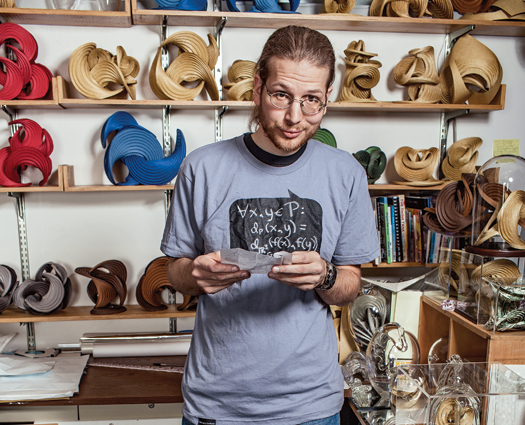
Just before he was old enough to vote but after he’d begun a doctorate in computer science, Erik Demaine arrived in New York City for the annual OrigamiUSA convention. He’d recently taken an interest in the hobby because he thought the math behind it might make for a compelling dissertation topic. Walking the aisles of the convention, Demaine saw the usual paper artistry—delicate insects, puffed-up bunnies—but he also learned of more elaborate forms, such as a three-car model locomotive crafted from a single sheet of paper. That train, like many intricate works of origami, sprang from a basic folding pattern called the box pleat.
Developed in the mid-1960s, the box pleat is a grid of vertical and horizontal creases combined with some well-placed diagonals. A Swiss physicist named Emmanuel Mooser popularized the pattern when he used it to create what’s now known as Mooser’s Train, one of the great achievements in origami. At the convention, Demaine began to wonder whether the box pleat could be used to make even bigger, more complex designs. Could it fold into a Mooser’s Passenger Jet, a Mooser’s Rocket Ship, or a Mooser’s Full-Size Nuclear Submarine?
In 2001, at the age of 20, Demaine joined the faculty of MIT, as a professor of computer science. He was the youngest professor ever hired by the university. In 2003, he won a MacArthur genius grant. By then, he’d set aside the box pleat in favor of other work on folding. But a few years later Mooser’s Train came rumbling back into his mind. He’d begun collaborating with another MacArthur fellow, the roboticist and computer scientist Daniela Rus, to design “programmable matter.” They wanted to create a sheet made from interlocking panels that could turn into any object, from a sofa bed to a computer, with the push of a button. To do so, they would need a simple folding template that was versatile enough to handle many different forms. Demaine started with the box pleat.
Working with a pair of students and his father, Marty, a technical instructor and artist-in-residence at MIT, Demaine proved mathematically that the box pleat had no limits. A single sheet of paper, were it big enough, could fold into more than a model train. It could become pretty much anything in the universe. Building on that work, Demaine, Rus, and a collaborator at Harvard applied the pattern to a set of panels made of glass fiber and polymer resin and made a robot that could fold from a boat shape into a plane shape. If this technology could be scaled, a similar design with smaller panels could one day morph into an e-book reader or a smartphone or any other design downloaded from the Web.
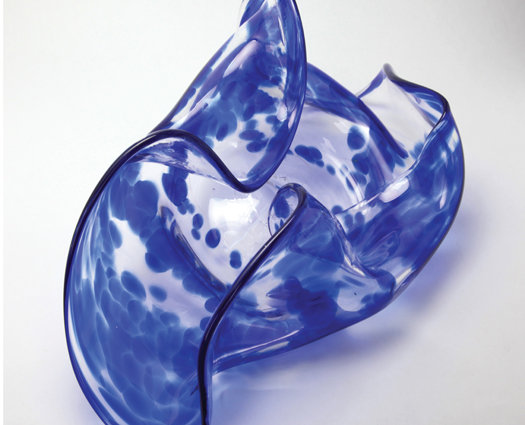
Demaine chooses projects based purely on his curiosity, regardless of where they may lead. For many scientists, the work in programmable materials could become the centerpiece for a long and fascinating career, but for Demaine it occupies only a small part of his research portfolio. His folding math has informed how auto manufacturers design safety airbags. He’s sketched out how a Star Trek–style replicator might work using bits of DNA and RNA, collaborated with archaeologists to decipher a coded Incan language, and made paper sculptures with his father that now are part of the Museum of Modern Art’s permanent collection in New York. His latest project could be described as computational glassblowing. By modeling how glass behaves under various conditions, he could help glassblowers refine their techniques and develop new designs.
At 31, Demaine has published nearly 300 papers and won numerous honors, including a Popular Science Brilliant Ten award in 2003. It would be easy to attribute his success to the mere fact of genius, but that would overlook the most important aspect of his work. Instead of concerning himself with applications or even defining a specialized area of research, Demaine chooses projects based purely on his curiosity, regardless of where they may lead. Where others seek answers, Demaine looks for questions. “I collect problems,” he says. “The problems are the key to everything.”

Demaine’s office is on the sixth Floor of MIT’s Building 32, the Frank Gehry–designed home of the Computer Science and Artificial Intelligence Laboratory. The day I arrive, Demaine is seated at his desk in a T-shirt and black jeans. We haven’t chatted for 15 minutes when a somewhat shorter, older version of him walks in and joins the conversation. Erik’s father, Marty, wears the same uniform: a T-shirt and black jeans. Like his son, he sports a ponytail, a pair of oval-framed glasses, and a modest growth of facial hair.
Whether intended or not, their matching appearance speaks to a lifetime spent in close collaboration. After Marty and his wife split up, he took Erik, then just seven, on a four-year road trip from their home in Halifax, Nova Scotia, across North America, homeschooling him along the way. When Erik entered college (administrators at Dalhousie University bent the rules in order to accept a 12-year-old), his father attended classes right beside him. Then Marty followed his son to the University of Waterloo in Ontario, where Erik completed his doctorate, and then on to MIT.
Son and father work together daily. When not on campus, they often travel as a team to scientific meetings, giving joint lectures and demonstrations. (In one, Marty posed as an angry heckler, only to remove his wig and reveal the prank midway through.) They’ve performed side-by-side in improv shows, and they still live together too. Of all the work that Erik does, the projects with his father tend to be the most contagious, in the sense that they feed back into his other interests. Erik and Marty often say they’re working on “recreational algorithms,” which is, Erik says, “sort of a catchall for anything that we do for fun.”
In recent years, Erik and Marty have written papers on the Rubik’s Cube, brainteasers involving dice, and tricky schemes for hanging picture frames. Even Erik’s more serious work, such as modeling the dynamics of protein folding or developing algorithms to enhance computer efficiency, follows from the same impulse: “It’s got to be cool,” he says. “Ultimately, everything I do I kind of view as recreational, in that I do it because I enjoy it.”
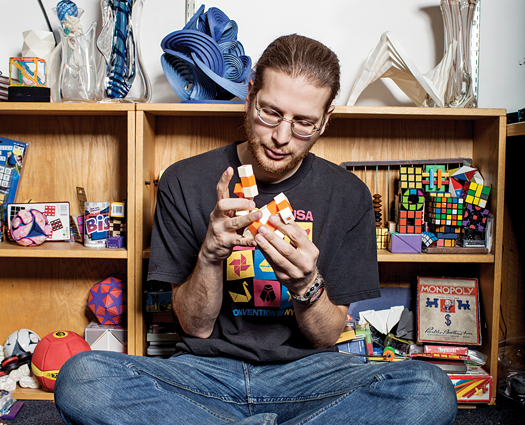
The bookshelves in his office are filled with toys and tchotchkes and paper foldings that he’s made with Marty. “I feel like a connoisseur of games,” he says sitting beside a 52-inch TV cabled to a Nintendo Wii. “I try to play almost every game for at least a little while, just to get a sense for the different genres.” Lately, some of the projects he and Marty are undertaking seem less like games and more like studies of the absurd. For one, they’ve been leaving breadcrumbs in a circle in the park to see how birds respond. For another, they will study the geometry of pasta shapes. They also plan to lock a pigeon in a cage of bread so it can peck its way to freedom. The projects may seem pointless now, but then it’s hard to say where play might lead.
They also plan to lock a pigeon in a cage of bread. The project may seem pointless now, but then it’s hard to say where play might lead.
The coincidence of the brilliant and the playful mind has a long history in science. Among its most famous exemplars was the 19th-century Scottish physicist and child prodigy James Clerk Maxwell. At 14 years old, Maxwell wrote his first scientific paper, on a method he’d devised for tracing curves using pins and thread. In his early twenties, as a fellow at Trinity College, he became interested in spinning tops. He attached colored paper to the tops of the toys and spun them around like whirling pie charts. He would record how the colors appeared to merge in motion. Maxwell found that red and green and blue could mix to make any color, a discovery that eventually led him to invent the color photograph.
“The only way you can do breakthrough research is constantly to play with phenomena,” says Robert Root-Bernstein, a physiologist and winner of his own MacArthur grant. Root-Bernstein and his wife, Michele, a historian and adjunct professor at Michigan State University, have studied creativity and how scientific genius manifests. (They wrote a book on the creative process called Sparks of Genius.) “If you don’t have that playfulness,” Root-Bernstein says, “you’re never going to have the breadth of experiences necessary to run into something, in a sense, by accident.”
Maxwell’s case is just one example of how play has fostered scientific discovery. Alexander Fleming’s identification of penicillin may have been inspired by his passion for painting agar plates with brightly colored microbes. (The fungus Penicillium happens to be an intense blue-green.) The quantum theoretician Richard Feynman began his work on the precession of electron orbits after watching a tossed plate wobble through the air in the Cornell cafeteria. “That’s what play does for you,” Root-Bernstein says. “You learn all the rules of the game, and then you know when something unexpected or interesting has occurred.”
At Temple University, psychologist Kathy Hirsh-Pasek has tested the connection between play and creativity in children. In one experiment, she gave groups of four- to six-year-olds a pipe cleaner, a paper clip, and some aluminum foil. She told one group to play freely; she told another to think about what uses the objects might have; and she told a third group to use the objects to build specific tools, such as a bridge or a ladder. She then challenged the children to figure out ways to get a bear across a river. Hirsh-Pasek found that the second group—the ones engaged in what she calls guided play—came up with the most creative solutions. The same idea applies to scientists, she says: They do their best work when they’re free to play around with a known set of problems.
“It’s not that children are little scientists—it’s that scientists are big children.”Alison Gopnik, a psychologist at the University of California at Berkeley, sees an explicit connection between toddlers and scientists. She’s done studies that show that children run their own experiments by playing with the world around them. “One of the things that we always say is that it’s not that children are little scientists—it’s that scientists are big children,” she told one interviewer. “Scientists actually are the few people who as adults get to have this protected time when they can just explore, play, figure out what the world is like.”
* * *
On Thursday nights, Erik’s class meets to work on unsolved problems in the field of geometric folding. As the grad students file in, he writes a set of questions on the blackboard. One involves a box of business cards that he’s left out on a desk. Can the students figure out a way to turn them into interlocking octahedrons? Another involves a square piece of paper. What’s the largest regular tetrahedron they can fold from it?
It doesn’t take long for the students to pop up from their seats and start scrawling on the board. Soon they’ve broken up into groups, sketching out ideas or punching thoughts into a laptop. Each team has its own approach. Some use rulers and Scotch tape; others draw things by hand. Erik stands by with his stylus, jotting notes onto a tablet, doling out advice and cracking jokes. These freewheeling sessions often lead to published papers, and the tetrahedron problem might even have some useful applications: It could teach manufacturers how to use a sheet of metal more efficiently.
As usual, Erik’s father Marty is also in the room, drawing his ideas on a scrap of paper. At one point, he shows the students what he’s doing, and they crowd around to see. He’s come up with a quirky way of folding a set of triangles—the four faces of the tetrahedron—from a bunch of smaller shapes. It’s a plan the others hadn’t thought of, but Erik shakes his head as he surveys the sketch. He and Marty can at times seem more like brothers than a father and a son.
“Well, it’s another approach to play with,” Marty says. “It’s very conceptual, but I think it has possibilities.” Later he’ll try to build a working model in his studio, and Erik will go and take a look. When Marty’s not around, Erik might even make some changes of his own—it’s all part of their process.
“We know each other so well that it makes for a really effective combination,” Erik says. “He’s always trying to reinject some playfulness into my serious work. It lets us do things that neither of us could do.” It also lets them do things that other academics would never try.
Among their many big ideas, the notion that play is fundamental to science may be the most profound. It could also form the basis for Erik’s greatest contribution to his field. As the students file out of the classroom, having spent two hours doodling and folding, doing math and generally enjoying themselves, he wipes the blackboard clean. When I ask him later why he chooses to teach the way he does, he answers simply, “I think this is a cool way of working, and more people should work this way. Sadly, not everyone does, so I try to pass it on.”
_Daniel Engber is a contributing editor and writes the monthly FYI column. This article originally appeared in the February 2013 issue of_ Popular Science.
