The fossil record has a lot of strange stories to tell about the evolution of life on Earth, and one of the strangest is how life moved from sea to land. Though clues from the record give the rough outlines of the story--limbs grew from fins in a series of stages in which fins grew longer and narrower--scientists are still filling in the details, trying to determine what genetic changes might have allowed the limbs to grow.
One of the best ways to learn those details is to reproduce the changes that occurred some 400 million years ago--to virtually go back in time and alter the development of the land-goer's living ancestors and see what happens.
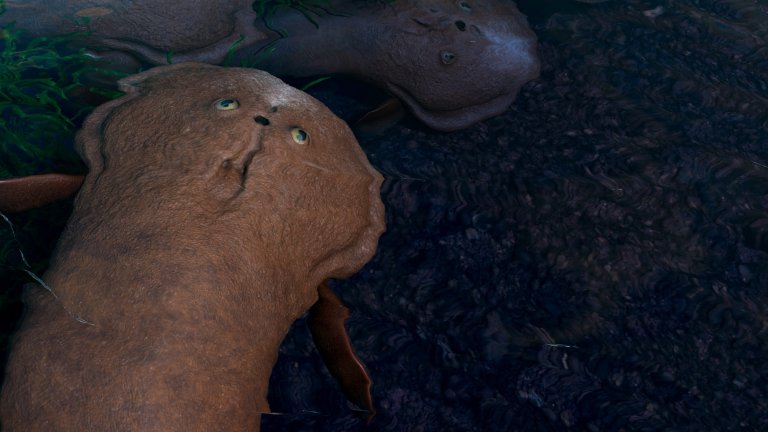
Which is what biologist Renata Freitas and colleagues were up to when they added some extra Hoxd13--a gene known to play a role in distinguishing body parts during embryological development-- to the tip of a zebrafish embryo's fin, and watched as the developing fin kept growing:

Those round objects on the ends of the embryo's fins look a lot like autopods, the multifinger proto-extremities that evolved from lobe-finned fish, allowing life's first foray on to land. Here's a diagram from the researcher's paper, showing the changes that the extra dose of Hoxd13 allowed:

Their lab findings led the researchers to hypothesize that the secret to limb development may have been a new element in some lobe-finned fish's DNA. When present, this DNA element would have helped turn on the Hoxd13 gene on the fish embryo's fins, leading them to lengthen and grow into limbs.
Five amazing, clean technologies that will set us free, in this month's energy-focused issue. Also: how to build a better bomb detector, the robotic toys that are raising your children, a human catapult, the world's smallest arcade, and much more.


Online Content Director: Suzanne LaBarre | Email
Senior Editor: Paul Adams | Email
Associate Editor: Dan Nosowitz | Email
Assistant Editor: Colin Lecher | Email
Assistant Editor: Rose Pastore | Email
Contributing Writers:
Rebecca Boyle | Email
Kelsey D. Atherton | Email
Francie Diep | Email
Shaunacy Ferro | Email
Can't wait to see what bagpipes100's thoughts are on this...
Just for the info this work is jointly funded by the Spanish Research Council CSIC, the Andalusian Regional Government (Junta de Andalucia), the 'Pablo de Olavide' University (UPO) in Seville, Spain and by EU research and innovation funds.
The Center is still looking for more top researchers
"Centro Andaluz de Biología del Desarrollo"
Was this done so fish could get out of the water we're making unfit for them to live in?
Speaking of "phish" "Catherined".......
Interesting. I'd personally love to have legged fish as pets... or test subjects. This indicates that we could someday "control" evolution. Now THAT's something to look forward to. Also, they could have at least shown what the fish actually looks like instead of that transparent image.
Next time can you grow a fish with Bluetooth and a bio-microprocessor?
Didnt fish already grow legs. Like a couple million years ago, hence me typing
Excellent example of intelligent design! :)
There TheKID11, happy?
Now when this happens purely by chance there may be something for evolutionists to celebrate about.
But seriously, did they grow to maturity? Did they see the end result? Or is this another example of media hype which will be quietly disposed of later when they show it didn't really show what they originally said it did?
@Bagpipes100
How is this in any way an example of intelligent design? Lol.
What crap do you read on the Internet to get the idea that this has anything to do with intelligent design. It supports evolutionary theory because it strongly supports that this already did happen by chance.
As for your questions: I don't really know. It seems to be a significant finding, but as always more research is needed. I doubt full limbs will develop using this method for a long time, until they lean and conduct more tests. However, if you are curious about genetic manipulation of body parts/body plan, there is a lot of interesting research using drosophila. Researches can engineer drosophila to grow appendages in different parts of their body.
@TheKID11
I don't think you are seeing it from Bagpipes' side. He sees that a human caused a mutation to grow feet but thinks it is impossible for random mutation(which all good intelectuals know is driven by natural selection, pretty much the opposite of random) to be responsible for the fish growing feet.
Bagpipes sees a ladder: Fins evolve into stubs, stubs evolve into arms/legs, arms/legs evolve into arms/legs with digits.
You see a tree: Successful traits are selected based on survival through variables such as food source, mating and genetic mutations.
@TheKID11
Intelligent design is all you can call it.
Intelligent beings forced something to happen in a labratory environment. Without that intelligent cause, it would not have happened.
If the scientists had zebra fish sitting in the tank and all a sudden one of them grew an arm that would be evidence for blind evolution.
But since this was engineered, it's intelligent design.
I bet you don't have any actual scientific issues with ID, and if you thought things through more than you did in your last post you would have a number of scientific issues with blind evolution.
@Bagpipes100
You are expanding the definition of intelligent design to something it is not. Intelligent Design is a creationist theory that negates natural selection (which there is an overabundance of evidence for), and hypothesizes the concept of their being a superior intelligent entity that created various species, thus negating the process of evolution. There is no scientific evidence for intelligent design, which is why it falls short as a hypothesis. What you have done here is extrapolated the literal definition of "intelligent" and "design" to explain how scientists are manipulating the zebrafish to grow limbs. In literal definition you can call this "intelligent design," but that separates your argument entirely from what you meant.
This supports evolutionary theory because the research was conducted to examine how over expression of the Hoxd13 gene can induce fin and limb formation, supporting that mutations in the past that manipulated regulatory transcription factors for Hoxd13 can explain the evidence seen in the fossil record.
Fish can't all of the sudden grow an arm (theoretically maybe). This is not how evolution works, it is a slow process over a LONG period of time, where subsequent mutations and natural selection allowed for the progression of limbs (as Anonymous Ace 92 described).
If you're suggesting that an intelligent entity such as HUMANS are responsible for the creation and modulation of different species, than you need to read a lot more scientific research in general.
Also,
@AnonymousAce92
The "tree" you referred to allows for the "ladder." It is important to understand that evolution through natural selection can work in this stepwise manner, and is probable due to the long periods of time it takes species to evolve as well as the evidence for how how mutations contribute to genetic variation within populations.
@TheKID11
I can tell you haven't taken any upper level math classes. You'd get toasted over your poor use of logic here.
"This supports evolutionary theory because the research was conducted to examine how over expression of the Hoxd13 gene can induce fin and limb formation, supporting that mutations in the past that manipulated regulatory transcription factors for Hoxd13 can explain the evidence seen in the fossil record."
False! It does not support evolution. In order for it to be supportive of evolution it would have to be observed occuring in natural conditions. IF it can occur naturally then it would give some evidence that it may have been a process used in the evolution of limb formation.
At this point in time however, it can only be said that in unnatural, intelligence caused situations this can occur.
"If you're suggesting that an intelligent entity such as HUMANS are responsible for the creation and modulation of different species, than you need to read a lot more scientific research in general."
Irrelevant. It doesn't matter what intelligent agents originally caused it, this article only shows that this zebra fish "limb" has so far only been observed happening by direct intelligent intervention.
@Bagpipes100
WOW. First off, I have taken upper level math classes, and they don't pertain to this argument or the "logic" of this argument, unless you are considering statistical analysis of scientific data or the formulation of models to test a scientific theory. I don't see what connection you are trying to make here, but if you would care to explain this, please do.
I'm not sure how to make you understand (because you seemingly don't)how scientific empirical research is used to support a scientific theory, but I am going to do my best.
First off, a scientific theory is tested through observation and empirical research. As new observations are made a theory can become more complete, modified, or discarded. Over 150 years the theory of evolution has become more complete and has been modified to fit observational and empirical data. The more data that is collected and the more observations that are made the better support for that theory, and new questions and connections can then be made based off of that data. This can only occur within the confines of human capability. We can only test theories to the best of our current knowledge and technological capabilities.
"False! It does not support evolution. In order for it to be supportive of evolution it would have to be observed occuring in natural conditions. IF it can occur naturally then it would give some evidence that it may have been a process used in the evolution of limb formation."
THIS IS FALSE. Support for evolutionary theory does not NEED to occur in natural conditions to be supportive evidence. I'm not sure why you continuously say this because this is not how science works. It would certainly be EXCELLENT support for evolutionary theory if we could observe it occurring naturally, but we cannot live for long enough periods of time to track such genetic changes. The manipulation by these researchers (which you refer to as intelligent design) was based off of previous findings in the fossil record, as well as findings in genetics. This serves as support for evolutionary theory because it illustrates how changes to a gene, that CAN occur naturally do to mutation (again based off of an abundance of evidence), can alter the over expression of a gene which regulates fin formation into limb formation. The lab is manipulating the expression of this gene in order to show how genetic mutation that happens in nature could explain the fossil record.
I think what you are really arguing is a lack of "proof." Am I right? It is important to realize that scientific theories aren't mathematical proofs. They are continuously tested over and over again with new techniques, new observations, and new manipulations. So far evolutionary theory has stood up to many tests. Saying that we haven't seen the formation of a fin into a limb in nature is a NO S**T statement. We can't, for a multitude of reasons. This in no way undermines the research that has supported the principles that allow for evolution. We can only use what is available to us to continue to test a theory.
"Irrelevant. It doesn't matter what intelligent agents originally caused it, this article only shows that this zebra fish "limb" has so far only been observed happening by direct intelligent intervention."
ABSOLUTELY RELEVANT, if you are talking about the theory of Intelligent Design. It DOES MATTER what intelligent agents originally caused it if you want to use Intelligent Design as a scientific theory, especially if you are using it as an alternative means to explain observational and empirical data. The problem with intelligent design is that there is no evidence for these "intelligent agents" (singular or plural) before humans. Without observational evidence for such entities existing before human manipulation, intelligent design does not serve as a well supported scientific theory. In other words, there is no evidence for Intelligent Design beyond saying that a human can cause changes in the laboratory.
@Bagpipes100
"False! It does not support evolution. In order for it to be supportive of evolution it would have to be observed occuring in natural conditions. IF it can occur naturally then it would give some evidence that it may have been a process used in the evolution of limb formation."
Funny, I anticipated this very argument...
You are missing the point entirely. This obviously is not a test to see if it occurs naturally, you'll have to look to other experiments for that information. The point of this experiment was to see if they could manipulate an existing gene to account for the change in limb formation; Specifically to see if they could influence the growth of feet-like limbs. You are only pointing out the obvious that they "intelligently" replicated the effects of a mutation(which can occur naturally).
-------------------------------------------------------------------------------------------------
Let us study your logic towards natural selection compared to something we know happened.
This Example: Scientists find fossil evidence to support transitional species and it is well documented.
Your Response: You see this experiment and say, "This is no proof that there is evolution, I would only believe it if I could directly observe it!"
Metaphorical example: The American Civil War happened and is well documented.
Metaphorical Response: You watch an American Civil War Reenactment and say, "This is no proof that the civil war happened, I would only belive it if I could directly observe it!"
In both examples there is overwhelming evidence yet you would dismiss it because you did not observe the original event. Obviously you don't deny that the American Civil War happened(or at least I hope you don't). Please enlighten me as to why you wouldn't apply the same logic to both examples...
@TheKID11
Your Quote: "Saying that we haven't seen the formation of a fin into a limb in nature is a NO S**T statement."
My Quote: "You are only pointing out the obvious that they "intelligently" replicated the effects of a mutation(which can occur naturally)."
Seems like there is observable evidence of his buffoonery that is evident to the both of us. Maybe we can construct a theory in real time so he can see how it works...
@AnonymousAce920
Thank you for making clear what I was trying to explain to bagpipes. You're explanation and metaphorical example serve as a more concise and eloquent approach at communicating these ideas than my excerpt did.
"It would certainly be EXCELLENT support for evolutionary theory if we could observe it occurring naturally, but we cannot live for long enough periods of time to track such genetic changes."
For examples, one needs to only use the search term: "observed examples of speciation" in any popular search engine. You are correct about the amount of time though; Most examples you will find are seen in organisms with short life spans and large numbers of offspring(microbes, plants, insects, etc.).
Correct, but I would prefer that bagpipes100 searches for such examples in scientific journals rather than basic online search engines.
Look, you both are very verbose, but both have some logical issues.
A couple things you both need to note.
1. There is no rigorous definition of species set as a standard that is used across the board.
2. The above article shows that tumors can be created when people inject genes into living organisms. Did it turn into a more advanced limb? Did it give a selective advantage?
3. Science is done by the scientific method. If you want to open it up to include evolution, then you need to define it by something other than the empirical scientific method. What would that be?
4. The fossil record really doesn't support 'missing links', there sure are not enough of them as there should be. And the ones that are found there isn't enough DNA evidence found in fossils to say whether or not they really are related, and studies on physiology alone aren't always helpful as in this case http://en.wikipedia.org/wiki/Flabby_whalefish.
I could go on, but I have better things to do.
My suggestion would be to quit assuming what you are trying to prove.
@Bagpipes100
Hey there. Once again, I am going to frustratingly go through your comment and discuss how it is false (in every point you listed). I am currently at work conducting experiments and can not devote the time to picking apart your argument piece by piece, so please be patient and expect a lengthy response later today (most likely this evening).
@Bagpipes100
I probably come off as verbose because it is difficult to explain genetics and biology to someone who doesn't understand it. I am trying to lay it out in a manner in which you can comprehend, but we seem to be passed that. Thus I am afraid I may have to resort to using scientific jargon in the hopes that you can follow along.
MY suggestion would be to read about evolution and try and understand how it works and the evidence for it before you try and bash on it in the comments section of a scientific magazine. I am going to address the points you discussed above, and how your misunderstanding doesn't come from a lack of "logic" on your part, but rather a lack of education about evolution and the evidence that's been accumulated over 150 years to support it. My guess is you weren't exposed to advanced biology or evolutionary courses enough during your lifetime(not your fault), and that you most likely read creationist blogs or postings on the Internet that try and negate evolutionary theory (which in turn are written by people ignorant of biology and genetics). The problem is "ignorance" not "logic." Logic can only follow from what information you know and understand, and in this case you're lack of knowledge in the areas of genetics, biology, and the scientific method in general is what is limiting your ability to understand evidence for evolutionary theory, such as the article above.
1) There absolutely is a rigorous definition of what a species is across the board, but like words In our English language (used to describe our reality), multiple definitions are often used or needed to explain things that exist in nature. For instance, bacteria live very different lifestyles than say a "whale." Bacteria reproduce in
different ways, function completely different, and interact with their environment differently than whales. However, the definition for species as it was originally created to describe creatures with large body plans, is still used across the board to classify all newly discovered life
forms. Not sure why you don't think there is a rigorous definition. Once again, I'm sure it's due to some nonsense you read on a pro-creation website. On top of that, I think it is more that "Intelligent Design" lacks a rigorous definition due to your extemporaneous comments about it above.
2)WRONG. This point only further illustrates your misunderstanding. First off, the researchers weren't "injecting" a novel gene into zebrafish per se. It is important you separate yourself from this idea. They were inserting Hoxd13 (a gene that already exists in zebrafish and is essential for fin formation)with promoters for a gluccocorticoid receptor, which would form a protein complex with hoxd13 transcripts. This allows for a steroid hormone-inducible system so the researchers could temporally control the hoxd13a gene expression. The same gene is there, but the researchers can now manipulate its level of expression during different stages of embryonic development. Secondly, the results are far from that of a "tumor." This is hardly an accurate analogy. Tumors are cell masses whose cells proliferate uncontrollably due to mutations in cellular machinery that regulates cell apoptosis or mitosis (amongst other factors that regulate the cell cycle and cellular death). In this study, there wasn't only a distal overgrowth of chondrogenic tissue with characteristics of autopod development (which you refer to inaccurately as "tumors") but there was also a concomitant reduction in fin folds (reduction in cellular mass). I don't feel I need to explain to you how a reduction in cell mass is not representative of a "tumor." In addition, these findings matched nicely with the domain specific activity of tetrapod hoxd enhancers seen in developing mouse limbs.
To address your next question. "Did it turn into a more advanced limb?" No, they essentially turned from a fin into a separate appendage while they developed! Would it need to turn into a more advanced limb to be qualified as astounding evidence? HELL NO, the finding is astounding enough.
"Did it give a selective advantage?" This is a laughable question. NO, certainly not. This wasn't a test for whether or not the growth of limbs on zebrafish in lab would serve as a selective advantage. Did it give a selective advantage for sarcopterygians? YES, and the fossil record makes a fine connection with the progression of tetrapods forming into autopods via fin fold reductions and increases in distal endoskeletal elements. We can't test gene expression effects on extinct species man, and even if we could there would be the limitations of transfecting such organisms. This is why zebrafish are used. They are a model organism in scientific research because they are easy to grow in lab, are transparent, and can be easily transfected with transgenes and vectors for gene modulation. I highly doubt an appendage on a zebrafish would have a selective advantage, it would be stupid and impractical to even test that. The only way to test such a irrelevant idea would be to place the fish back in their natural habitat or a slightly different habitat and record their reproductive success for 100s to 1000s of years, which in of itself is not pragmatic.
3)I'm really not even sure what these next sentences mean.
"Science is done by the scientific method."
Seems a bit redundant. Why are you stating the obvious here?
"If you want to open it up to include evolution, then you need to define it by something other than the empirical scientific method. What would that be?"
Okay, I THINK I get what you are saying, even though its muddled down in your ignorance of how science is conducted. Do you mean other than empirical laboratory research? Cuz if you do, we have already discussed this. The answer outside of what occurs in the lab would be OBSERVATION, which there is PLENTY of. Fossil record, real-time bacterial speciation, natural selection occurring in wild populations via geographical separation, environmental changes, food scarcity, and introduction and removal of predators. The list goes on. In this case a STRONG connection is being made between genetic contributions of fin to limb development and the observed fossil data.
4) "The fossil record really doesn't support 'missing links', there sure are not enough of them as there should be. And the ones that are found there isn't enough DNA evidence found in fossils to say whether or not they really are related, and studies on physiology alone aren't always helpful as in this case http://en.wikipedia.org/wiki/Flabby_whalefish."
Again, a lack of education on the subject. There are and always will be "missing links" in the fossil record, but if you devoted any attention and reading to fossil accumulation over the past 150 years you would know that every few years these gaps or "missing links" are filled. The "missing links" that existed two decades ago have been filled with new fossil evidence. This trend has been consistent, and the "missing links" in the fossil record today will be found as we continue to discover more fossils. As for DNA extraction from fossils: this is limited to bone fossils primarily, but the lack of technological ability to be able to extract DNA from other fossils doesn't hinder the analysis of their age or contribution to homology. You keep using these red herring arguments that since we CAN'T physically test for something, that the abundance of scientific evidence we CAN/HAVE tested for must be inaccurate.
As for the whalefish, we have struggled to identify it's species using the only physical evidence we have (it's physiology/body plan)...So, what's your point? How does the difficulty in classifying the species of one organism retract the theory of evolution. All we have to work with is what we have, and as new fossil evidence and DNA analysis develops we can better classify this species. This example does nothing to hinder the majority of organisms in the fossil record. Please do go on.
"My suggestion would be to quit assuming what you are trying to prove."
Why? Assumptions are an important aspect of science. When there is a significant body of evidence supporting a theory, it is only responsible to assume its validity in order to progress scientific research. I'm not arguing against questioning the results of specific studies every once in a while because that is good scientific practice, but when a theory is so well supported (especially in the interdisciplinary manner that evolution is) it no longer is useful to doubt its validity as a theory. It is instead better to assume its validity and continue to test it. If evidence for the contrary comes along, then the theory of evolution can be discarded or manipulated, but there is no evidence for the contrary in the past 150 years (only a bunch of creationist nay sayers who try and disprove evolution by arguing the validity of data, without proposing a "scientific" alternative).
Here's another study that was just published in SCIENCE, about hox gene regulation of limb development. They reversed the effect in mice, and illustrate an underlying mathematical model of how gene expression functions in the modulation of limb development. They were able to reverse the effect, turning digits into fin-like structures in mice.
http://www.sciencedaily.com/releases/2012/12/121214112652.htm
I figure the news story would help you better understand this type of research.
Ooh ooh! I want a turn!
"1. There is no rigorous definition of species set as a standard that is used across the board."
Once again Google saves the day; Here is a basic definition: A group of living organisms consisting of similar individuals capable of exchanging genes or interbreeding.
"2. The above article shows that tumors can be created when people inject genes into living organisms. Did it turn into a more advanced limb? Did it give a selective advantage?"
Once again you're missing the point dood. The scientists were altering existing genes to see if a drastic change could be made. This article has nothing to do with Natural Selection.
"3. Science is done by the scientific method. If you want to open it up to include evolution, then you need to define it by something other than the empirical scientific method. What would that be?"
The theory of evolution was not just drawn out of a hat. It has been developed by studying the vast amounts of biological and geological evidence that has been found.
"4. The fossil record really doesn't support 'missing links', there sure are not enough of them as there should be. And the ones that are found there isn't enough DNA evidence found in fossils to say whether or not they really are related, and studies on physiology alone aren't always helpful as in this case http://en.wikipedia.org/wiki/Flabby_whalefish."
There is no DNA evidence in fossils. Transitional forms only represent long term change in species which is why they are usually broadly dated. No scientist is going to say a fossil is exactly from B.C. 135,000,000 and is the second cousin, twice removed of Tyranasaurus Rex. It just doesn't work that way.
Finally you are right, physiology is not everything. Species are divided by the ability to interbreed.
Well would you look at that - it does take intelligence , and creation to create new species of whatever...-.
oh yeah, that thing looks like it's ready to break off some Eddie Van Halen 'Eruption' with those suckers! Oops, I'm sorry this article says legs I should have seen they were clearly toes. Could have been a cross country champ, think of the potential for scholarships! If only it lived more than 4 days. Not suprising I can't find this little tidbit in any of the articles.
You mess with with one aspect of DNA to make it better, you mess up a whole lot more in the process. DNA not so simple as you want the lemmings in the general public to belive.
Something from the the dark side to consider. Free your mind. I know you hate this stuff with a passion, but please hold your preprepared, prejudged ad hominems until the ride has come to a complete stop:
When New Scientist magazine questioned one of the researchers, Fernando Casares, about the popularized claim, he responded, "Of course, we haven't been able to grow hands."2
Nevertheless, Casares and his colleagues did claim that their data had profound implications for the hypothetical evolutionary change required for fish fins to magically morph into legs, arms, hands, and feet...
The zebrafish has been an important model organism for the study of embryology, because it can be easily manipulated by modifying its DNA. Researchers can then observe the effects in developing embryos. These genetic manipulations can be easily observed in the transparent fish embryos, which provide a window into the developmental process.
In this study, scientists inserted a control element (genetic switch) from mouse DNA into some zebrafish. The switch drastically ramped up the expression of a key developmental zebrafish gene called hoxd13. This caused a manifold increase in the hoxd13 gene product in developing fish fin tissue.
So, what were the effects of over-expressing the hoxd13 gene? Not only did the fish not develop hands or any other novel evolutionary favorable appendage, but normal fish fin development was completely and grotesquely perturbed. The resulting embryos died within four days on average—hardly a hallmark of evolutionary progress.
The mutated results of the study was that the normal tissue area of expression for the hoxd13 gene was markedly expanded beyond its normal, well-defined boundaries. It produced grossly distorted and lengthened sections of perturbed tissue. In fact, the growth distortions were not symmetrical but exhibited uncontrolled development.
Evolutionary media were quick to propagate a story where fish supposedly grew hands in the lab. But the actual experimental results told just the opposite story. Altering only a single gene's expression level disrupted the finely tuned system of hundreds of interacting genes within the irreducibly complex developmental genetic network, resulting in death of the organism.
Rather than showing how limbs could be produced from fins, this research showed how wonderfully fine-tuned and built the genome is.
@fromgootoyoubywayofthezoo
Nobody said this was a demonstration of our ability to perfectly manipulate genes to express exactly the kind of things we would expect to see in nature.
This experiment is simply to see if the existing genome could be used to grow more leg-like parts. Natural selection picks out the failures like the ones we created.