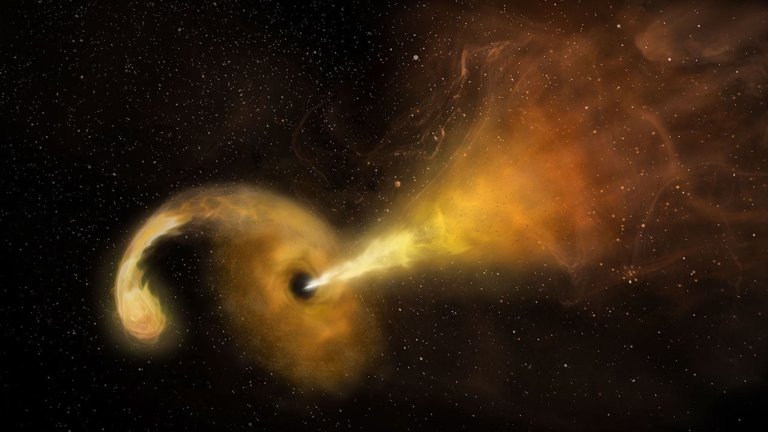
Galaxy-building theory says there are stars and there are stage hands. The bright, shining galaxies filled with stars, the theory goes, took star-building gas from somewhere else, but we couldn't find exactly where the help came from. Now astronomers have likely found that source; starless "dark galaxies" that fed others early in the history of the universe have been seen.
The European Southern Observatory's Very Large Telescope was able to catch a glimpse of the galaxies for the first time as they were being illuminated by a quasar. Since the galaxies are bad at forming stars on their own, they're difficult to see without a light source like a quasar, which shines UV light and can cause a fluorescent glow in the starless galaxies. Their existence has been hinted at before, but this marks the first direct look.
Some estimations were also offered by researchers on the properties of these galaxies. The mass of their gas is about 1 billion times that of the Sun's, and they're about 100 times less conducive to star-forming than similar neighbors.
The find also validates progressive rock band King Crimson's early scientific predictions.
140 years of Popular Science at your fingertips.
Each issue has been completely reimagined for your iPad. See our amazing new vision for magazines that goes far beyond the printed page
Stay up to date on the latest news of the future of science and technology from your iPhone or Android phone with full articles, images and offline viewing
Featuring every article from the magazine and website, plus links from around the Web. Also see our PopSci DIY feed
For our annual How It Works issue, we break down everything from the massive Falcon Heavy rocket to a tiny DNA sequencer that connects to a USB port. We also take a look at an ambitious plan for faster-than-light travel and dive into the billion-dollar science of dog food.
Plus the latest Legos, Cadillac's plug-in hybrid, a tractor built for the apocalypse, and more.

Online Content Director: Suzanne LaBarre | Email
Senior Editor: Paul Adams | Email
Associate Editor: Dan Nosowitz | Email
Assistant Editor: Colin Lecher | Email
Assistant Editor:Rose Pastore | Email
Contributing Writers:
Rebecca Boyle | Email
Kelsey D. Atherton | Email
Francie Diep | Email
Shaunacy Ferro | Email
Another nail in the coffin of dark matter.
@monkeybuttons
Dark matter is used to explain interactions within a galaxy. What bearing would dark galaxies have on dark matter?
Wait, I thought dark matter was the stuff that collects under the rim of a toilet bowl. I'm so confused. How did NASA's $20,000 toilet get all the way out there?
Agreed, Democedes, this has nothing to do with Dark Matter, but to say, "dark matter is used to explain interactions within a galaxy," while technically correct, is a somewhat shallow explanation. The most defining features of dark matter are that it accounts for the vast majority of mass in the universe, though we only interact with it through gravity, and that it's gravitational pull seems to dictate where visible matter coalesces into galaxies.
It would be interesting to know the ratio of dark galaxies to visible ones, and if any are heading for the Milkyway.
Such a terrible thought. Whole galaxies, unimaginable spans of space, filled with frozen planets and nebulae. All existing in absolute pitch darkness for eternity. Nothing but the stars around them. What kind of life or organized structures might evolve in environments like that?