
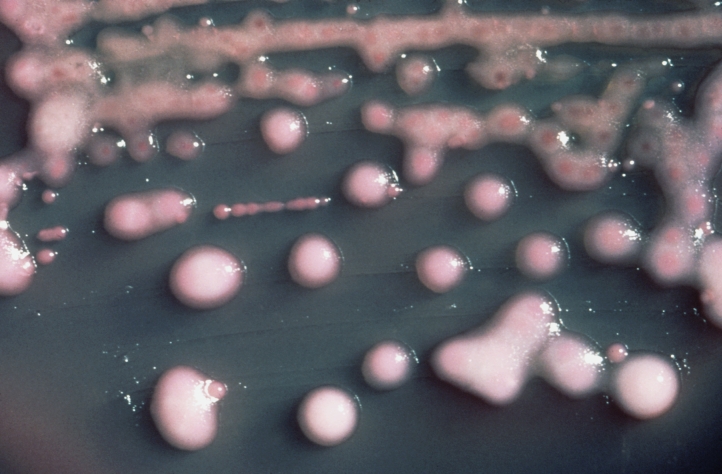
Pneumonia Bacteria Culture Klebsiella pneumoniae are commonly found in the human gastrointestinal tract, and are often the cause of hospital- acquired infections. Wikimedia Commons

A new drug compound can recharge a class of antibiotics used to fight superbug bacteria, improving the antibiotics’ effectiveness 16-fold. It’s another volley on the part of humans in the ongoing battle between new drugs and bacterial resistance.

This new compound doesn’t fight the bacteria itself — it just makes the antibacterial drugs more potent, and better able to fight the bacteria despite the bugs’ resistance. The compound, developed at North Carolina State University, could help researchers fight an emerging problem with a tricky bacterial enzyme.

The enzyme is called New Delhi metallo-β-lactamase, or NDM-1, and it has been found in bacterial strains around the world since its isolation in 2008. It’s particularly ugly because it makes bacteria able to resist a broad range of antibiotics — including the type that are typically used to fight antibiotic-resistant bacteria. It can resist the most powerful drugs that still work on drug-resistant bacteria, in other words. A superbug indeed. To make matters worse, it confers this ability on gram-negative bacteria, little bugs that are harder to treat — like E. coli and  K. pneumoniae. The Staph strain MRSA, the superbug we hear about most often, is a gram-positive bacteria.

Resistance-proof drugs, part of the carbapenem family, can kill most bacteria by preventing their cell walls from synthesizing properly. NDM-1 gives the bacteria a tool to break down those drugs and inactivate them. But this new compound thwarts that ability, making the carbapenem drugs better able to withstand the wily bacteria and fight infection. The compound is derived from a class of amino acids known as 2-aminoimidazoles. These amino acids can inhibit the growth of bacterial biofilms.

In previous research, NC State chemist Christian Melander found that the amino acid compounds could recharge existing antibiotics, and make them work better against gram-positive drug-resistant bacteria. They figured it might also work on the little guys, and it did. Melander and colleagues just published a paper in ACS Medicinal Chemistry Letters, explaining that a version of this amino acid compound pumped up the power of the antibiotics imipenem and meropenem 16-fold.

This is promising for future drug development, the researchers say — it could to our arsenal in the ongoing battle against microbe resistance.

[via Science Daily]
6 Comments

Now the sequel to the movie " I am Legend ", should be in the works as well!

.............................
Science sees no further than what it can sense.
Religion sees beyond the senses.

'Robot'
Please try to make semi-intelligent comments!
Beyond sense is NONSENSE

Just hope it can not be produced really cheap, otherwise the cattle farmers will feed it to their bests by the pound and the FDA will do nothing about it.

ejfineran,
I was simply speaking towards future movie developments. Of course movies are not real life as the move "I am Legend".

ejfinderan, did I disturb your 'contra?’

Still with a few geniuses ideological scientifically development does influence the fate of a much larger group.

How often in society just a few in powers decide the outcomes of the many.

Factually, do you know who is making this development and how they are being implemented? As you except you next flu shot, you trust all is well from the source? Scientifically you and I know nothing of what is put in our bodies of the next flu shot and its outcome. All we do is trust and hope the outcome will be better.

.............................
Science sees no further than what it can sense.
Religion sees beyond the senses.

why don't we just keep an active penicillium colony in all the hospitals? i know that some people are allergic to penicillin but we could easily divide the hospital between those allergic to it and those that aren't making sure to add the emergency ward to the section that is not connected to the penicillium colony.

to mars or bust!

@ghost
Because hospitals are some of the least efficient organizations active.
-Spouting a fountain of nonsense since 1995-


July 2013: The Future Of Flight

The incredible innovations, like drone swarms and perpetual flight, bringing aviation into the world of tomorrow. Plus: today's greatest sci-fi writers predict the future, the science behind the summer's biggest blockbusters, a Doctor Who-themed DIY 'bot, the organs you can do without, and much more.


Online Content Director: Suzanne LaBarre | Email
Senior Editor: Paul Adams | Email
Associate Editor: Dan Nosowitz | Email
Assistant Editor: Colin Lecher | Email
Assistant Editor: Rose Pastore | Email

Contributing Writers:

Kelsey D. Atherton | Email
Francie Diep | Email
Shaunacy Ferro | Email

circ-top-header.gif
circ-cover.gif
bmxmag-ps