
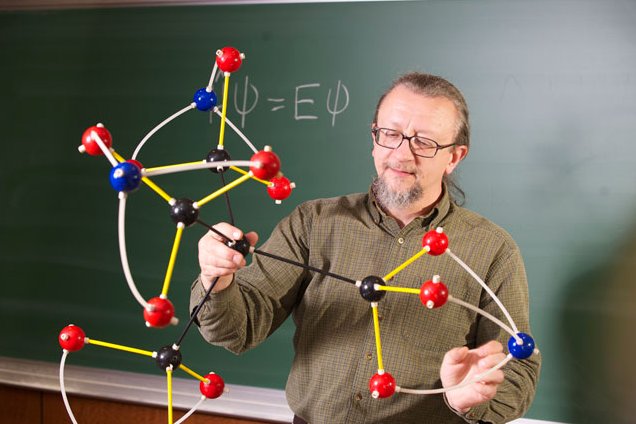
Little Clara's tetranitratoxycarbon is brand new and explosive

Tetranitratoxycarbon Professor Robert Zoellner holds a model of tetranitratoxycarbon. He has a co-authorship on a paper about the new molecule--along with ten-year-old Clara Lazen. Humboldt State University

Clara Lazen is the discoverer of tetranitratoxycarbon, a molecule constructed of, obviously, oxygen, nitrogen, and carbon. It's got some interesting possible properties, ranging from use as an explosive to energy storage. Lazen is listed as the co-author of a recent paper on the molecule. But that's not what's so interesting and inspiring about this story. What's so unusual here is that Clara Lazen is a ten-year-old fifth-grader in Kansas City, MO.

Kenneth Boehr, Clara's science teacher, handed out the usual ball-and-stick models used to visualize simple molecules to his fifth-grade class. But Clara put the carbon, nitrogen, and oxygen atoms together in a particular complex way and asked Boehr if she'd made a real molecule. Boehr, to his surprise, wasn't sure. So he photographed the model and sent it over to a chemist friend at Humboldt State University who identified it as a wholly new but also wholly viable chemical.

The chemical has the same formula as one other in HSU's database, but the atoms are arranged differently, so it qualifies as a unique molecule. It doesn't exist in nature, so it'd have to be synthesized in a lab, which takes time and effort. So Boehr's friend, Robert Zoellner, wrote a paper on it instead, to be published in Computational and Theoretical Chemistry. Listed as a co-author: Clara Lazen.

Boehr says the discovery and subsequent publication has incited a new interest in science and chemistry at his school--and Clara seems particularly pleased, saying she's now much more interested in biology and medicine.

[The Mary Sue via Gizmodo]

31 Comments

? Clara Lazen is the discoverer of tetranitratoxycarbon! Cool!! Way to go!

Why are we looking at a picture of Professor Robert Zoellner and not a picture of Clara Lazen?
Hello!

Why not? Easy, pedophiles.

dontbother,
Well my knee jerk response was to root for the children.
But I also absolutely agree with you too!

I just wish to say one more thing.

YEA Clara Lazen! YEA Clara Lazen! YEA Clara Lazen!

An interesting conjunction, this issue has a half joking reference to past articles on cryptozoology, "the study of animals that have not yet been proved to exist", and an article about a 10-year-old girl who "discovered" tetranitratoxycarbon. Popular Science condemns cryptozoology by pointedly describing material on the subject as "'real' science, filled with 'facts' and 'research'". But, then, it describes tetranitratoxycarbon as having been "discovered" even though it exists only as a ball on stick model assembled at random! No one has seen the moceule, the article acknowledges that, and it hasn't even been determined to be actually viable, but it's been "discovered" simply because some balls and sticks were put together! People have posited more or less reasonable forms for creatures from Bigfoot to the Loch Ness Monster, but, for them, "science" requires actual obtaining of a sample; with tetranitratocycarbon, all you need is to draw a picture! "Science" is hypocritical in the extreme.

julianpenrod,

'Wholly viable' or did you miss that?

Jealous much?

julian, it's not as though a person could arrange the molecule in any given manner they wanted and it would constitute a discovery. Sure, the girl likely created it purely out of chance, but the model itself still apparently adheres to all physical requirements.

By way of explanation, if you took the model and modified it in some slight way, it likely would no longer be a viable molecule. For example, tetranitratoxycarbon may be viable, but pentanitratoxycarbon may not be.

What's your thought process behind thinking the molecule hasn't been determined to be viable? The article being published is specifically going to address that issue: not only is it viable, but here are its chemical properties.

Fact is, if anything, it's a testament to science that a girl can arrange a model that happens to meet all the physical requirements for a real molecule to exist, and based on that model we can extrapolate that a real molecule can exist and what properties it would specifically exhibit.

That's a pretty bloody good example of the predictive power of science, once the molecule is actually created and shown to have the same, predicted properties.

In comparison, the vast majority of evidence for Bigfoot, et al, is anecdotal, heresay and personal accounts, but completely riddled with hoaxes and blatant lies (even if you accept that some accounts are truth, there's a lot out there that's intentionally deceptive -- and it's difficult to discriminate between them, assuming any accounts are real at all).

Yes, there are some castings made of apparent footprints or clumps of hair, etc., but even these have been verified to be false -- either through DNA reconstruction or by proving the cast was a hoax (for example, many castings are flat-footed, rather than a varied depression like a real footprint).

So it's not quite enough to say all you need is to draw a picture of the molecule; you need a picture and a thorough knowledge of how molecules are put together and what physical laws they must adhere to.

But yes, to verify Bigfoot exists you're going to need to actually find one. How else do you plan to prove its existence with enough certainty that you can actually request serious conservation efforts to be put in place -- costing significant sums of money -- to ensure the nearly-extinct species isn't eradicated entirely?

----------------
"Extraordinary claims require extraordinary evidence." - Carl Sagan

This is the wonderful thing about science. You can create a theory, and once you have a goal, go test that theory and see if it works or not. This is very similar to when Mendeleev created the periodic table and predicted several elements that hadn't been discovered yet. He even predicted some of their qualities due to the periods and groups they were a part of. There is no difference here with Clara predicting a molecule and then having someone else clarifying its existance. Good for her!

Yeah a little girl put a ball n stick model together. Its theoretically viable because the bonds are correct for a molecule. So what? Any scientist will tell you ball n stick models are not accurate representations of the shapes of molecules. They are only as accurate as a caricature of someones likeness drawn at a carnival. Its only wholly viable because its theoretically possible.
Einsteins quote " imagination is more important than knowledge", is backed heavily by people who are short on knowledge. Give a high school chemistry class an assignment to create new molecules with ball n sticks, they would find new theoretical molecules too.

Canadian Skeptic calls it a "testament to science" that Clara Lazen supposedly could put the model of tetranitratoxycarbon together.  There was no significant act involved here. All she did was connect rods to balls representing different atoms, with holes in them corresponding to the covalence of each atom. You just put atoms and rods together until there aren't any unconnected rods and, not a major point but considerable, so rods are not bent too much. And the fact is that nothing was discovered. A model was put together, much as many have put together theories of what Nessie and Bigfoot look like. And there are records of people saying they saw each of them, but, so far, not one molecule of this substance has been produced to actually declare it "discovered". Consider, too, the name applied to it violates normal nomenclature for covalent molecules. Among other things, the carbon should be before at least the oxygen and there should be an -ide suffix. The story is suspicious in the extreme.

Julian, I'm pretty sure that what Skeptic meant by calling her discovery a "testament to science" was that quite a few scientific discoveries are completely random and accidental. The whole point is that it wasn't a "significant act". Having a masters in chemical engineering doesn't make someone more qualified to discover something than a little girl. The CE is, however, more qualified to assess whether the "discovery" is valid or not.

-Why?
-Why not?

Always, always reward and inspire our children! It seems for a few of you, you do not understand this. Take it on faith, belief in children, reward children, inspire our children and always love them.

I have come across to a definition of discipline I do not approve of. And I have learned it has a large history and following by many. This definition by many is to punish those who intentionally want to do wrong, but also includes (those who make a mistake); the response of discipline is punishment, often with beatings and impressions of fear.

Now I think discipline is good. But the reality of life is humans, everyday make mistakes happen all of us, daily. Babies, children and teenagers know nothing and grow. They are a product of life. They will make 100 mistakes a day. It is the responsibility of parents and teachers to educate them inspire them and love them. They will make mistakes and is natural. We as adults must just educate them, inspire them and reward them. Punishment should only come, when intentional bad behavior is done intentionally.

I vented. Thank you for my patience. I am tired of children across the world of being beaten, abused and harshly punished. STOP IT!

I am so tired of childrens soul and inner being, being crushed. We must care and adore and teach and inspire our babies all their lives. We are lucky to be parents and lucky to give the give of love and to enjoy their beauty of our babies! Stop hurting our babies our children! Inspire them!

Thank you!

..........................................
See life in all its beautiful colors, and
from different perspectives too!

When I took exception to the characterization of this as a "testament to science", I meant that there really was no "science" involved in this at all. The children were given "atoms" with the specific number of covalent bond holes and rods to connect them. I specified that it's desired in these constructions that connections not be too curved, because that implies bonds not direct enough or well oriented enough to be strong. And that brings up a point. The picture shows many different rods of different lengths being used. Overall, it looks like a very detailed and much less likely off the cuff construction. It begins to look more and more like the substance had already been synthesized by Robert Zoellner, co-author on the paper on the chemical, and this is just a cheap, fabricated wayt to get attention for it.

As far as the science, what I find important isn't so much that the girl "discovered" the molecule, so much as our ability to determine the molecule's properties and determine whether or not it can exist, based purely on theory (which can subsequently be proven or falsified by experiment).

But, as Space and proaeternus suggest, it's also extremely valuable that this be taken as an opportunity to inspire a little girl and show that even she can make a contribution (though, no doubt, the story highly exaggerates her involvement -- it's not terribly relevent, in the sense of inspiring and congratulating her. She is a child.)

----------------
"Extraordinary claims require extraordinary evidence." - Carl Sagan

Personally, I see no reason to get upset over a feel good story as this one -- whether or not you feel it's the benchmark of scientific discovery.

----------------
"Extraordinary claims require extraordinary evidence." - Carl Sagan

That's not chance - she ordered the sticks and balls in a particular way. It's feasible that the directive was given that red can connect to yellow and white while the black can only connect to the black and yellow. From that she let her mind do a little artistry and she made a molecule.

Yeah bean, that's another thing - we really don't know what kind of direction she was given. For all we know, she's some kind of ridiculous child prodigy like that Jacob kid (http://bit.ly/x6gSTH). Or she was given sufficient direction, or it was totally by chance.

----------------
"Extraordinary claims require extraordinary evidence." - Carl Sagan

To those who keep trying to discredit and insult a little girl:
Are you all honestly so uneducated as to know that the synthesis of a new molecule, even if only using a simple ball-and-stick model set, is an extremely complex thing. The synthesized molecule being viable is not based solely on filling all of the possible bond sites, it is also dependent upon which isomer it is. Is it a D or and L isomer? Are the bonds actually spaced and oriented in such a way that the molecule will be stable for more than a few nanoseconds? Could it have a use? If so, what are they? Sure, Clara Lazen happened upon this construction by chance but regardless of that, she can be and should be given, at least, partial credit for the discovery because her model was deemed stable and viable as an actual molecule. A molecule that could be produced in the lab. It's sad really that a high school student who hasn't even taken an AP Chemisty, or a single physics class understands molecular physics more than some of you.

It's amazing how little those who go to lengths to identify themselves as "skeptics" actually use skepticism, at least in looking at items the corporate controlled "news" media or government order the public to believe. "Discover" means something that actually exists or, in a much loose sense, has a potential to exist. So far, this substance, the article asserts, has not been seen, despite centuries of involved chemistry and physics, and, until it's actually produced, it's not necessarily any more legitimate to say it can exist than that Bigfoot can exist. People have spent a lot more time a lot closer to chemicals than Bigfoot's environment, but none has ever seen this molecule.
Note, though, such enlightening items as Canadian_Skeptic saying, the story shows even the 10-year-old girl "can make a contribution", then proceeds to add, "though, no doubt, the story highly exaggerates her involvement". Yet, Canadian_Skeptic defends the story as "a feel good story". The message is clear, forget the facts, as long as it gets you to feel the way the New World Order want you to feel.

Basically, yeah.

NWO for life!

----------------
"Extraordinary claims require extraordinary evidence." - Carl Sagan

Look at the molecule. It's got a beautiful symmetry. There's an intellect behind it's assembly. Clara's made sure the valency was right and conceived of this little baby all by herself, based on the rules. I'd call that good, predictive Science, even if she wasn't only ten.

In all honesty the probability of the girl understanding what she did is very slim. Its unimpressive if a girl can randomly assemble parts of the bases and thus create an new element. If the girl had an understanding of advanced chemistry or understanding the sequencing of bond or even the properties of each element as their linked to another element, then it would be considered significant. I agree with the previous comment that the teacher is just trying to get publicity by saying that a 10 year old invented it.

For all you people trying to sympathize for the little girl ask your self this question: How would it feel if you were someone in Chemistry field working on synthesizing on a new element and a little girl randomly assembles it out of pure luck, should that girl really be accredited to a discovery that she does not even slightly understand.

And to make one more obscure reference if an inventor/discoverer creates something shouldn't they be able to explain what is that they have found even just a little on an advanced scale?

This comment is more relevant to the chemistry itself. Having four times the same group attached to the central carbon (which seems not to be excessively crowded) seems a lesser problem than the -CNO3 groups themselves.

As is evident from the pictured model, the three oxygens are forced out of the plane through the nitrogen perpendicular to the CC bonds. Two cases to compare this with are the nitrogroup and nitric acid. Both demonstrate the tendency of the central N to become positive, with the oxygens satisfying their usual strong electronegativity.

In the proposed -CNCO3 group the forced geometry creates a strongly developed lone electron pair on the nitrogen, making it neutral (following the octet rule). I can't see any plausible synthetic pathway to this group, so I wonder what the purported "viability" refers to.

Further to my previous comment, this might well be a hoax. On the blackboard behind the teacher is what at first sight looks like a random piece of scientific obfuscation visible. Namely the famous Schroedinger equation in it's basic eigenvalue notation (except more usually its written E psi = H psi). As I was getting at in my comment, an analysis of the molecular orbitals around the nitrogen is in order, but the blackboard sadly omits any reference to a discussion of it (which would of course start off with Schroedinger's equation).

Did some googling and found an extended abstract with figures of the article by professor Zoellner et al. http://www.sciencedirect.com/science/article/pii/S2210271X11005433 Dealing with Hartree-Fockcalculations.
Computational and Theoretical Chemistry, Volume 979, 1 January 2012, Pages 33-37
Robert W. Zoellner, Clara L. Lazen, Kenneth M. Boehr Costs on-line US $ 31.50

The abstract confirms my back of the envelope observations. There are now more than a hundred google citations, mostly exact replicas of the presshandout it seems. Publicity wins, grants rolling in, what's new?

Lol Contoria, as clair (the poster right above you) indicated, the equation is E psi = H psi. Psi actually looks like a U with a vertical line bisecting it down the middle (http://bit.ly/zRFzc1).

Though, I do know a lot of people who write 0 with a slash through it, which the chalk board symbols rather resemble, so it's definitely understandable (and yes would make for a very funny equation!).

Hernandez, let me answer your question with another question: if your daughter came home and said she created a model of a previously undiscovered molecule and will now be cited in a scientific journal, would you tell her "well, you really didn't contribute that much. You shouldn't really feel that proud"?

To answer your question more specifically, if I was a chemist having devoted my life to the pursuit of discovering new molecules or some other related Chemistry field, and out of the blue some 10-year old is attributed to a discovery she likely had no clue about -- I'd feel absolutely proud for her and glad of the fact she was given an opportunity to take pride in a field I'd devoted my life to.

That shared bond, the joy of making a discovery and a sincere interest in chemistry, is far stronger than being jealous of a 10-year-old girl for making a discovery she wasn't apparently educated enough to make.

----------------
"Extraordinary claims require extraordinary evidence." - Carl Sagan

my roomate's aunt makes $83/hr on the laptop. She has been without work for 8 months but last month her pay was $8682 just working on the laptop for a few hours. Read more on this site...Nuttyrich . com

Great job Professor Robert Zoellner. It takes one great teacher like him in a kids like to make kids interested in science.

my roomate's aunt makes $83/hr on the laptop. She has been without work for 8 months but last month her pay was $8682 just working on the laptop for a few hours. Read more on this site...Nuttyrich . com

@julianpenrod: The paper doesn't claim they are real molecules, instead it computationally analyzes the relative stability of the forms. It is a far cry from cryptozoology, the density functional calculations are quantum mechanically based (hence the Shroedinger eqn being there maybe?) and are extremely rigorous and accurate. Synthesis of all sorts of things is difficult but not impossible, analysing something computationally is often a great first step in guiding chemists to know what to make and also give clues about how best to do it.

@clairechemist: In the paper Zoellner notes that the strange nitrato-O,O,O- structure as shown in this photo is not the most stable isomer, but is a stable minima on the Hartree Fock surface, but not on the density functional surface. And he concludes that synthesis is unlikely, but suggests some of the forms are low energy and could be interesting targets for synthesis.

The whole point of computational analyses such as this is that can be a way to guide synthetic work. What I imagine happened was that Zoellner, upon seeing the photo of the molecule, thought 'I've never seen anything like this, I wonder how likely it is' and rather than attempting to synthesise it (which one could take a lifetime doing) he decided to run calculations on it as a matter of interest. I can't blame him, as a starting point Claras model would not have taken a lot of effort to run but after seeing the optimisation it clearly piqued his interest and he felt compelled to do some more work on it.


June 2013: American Energy Independence

Five amazing, clean technologies that will set us free, in this month's energy-focused issue. Also: how to build a better bomb detector, the robotic toys that are raising your children, a human catapult, the world's smallest arcade, and much more.


Online Content Director: Suzanne LaBarre | Email
Senior Editor: Paul Adams | Email
Associate Editor: Dan Nosowitz | Email
Assistant Editor: Colin Lecher | Email
Assistant Editor: Rose Pastore | Email

Contributing Writers:
Rebecca Boyle | Email
Kelsey D. Atherton | Email
Francie Diep | Email
Shaunacy Ferro | Email

circ-top-header.gif
circ-cover.gif
bmxmag-ps