
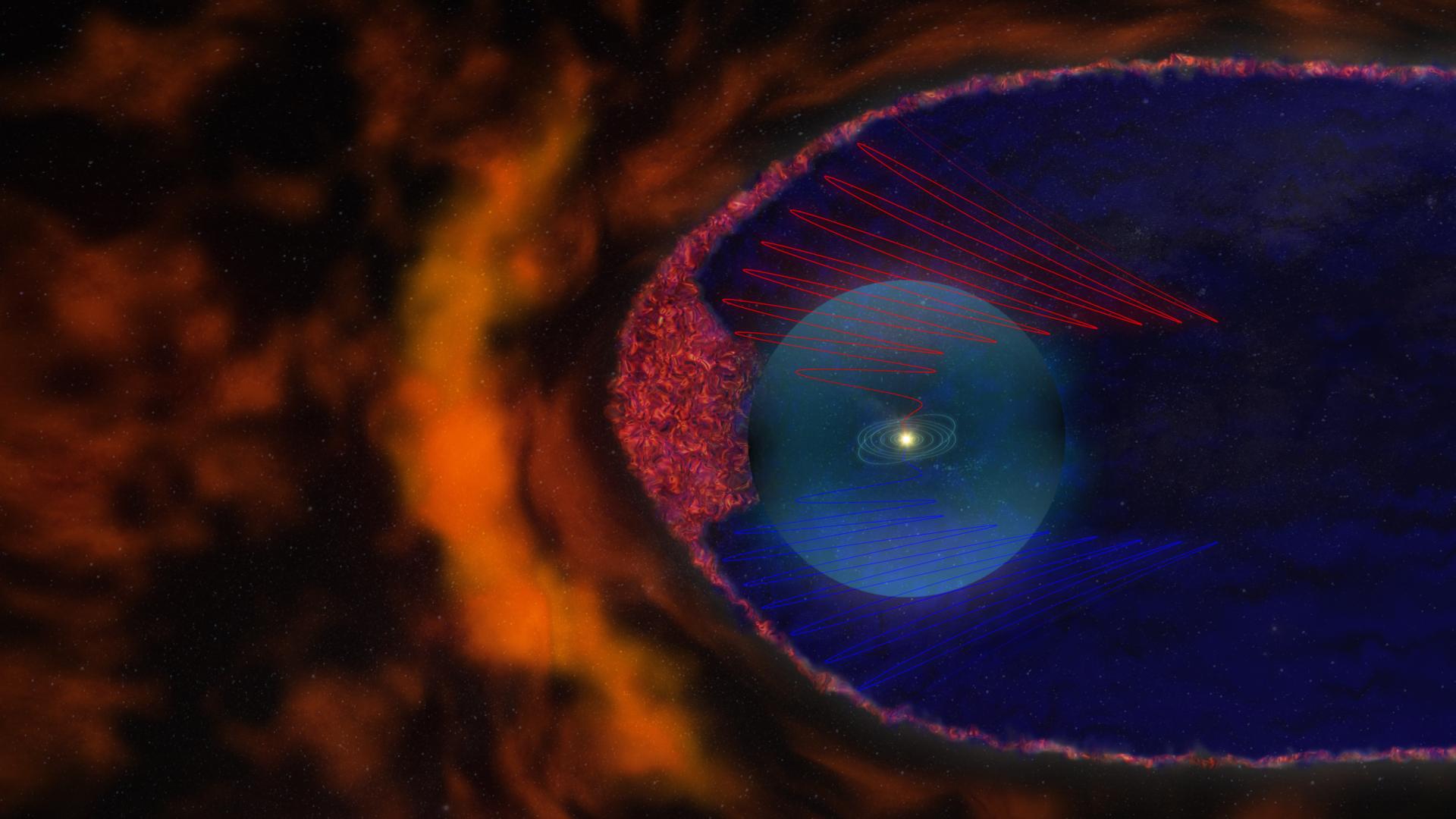
For decades, scientists have believed there to be a fairly well-defined boundary at the edges of our solar system, a region where the sun appears only slightly brighter than the rest of the spangled heavens. But as they sail through the blackness, humanity’s most-traveled spacecraft, the Voyager probes, have learned the lines are anything but clear. The edge of the solar system may not be a smooth edge at all, but a turbulent moat of roiling magnetic bubbles.
Interstellar cosmic rays flowing toward us can get trapped in the moat, churning around in the foam, and they can hitch a ride on supercharged magnetic field lines, hurtling toward the sun — and toward the Earth. Put another way, the sun’s enormous protective shield may not be a shield at all, but a permeable membrane that can be breached more easily than scientists thought.
Along with revising their theories about the sun’s protective casing, scientists may also need to revise accepted theories about cosmic rays themselves. If the moat affects how many get in, there could be more or less of them than we thought. This could change our understanding of the early Milky Way and how stars interact with the rest of the galaxy. Understanding cosmic rays will be crucial for interplanetary missions, because the low-energy radiation can harm astronauts who venture outside of Earth’s protective magnetic fields.“The heliosphere is a window where galactic cosmic rays enter our home,” said Merav Opher, an assistant astronomy professor at Boston University who analyzed the new Voyager data. “On Earth, we are shielded by a thick atmosphere, so we don’t have to worry about that. But if you are an astronaut and you are headed to Mars, you really have to care about the charged particles in the heliosphere.”
Here’s a bit of background: The heliosphere is a bubble of charged particles encasing the entire solar system, protecting it from incoming galactic cosmic rays and the interstellar wind. The interstellar wind consists of speeding particles left over from supernovae millions of years ago, and its pressure helps dictate the size of the heliosphere. The sun’s magnetic field also has an impact.
Its magnetic field spins in opposite directions at its north and south poles, creating a twisty sheet where the two spins meet. Billions of miles away from the sun, where the Voyagers are now, the sheet starts to bunch up on itself. New data and new models show that in this twisty region, magnetic field lines criss-cross and reconnect — this is the same process that underlies solar flares, by the way — and the fields reorganize themselves, popping out into magnetic bubbles 100 million miles across.
The bubbles form a foamy froth, like “a very agitated jacuzzi,” Opher said.
The bubbles are disconnected from the broader magnetic field. Charged particles and cosmic rays must escape the bubbles to reach the magnetic field lines that do connect to the sun.
“It’s very much like they enter a highway and they quickly escape back to the sun,” Opher said.

Why does this matter? The bubbles represent a different theory of the interaction between the sun and the rest of the galaxy, Opher and others explained in a press conference Thursday.
“It changes our understanding of how (cosmic rays) get into the heliosphere from outside, from interstellar space,” said Eugene Parker, emeritus physics professor at the University of Chicago, who first proposed the twisted magnetic field theories 50 years ago. “The solar wind sweeps them back, but we have to modify our estimates of how much sweeping back is taking place.”
The bubble theory is the result of new computer models and the latest data, and physicists are still trying to figure it all out. The Voyagers are getting old — they launched 34 years ago, and their instruments were designed in the late 1960s and early 1970s — so they’re not exactly state-of-the-art. Physicists want newer spacecraft with more sensitive instruments to take more measurements so they can be sure the bubbles are real.
Bizarre as they are, they’re just the latest in a series of strange results from the Voyager probes. Last year, Voyager 1 picked up signals that suggested the solar wind was at zero. The spacecraft had already passed the termination shock, the point at which the solar wind slows down from supersonic speeds (listen to it here) but this was an odd result — what could cause the wind to suddenly peter out? Scientists suspect the wind has turned a corner, bent by pressure from the interstellar wind, said Ed Stone, Voyager project scientist based at the California Institute of Technology in Pasadena, Calif. This was unexpected, too, he said.
The bubbles have changed everyone’s expectations about what that zone will look like, Opher said.
“The heliopause is not a shield, but more like a porous membrane, with fingers and indentations,” she said. “We are speculating that the heliopause would be patchy and turbulent.”
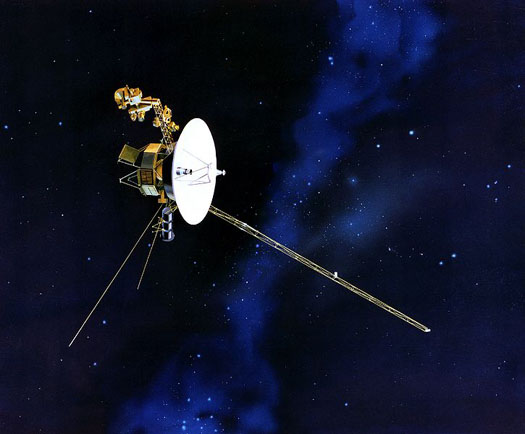
Voyager 1 and 2 are powered by radioisotope thermoelectric generators, and have enough juice to last at least another 5 years, said Arik Posner, Voyager program scientist with NASA’s heliophysics division.
After exploring the solar system in unprecedented detail in the first half of their lives, it appears their work is only just beginning.


Five amazing, clean technologies that will set us free, in this month's energy-focused issue. Also: how to build a better bomb detector, the robotic toys that are raising your children, a human catapult, the world's smallest arcade, and much more.


Online Content Director: Suzanne LaBarre | Email
Senior Editor: Paul Adams | Email
Associate Editor: Dan Nosowitz | Email
Assistant Editor: Colin Lecher | Email
Assistant Editor: Rose Pastore | Email
Contributing Writers:
Kelsey D. Atherton | Email
Francie Diep | Email
Shaunacy Ferro | Email
Does anybody else see the resemblance of the solar system to single cell like an amoeba? The heliosheath is like the permeable cell membrane.
I've made similar observations.
Galactic cannibalism for example… two galaxies merging… Or a star going super nova… creating new stars/planets/etc. A lot mirrors biological processes.
Food for thought.
Wow, this seems like a mind-boggling discovery. Looking forward to the explanations for this from everyone here as well as the scientific community (only slightly meant to be offensive ;).
I'm curious how long a more modern craft with more/better sensors would take to catch up to the Voyager space craft. Say a solar sail (not sure how effective this would be after the first couple years though), some propulsion (dont we have an ion drive of some sort now?).
Now with this new understanding of the heliosheath I would agree that it looks a lot like a cell. And then you couple that with the resemblance of our solar system to general atomic structure (nucleus = sun, electrons = planets, etc) and its a fun coicidence that the largest things we can imagine and the smallest things we can imagine resemble one another.
i thought this reminded me of a stem cell. incredible finding. voyagers have done a great job for humanity.
Does this "Froth" create drag on traveling objects like say the planets? Does it permeate the entire solar system? P34 BR3W3R
NASA needs to send a probe there with an ion drive and loaded with high tech instruments to measure the heliosheath.
Couldn't agree more, I've always teased with the idea that we are nothing more than residents of some cell structure of something much larger. It really is amazing that as we continue to expand our views both micro and macro, they both seem to continue to mirror each other. Which in essence makes perfect sense, if the model works why not simply scale it up? It would be amazing if we found out that we were simply an experiment in some petri dish in someone's lab. Makes me wonder about time itself.. How does a fruit fly perceive time with only a 24 hour life span? So much to learn, so little time. Greatly impressed with this NASA mission.
Playing Devil's Advocate since 1978
"The only constant in the universe is change"
-Heraclitus of Ephesus 535 BC - 475 BC
Wow, so in 4 years our first craft will break the membrane of our solar system? Wonder if such an event will be noticed.
i was thinking the same thing kartman, hoping some ET's are out there watching wating for something to be kicking out EM waves in an un-organic way, reminds me of the Star Trek first contact, passing vulcans see the warp signature stop by to say hey nice to meet you
Doesn't matter, soon enough the probe will smash into a giant wall painted to look like stars. After which we will discover we're living in a giant production studio for a reality TV show.
you guys might really enjoy this simpsons intro about worlds within worlds: http://www.ebaumsworld.com/video/watch/684825/
Nice "Truman Show" ref bigburb!
Playing Devil's Advocate since 1978
"The only constant in the universe is change"
-Heraclitus of Ephesus 535 BC - 475 BC
"Then look again and yet again, thy sight will return unto thee weakened and made dim. Holy Qur'an 67:4"
The above verse is from Holy Qur'an, it clearly told us that the vastness of the universe is unimaginable by humans.. Still scientists are opening their mouth when they look up.. is it? Then what to do within these short duration of 60-70 years of human life? That's what the reason people like us obeyed the will of our Creator, the one and only God. That is what Al Islam. So know your lord and obey his wills before the compulsory fact comes upon you.
This page is more suitable to post this comment because most people who visit this site understand the weakness of human's ability.(sorry for my poor English)
I am Highly interested in Voyager mission. Thank you.
this makes me think of men in black, when the hole universe in the cats colar, adn were all in sum locker in sum bigger world xD lol
but htats crazy adn eyah we could gert a prob out tehre i imagine quick as some dude jsut made a plasma thruster, accelerates to 123,000 mph :D (makes the trip to mars in about a month)
We're on the brink of so many jumps in technology its impossible to conceive what will come in our lifetimes. pardon me spelling
muhifth06/16/11 at 2:08 pm
"Then look again and yet again, thy sight will return unto thee weakened and made dim. Holy Qur'an 67:4"
The above verse is from Holy Qur'an, it clearly told us that the vastness of the universe is unimaginable by humans.. Still scientists are opening their mouth when they look up.. is it? Then what to do within these short duration of 60-70 years of human life? That's what the reason people like us obeyed the will of our Creator, the one and only God. That is what Al Islam. So know your lord and obey his wills before the compulsory fact comes upon you.
This page is more suitable to post this comment because most people who visit this site understand the weakness of human's ability.(sorry for my poor English)
Clear? Yep, that was about as clear as stainless steel alright.
So far, if there is a god, Ive seen a lot more fruit come from the labor of us "weak" humans than has ever come from "him".
Here's some food for thought, if the world and humans have only been around for around 5000 years like it says in genesis(which is much clearer than that piece of poetry), and we've gone from naked foragers, to exploring the outer edges of the solar system in such a short time, and god has existed since before time... wouldnt it make sense for him to be a little farther along? lol
Sometimes the ignorance of some of the comments on this site leave me in more awe than the articles themselves.