The Kepler telescope team announces a trove
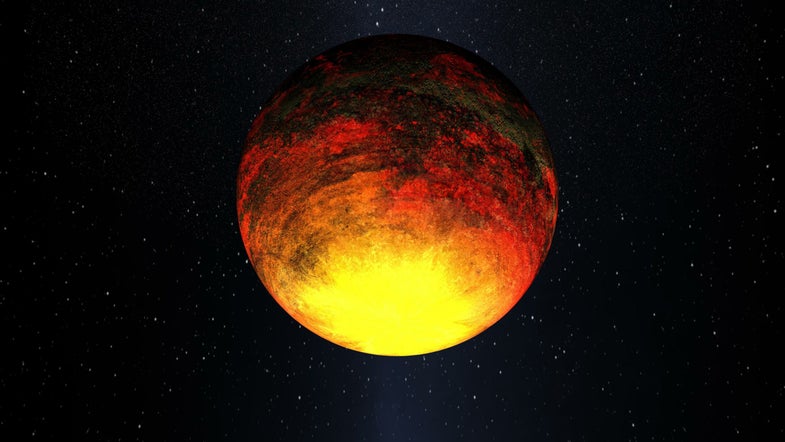
Kepler 10b Closeup NASA

Updated: Scores of Earth-like planets orbit sun-like stars scattered throughout the Milky Way, NASA scientists said today. This morning, the agency released data on more than 1,000 new exoplanets, and early indications are that 54 of them are at just the right distance from their stars to harbor life as we know it.

Today’s results more than double the exoplanet-candidate population, bringing the number of planet candidates identified by Kepler to 1,235. NASA needs to conduct follow-up observations to be sure their candidate planets are actually planets. So far, they are certain about 15 of them.

"The fact that we've found so many planet candidates in such a tiny fraction of the sky suggests there are countless planets orbiting sun-like stars in our galaxy," said William Borucki of NASA's Ames Research Center in Moffett Field, Calif., the father of Kepler and its principal investigator.

Small, Earth-like planets are apparently more common than gas giants like Jupiter, according to today's announcement. Sixty-eight of the new planet candidates are approximately
Earth-size, and another 288 are super-Earth-size; 662 are Neptune-size; 165 are the size of Jupiter and 19 are larger than Jupiter, NASA said.

NASA said today that 54 planet candidates are in their stars’ Goldilocks zones — not too hot, not too cold, not too far, not too old — which means they might have liquid water, and therefore a key ingredient for life. Of those 54, five are near the size of Earth. Pretty stunning news when you think about it: In one tiny slice of the sky, scientists have found five other planets that may very well resemble our own.

Since launching in 2009, Kepler has been staring at a bunch of stars in the constellations Cygnus and Lyra, looking for small blips in their brightness that would indicate a planet circling around them. Kepler astronomers released data on about 156,000 stars last summer, allowing competing scientists to check them out. The team saved some potentially promising star systems for further study, and those are among the data announced today.

Kepler team members have said they wanted to check and double-check the promising stars so they don’t have any false positives. Other physicists say they’ve been pretty good at this so far — the telescope has had an accuracy rate of at least 80 percent, according to a review by astrophysicists at Caltech. Taking a high-resolution picture of a possible exoplanet candidate can help with follow-up observations, they say. Scientists will want to check out NASA's new findings, and physicists would like some statistical models to help them sift through all that data.
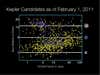
Kepler Candidate Planets:  NASA

Even before today's announcement, new planet discoveries have been trickling out in the past few months, including the recent news of Kepler’s smallest, rockiest find to date: Kepler 10b, just 1.4 times the size of Earth. That fiery world is much too close to its star to harbor water, and therefore unlikely to harbor life (at least the kind we understand).

In the new data, there are at least 170 exo-solar-systems harboring multiple planets, NASA said. Kepler-11, located 2,000 light years from Earth, includes six planets in a tight orbit around a yellow dwarf star. New research on Kepler-11 will be published in the Feb. 3 issue of Nature. Other findings are being published in Astrophysical Journal.

10 Comments

So when are we going to put together the antimatter powered starship andjet out there at just under the speed of light to check out the possibility of extraterestrial life?
HALO Nerd ;D

Now it is time to get antennas from SETI project pointing towards these 58 planets to be able to get their TV & Radio programs here. Can you imagine the number of TV channel we could get available now? What a wonderful world it would be to listen to ESBC live (Extra Solar Broadcasting Channel) :).

this is amazing... how? with the amount of stars out there, you might expect MORE exoplanets than we've found so far.

@ Patron
Yeah... Near the speed of light would create a huge time distorsion, making the ship useless for quick travels...

We'd be better off researching in the Alcubierre drive theory!

Patron - What would be the point? It would still take over 560+ years to get there at light speed (or send radio message there). Why even send robots? Still wouldn't learn anything new or outstanding in our lifetimes. All that travel and all we find is a planetary network of disconnected agrarian wood gatherer societies who think their world is the center of the universe like we once did. And what about the Christopher Columbus first contact mentality? Are we going to expose them to our corrupt greed-driven social morays? No I don't think humans are ready for first contact yet. We need a new system of things here on earth and a few more centuries to prepare. And when and if we get there we are probably going to be the teachers NOT the Hollywood version of ET aliens teaching us.

Loule - So we aim the SETI antennas so what? If an exoplanet alien is plowing his potato fields like the Earth inventor of Television (Philo Farnsworth) was doing in 1921 when he discovered the basis for his invention (TV), what makes you think the alien will think of the same method Philo used of raster scanning? Our TV signals are quite confusing as they used synchronization scenarios unlike standard radio. Now we are doing digital. The closest thing to a bona-fide SETI contact was WOW! signal in August of 1977 which originated from the Sagittarius system. It could have been an alien microwave oven or maybe a rudimentary alien beacon transmitter scanning their skies. But definitely not aimed at us.

@spookysr

Maybe the civilization on those planets are more advanced than we are? Maybe they have a few thousands of years of evolution more than we do. Or they just advanced farther in a shorter amount of time than we did. Or maybe they are in thier own version of the dinosaur age. Who knows.

The point is (people) that science has once again and continues to rock the foundation of our preconceptions (or rather misconceptions) of the truths we hold about nature, the environment (yes I'm referring to space in that regard and can do so), and the universe in general. The progressive things one generation does sets the foundation for something greater for future generations to build on.

So we can't make it to these worlds. Future generations will find a way for all humanity. So you may not be alive to see these worlds up close. Yesterday you had nothing; today you have enlightenment; for tomorrow you have hope.

The time is now to dream and aspire, then lead and take action.

Every journey, no matter how long begins with 1 single footstep.

If we don't try, why bother?

@Kherzhul, time is relative to the viewer. This "time distortion" you speak of which renders quick travel "useless" as you say is a manufacture of science fiction. If this were the case, then any object traveling at light speed would cause this distortion, yet, light travels at light speed all the time with no "time distortion". And yes.. light IS an object.

Someone traveling at the speed of light, if we were able to see them via some commlink, would appear as if they were "frozen in time" however, we would appear to be moving super quick to them.
Read up some more on Einstein's twins paradox and you might have a better understanding.

I would like to bring up an interesting point here. There is a vast array of stars and planet sytems of different ages, so it is reasonable to think that many planets with life exist at a vast different age of more or less advancement. Given that, it seems to me that either no one ever visits other planets, or one of the more advanced would have been here already. It seems least likely actually as for what most of us seem to believe, that we are just a planet that hasn't been found and hasn't yet found a nother (for this would imply that all civilizations are the same age) Or maybe just the impractical limitation of the distances between life supporting systems has us trapped in a mediocre time frame that will have us all traveling at about the same time? Not likely. Not in this Universe of vast difference. What if we were contacted before modern record keeping; history, they could have already been here and interbreed with us or died within that one generation and we would have nothing left of evidence but a stone carving of a spaceship... wait a minute...!

We're trying to find life on other planets....but if we're not careful, we're going to run into something we will regret.
38KKK
*D Ace Lee*
\m/(>.<)\m/


June 2013: American Energy Independence

Five amazing, clean technologies that will set us free, in this month's energy-focused issue. Also: how to build a better bomb detector, the robotic toys that are raising your children, a human catapult, the world's smallest arcade, and much more.


Online Content Director: Suzanne LaBarre | Email
Senior Editor: Paul Adams | Email
Associate Editor: Dan Nosowitz | Email
Assistant Editor: Colin Lecher | Email
Assistant Editor: Rose Pastore | Email

Contributing Writers:

Kelsey D. Atherton | Email
Francie Diep | Email
Shaunacy Ferro | Email

circ-top-header.gif
circ-cover.gif
bmxmag-ps