
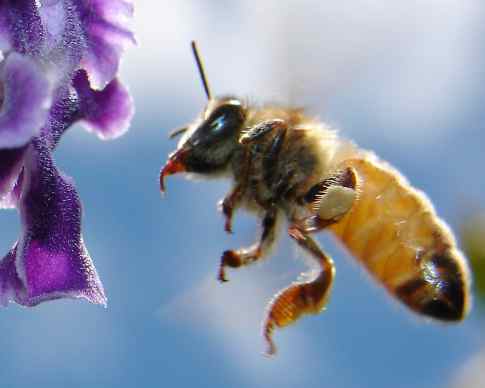
Over the last four years, 20 to 40 percent of the honeybee colonies in the U.S. have mysteriously collapsed. The killer has remained unknown--until now. A team of entomologists, along with military scientists from the Department of Homeland Security, have a new prime suspect (or rather, suspects), as shown in a new report on the science website PLoS One. A tag-team of a virus and a fungus show every sign of being the culprit. Now it's just a matter of eradicating that dastardly partnership.
Entomologists from the University of Montana have teamed up with military scientists from the Department of Homeland Security--an unexpected liaison, for sure--began following the clues of the mass deaths of the honeybees. The honeybee die-off is peculiar, and the circumstances of the illness that collapses colonies makes it particularly difficult to analyze. Before the bees die, they fly away from the hive in all directions, which hampers efforts to collect large numbers of bees for analysis.
But the military proved to have the tools the academics did not, a protein research software that is designed to test and identify biological agents in the field. (The New York Times elaborates on the somewhat grotesque way the bees are analyzed--they must be turned into a paste, and it turns out that coffee grinders are the best tool for that unsavory task.)
The culprit seems to be an unholy combination of a fungus and a virus--to be precise, Nosema ceranae and an invertebrate iridescent virus. The fungus, N. ceranae, had already been identified, but the particular virus had not been connected. It turns out that the virus and fungus working in concert is just about 100% fatal, whereas either alone is not necessarily so.
Of course, just identifying the culprit is only the first step. The entomologists still have to find a way to stop the tag-team attack. It looks as though they'll focus on the fungus, which is easier to block and defeat than the virus, and which, if defeated, should be enough assistance to help get honeybee populations back on track. And there's always more to uncover--the tendency of the bees to wander off just prior to death is still a mystery (a University of Montana doctor actually uses the phrase "insect insanity" as a possible explanation), but that should all come in time.
[PLoS One via New York Times]

Five amazing, clean technologies that will set us free, in this month's energy-focused issue. Also: how to build a better bomb detector, the robotic toys that are raising your children, a human catapult, the world's smallest arcade, and much more.


Online Content Director: Suzanne LaBarre | Email
Senior Editor: Paul Adams | Email
Associate Editor: Dan Nosowitz | Email
Assistant Editor: Colin Lecher | Email
Assistant Editor: Rose Pastore | Email
Contributing Writers:
Rebecca Boyle | Email
Kelsey D. Atherton | Email
Francie Diep | Email
Shaunacy Ferro | Email
Yeah, write the Bees a prescription for some Tough Actin' Tinactin...
To bees: Apply liberally after shower on all affected areas.
Wasn't there a French study that some simple solution like soap or something like that seems to protect hives?
Here is a solution: add 'anti-fungi' or 'vaccine' to some type of flower and spread these flowers around the country. Once bees come in contact with the flower the medication gets transferred to the bee and the whole colony..
*David Tennant Voice* THE BEES DISAPPEARING!!!!!!!1
Wow, I'm glad we have found a natural cause is behind all this. Now at least here is one thing we can quit blaming on manmade global warming. Of course, someone out there will still say it's somehow exasterbated by mankind. Maybe the fungus is developing because of over incesticide use. Or maybe the government is behind is all and just trying to cover up the fact that they developed this "virus" in the first place. Either way I'm sure our own misanthropic nature will take over and we will find a way to blame ourselves and further our own self hatred.
Uhm I think it'd be a lot smarter to let natural selection work its magic, rather than going in and eradicating a fungus. While the choking effect may apply if too many hives are killed, letting the bees adjust is a much safer solution.
YOU MUST NOT MISS IT!!!
http://www.newgoing.com
Our company specializes in manufacturing from located in CHINA and Netherlands,With more than 6 Years of experience,we are mainly dealing with are:Nike shox,Christan Audigier t-sh irt,Ed Hardy,COACH Bag,New Era cap ,Tiffany_Ring. More products.
Supply . COACH Bag,Nike shox.Ed Hardy t- sh irt.
Safe Payment.Paypal
Fast Shipment.5-7 days you can receive your order product.
No min order request.You can order only one product
Free Shipping.The price on our website are including
everything.
http://www.newgoing.com
newgoing,Inc. We are the best online dealer,about all kinds of jordan.run retailing and wholesale trade wordwidely for years. Free Shipping And Customs,Super Sale Off Retailing,With 1Week Delivery to your door.
http://www.newgoing.com
a leading worldwide w holesaler company (or ucan say organization). We supply more than 100 thousand high-quality merchandise and famous brand name products all at wholesale prices.
http://www.newgoing.com
fda
YOU MUST NOT MISS IT!!!
http://www.newgoing.com
Our company specializes in manufacturing from located in CHINA and Netherlands,With more than 6 Years of experience,we are mainly dealing with are:Nike shox,Christan Audigier t-sh irt,Ed Hardy,COACH Bag,New Era cap ,Tiffany_Ring. More products.
Supply . COACH Bag,Nike shox.Ed Hardy t- sh irt.
Safe Payment.Paypal
Fast Shipment.5-7 days you can receive your order product.
No min order request.You can order only one product
Free Shipping.The price on our website are including
everything.
http://www.newgoing.com
newgoing,Inc. We are the best online dealer,about all kinds of jordan.run retailing and wholesale trade wordwidely for years. Free Shipping And Customs,Super Sale Off Retailing,With 1Week Delivery to your door.
http://www.newgoing.com
a leading worldwide w holesaler company (or ucan say organization). We supply more than 100 thousand high-quality merchandise and famous brand name products all at wholesale prices.
http://www.newgoing.com
fda
@ Petudy
The fatality rate is close to 100%...by the time any bees resistant to the disease survive long enough to reproduce in a large enough number, billions and billions of dollars worth of crops will be lost and we'd all be eating grass for breakfast to survive.
Sure, they can recover naturally...but the timeline is too long for the rest of us to endure. Think about it...millions of people will starve if the cost of crops skyrockets (which it will if enough bees die off, preventing pollination of vital crops)...
Only the rich will be able to eat and those without hefty wallets will have to literally eat dirt and grass to try to survive. That, or become cannibals...
@ Petudy,
Thanks for being the thinking kind of human.
Your point is valid but so is repenri's, at least his first couple of sentences. We (the beekeeping community) faced something similar with the introduction of Varoa (mites). They decimated colonies and left many scrambling for a cure or way of eradicating the mites. As time went on and no 100%reliable cure was found (only knock downs), beekeepers started looking to breeders who had refused to treat their hives and allowed only the bees with resistance to survive.
Although the final chapter on Varoa has not been written, what has been done seems to be the best we can hope for with CCD. A fungicide to knock down the fungus and give the bees, their beekeepers, the plants that need polination, etc... a fighting chance. and a few breeders who refuse to treat and allow natural selection to choose bees with a natural immunity.
Thanks,
Andrimitum
I may have been a lot closer than people have thought with my theory. I explained to a prominent beeologist that the removal of phytic acid from our plants by genetic manipulation may not be a good thing. Phytic acid is known to remove iron from aflatoxin and disallow its use by the fungus. WHEN we REMOVE phytic acid from our plants DOES? this NOW allow the aflatoxin to 'take off' ? I asked the beeologist whether the removal of the phytic acid NOW would make the bees MORE susceptible to OTHER pathogens ? He hadn't heard about the theory and we left it at that. I wonder ..
I am surprised by the wonderment at colony dispersal before death. Many colonal species have behaviors that either drive, remove, or voluntarly disperse sick member to avoid contamination of the central population.
Likely, the fungus is sufficient to click the bee desire to leave beofre further contamination happens.
The problem here is that their are two pathogens. Controling the fungus will not remove the virus, which can sustain in the population with its decreased virility, until the fungus adapts to the fungicide.
A fungicide in combination with a spray on anti-virus would extend the lifespan of any fungicidal fix. Eventually, however, a resistant strain of bee will have to be developed.
@ Petudy, rpenri and andrimitum:
If the virus is being carried by the fungus, killing its mode of transport is a quick and easy way of curing the disease (until the virus mutates and starts all over).
But, by that time, the bee population should be full again, and crops are saved and honey production continues so the price of honey will drop and I can enjoy it on my PB&H sammich.
Let nature takes its course. It has done so for billions of years, and will probably results in a race of bees much more resistant to this virus/fungus. If we interfere we will have to perpetually fight a fight already being fought by the bees.
The "no-treat" option of natural selection might be made to work a heck of a lot faster. The breeders could start by breeding for resistance to each cause independently, then cross breed the resulting strains of bee. Thereafter bread for the combination. While the article doesn't specify, the fatality rate for either pathogen alone is certainly lower than the combined 100%. That method should show results in much less time.
Of course that should be "breed" not "bread" for the combination...8)
@edisonkenevil You might feel better by not fixating so much on whatever the kooks say.
I'm happy to see comments regarding how we humans should be careful about how we reduce or eliminate the disease. But it strikes me that honey bees (apparently?) didn't even exist in the New World before they were imported by humans, hundreds of years ago. Ie, whatever we do should be considered in the context of customizing a desired, invasive species.
Btw, I haven't yet read what kind of affect the fungus by itself may or may not have on the colony, or on the honey. Does anyone know for sure if the effect is purely negative?
Also, maybe we're looking at more than one step in this process. First step might be to eliminate the fungus in colonies as best we can--assuming we comfortably know all of the potential consequences, including consequences in the rest of the environment, with the second step being to swap out current bees with bees bred with genetic resistance.
Finally, speaking of customizing this invasive species, perhaps breeders and beekeepers could take this opportunity to breed in an anti-africanization component. (I have no idea how possible that is.) I also wonder if it's possible to customize its genome in a way that makes it impossible to cross-breed with other (eg africanized) bees? Another advantage of making a bee that's non-cross-breedable is that it could be more easily watched and controlled, once it's out there in the environment. Should this bee not be considered a "custom" species unnaturally existing in its environment, anyway? It would have its own disadvantages as a mono-culture (eg much less naturally adaptable to newly encountered/evolved environmental pressures), but it could be scientifically very interesting as a sub-population.
For all those on the natural selection band wagon, I'm right there with ya. "Mother Nature" is a beast all her own. However, it is natural selection that has allowed humans to evolve in a way that allows us to control our environment, and that of other species, in a way no other is capable of. This gives us a distinct advantage when it comes to procuring our own survival. Therefore, in a sense, it is natural selection that has made it possible for us to alter natural selection. Either way, sadly, weather we choose to intervene or not, there is currently no way for us to know which will have the greater outcome for humanity until the future becomes our present. Good luck to all.
Simply Simple...
China's bees suffered from a similar bee epidemicm, they chose natural selection and they now have no bees!
Quoted from the end of the story...
"the tendency of the bees to wander off just prior to death is still a mystery"
It's called preservation of the hive... When a bee believes that it is going to die it leaves so as not to make the rest of the hive sick and die as well... many species do that.
I personally believe that the cause of colony collapse is an pesticide, one that contains a similar substance to nicotine. I believe that this pesticide does not "kill" the bees but I believe that it triggers the bees to feel ill and leave the hive. They then go away from the hive and find a good place to die (where they stop eating and drinking, and will often die of exposure overnight) The group of pesticides that I am talking about has been banned in Europe, I believe that it warrants a closer look.
The bees flying away could be a defense mechanism. When the bees realize they are sick, they may fly away from the colony to prevent the disease from destroying the whole colony, especially the queen. When a worker ant notices a fungal infection in another, that worker carries the infected ant away from the colony.
Possibly the fungi doesn't live in all parts of the world and if Wood used for new hives were produced and packaged, (air tight), the spread could be reduced.
Since a field test, (like with Aphlatoxin), could be developed hive producers could be inspected for infestations before shipments.
As for kamydon's aproach.. a sistemic fungicide might have some marit!
Beekeeping is expensive to start into unless you do it like they did in the Foxfire book series written in the 70's.(put a top and bottom on a section of hollow stump).. You hippie tree huggers should like that. To safely,(bee suits and EppiPens), and efficiently, (basic econo-equipment), get started with just 3 hives is costing me about $750. So, if the costs, (1 of 3 hives die out), out weight the gains why should I or others bother raising bees for fun or profit.
Should naturalists stop suporting intervention and bees disappear due to lack of cultivation, they should bee happy knowing an invasive species the,"Whiteman's Fly", brought by colonists in the 1620's) has been eliminated. But the taste of victory might be.. bittersweet since it will help keep our struggling economy down with higher food costs.
Another consideration for naturalist friends out there that want to keep bees naturally might be to fore go the EppiPens.. it might desturb natural selection..
"Another consideration for naturalist friends out there that want to keep bees naturally might be to fore go the EppiPens.. it might desturb natural selection.."
all the naturalists just got WTF PWNED. or will tehy change there mind and say we should do it for people, because there people and not for bees because there different? and and agreed due to natural selection, we now have the ability to interfere with it, but instead of trying to wipe it all out, take a healthy bunch of bees (a large bunch) away for safe keeping adn repopulating incase thigns go south, and then see if natural selection wins out adn the bees prevail? if not, repopulate using stored bees and remove fungus...
We're on the brink of so many jumps in technology its impossible to conceive what will come in our lifetime.