
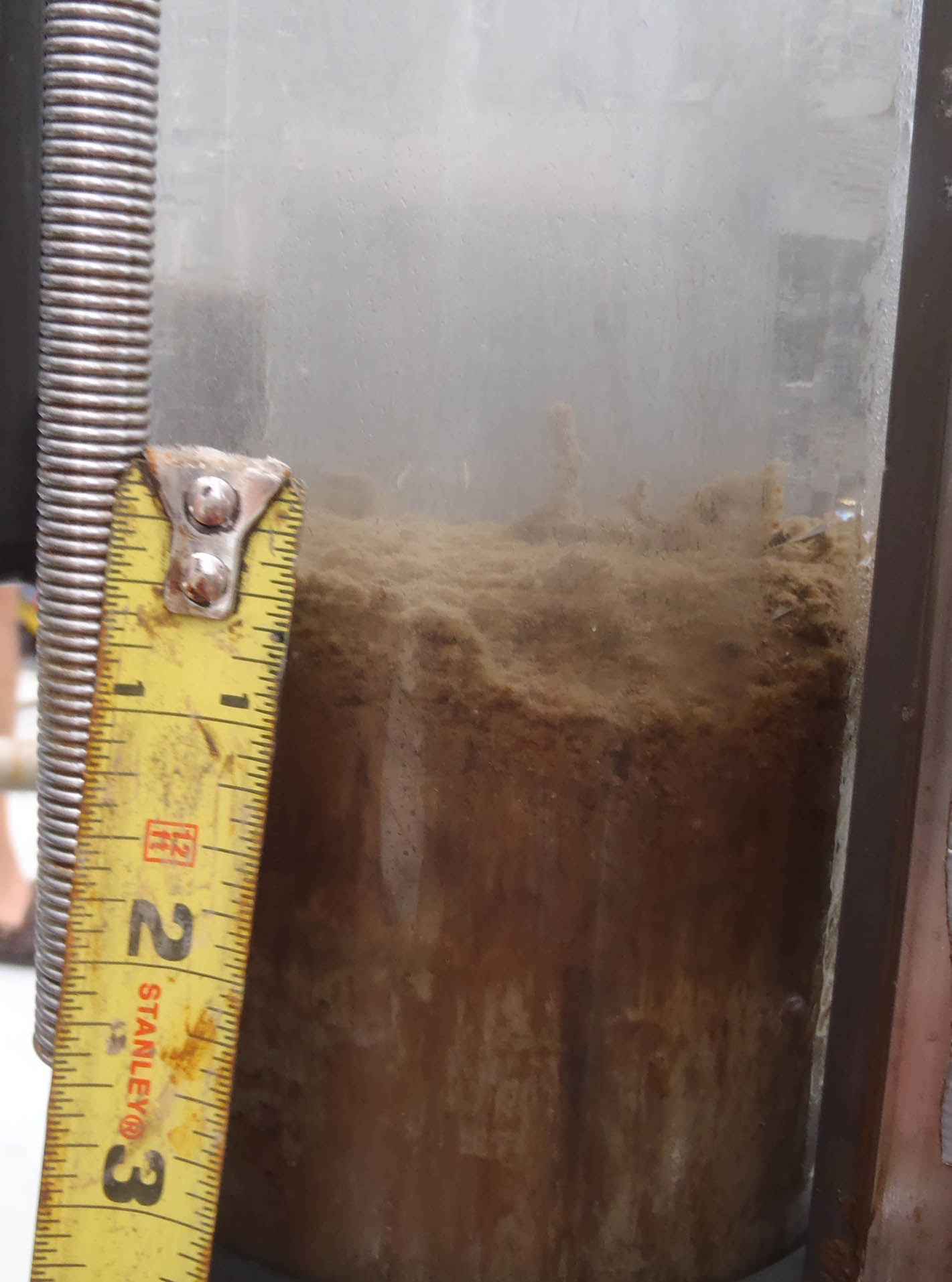
Oil at the Bottom A layer of oil on a sediment core, taken from a site northeast of the blown BP wellhead. Samantha Joye

Researchers on board a ship in the Gulf of Mexico have found a layer of oil at least two inches thick, nestled in the depths a mile below the surface, that they believe came from the blown-out BP well.

Samantha Joye, a professor in the Department of Marine Sciences at the University of Georgia, set sail August 21 on the research vessel Oceanus and has been posting blog updates throughout the mission. Over the weekend, she wrote that her team found a layer of oil in a valley on the seafloor, about 18 miles from the wellhead. It is two inches thick in some spots, and it rests on top of recently dead sea creatures like shrimp and tubeworms.

Joye expected to find some oil on the seafloor, she told the AP — just not that much. Her team is the second in as many months to announce finding oil at the bottom; last month, a University of South Florida crew reported finding oil droplets 1.4 miles beneath the surface.

The presence of seafloor oil is another blow to the theory that most of the spilled oil disappeared. Scientists previously said plenty of oil was floating in an invisible plume, and while yet another research team said microbes were eating it, not all of it could be accounted for. Several experts, including some government scientists, believe at least some of the oil sank to the bottom, and that’s what Joye’s research seems to prove.

Although she can’t be certain until they conduct further tests this week, the oil almost certainly came from the spill and not a natural seep, Joye said. It clearly came from above the seafloor, not below, she says in her blog post.

The oil layer is pretty dispersed, indicating that chemical dispersants broke it down into small droplets. In an interview with NPR, she also reported finding small tar balls that look like cauliflower heads. While dispersants likely helped some of the oil sink to the bottom, Joye said natural processes also played a role. As microorganisms break down oil, they excrete mucus, which eventually sinks to the bottom.

Government scientists acknowledge they have not done a good enough job looking for oil at the bottom of the sea. It’s partly because the environment is so difficult — teams have to use send 1,000-pound vessels to the seafloor where they can pull up core samples. The AP quoted a NOAA official saying government and BP vessels will plumb the depths in the coming weeks.

[AP]

6 Comments

BP are a bunch of crooks

A two inch "drift" in a sea floor ditch is not a miles wide, all covering, spread of death. Sure, some local marine death, but nothing compaired to the annual dead zones due to fertilizer run off (and the O2 killing algae blooms that follow).

This is what is supposed to happen as nature cleans up her own mess (it is nature's oil - we just popped the zit).

@Oakspar77777 HA! Popped a zit? What kind of zit has millions of gallons of life threatening fluid spewing from it for days on end? Nature would not have drilled a hole in the ocean floor. Nature didn't make the mess it was clearly the fault of people. You may think it's not a big deal, but these billion dollar corporations are excused for destroying lives on land and in the sea because justice is for sale.

Comparing one type of man made destruction does not excuse another. The fertilizer run off is just as inexcusable as the BP debacle.

@aware_one Right On!

Yeah...the oil didn't magically disappear like Popsci had reported...the bacteria didn't eat most of it after all...the hurricane didn't spread it out either...

i hate BP but i love Mother Nature.

I tend to like Oakspar's comments. So I feel I need to defend his position as I share it, yours too. Most of your positions are not mutually exclusive. Yes it's bad, just like agricultural and industrial run off. However, these don't naturally occur in the Earth. People keep lumping this into one large Earth-ending catastrophe. Did BP screw up big time and carry out unsafe and possibly illegal actions? Yes. The gulf isn't some pool someone over chlorinated, it's huge and connected to an even large ocean. This is locally bad, but not as 2012 scary and people wish it was.

/ramble_off


June 2013: American Energy Independence

Five amazing, clean technologies that will set us free, in this month's energy-focused issue. Also: how to build a better bomb detector, the robotic toys that are raising your children, a human catapult, the world's smallest arcade, and much more.


Online Content Director: Suzanne LaBarre | Email
Senior Editor: Paul Adams | Email
Associate Editor: Dan Nosowitz | Email
Assistant Editor: Colin Lecher | Email
Assistant Editor: Rose Pastore | Email

Contributing Writers:
Rebecca Boyle | Email
Kelsey D. Atherton | Email
Francie Diep | Email
Shaunacy Ferro | Email

circ-top-header.gif
circ-cover.gif