Mademoicell Chelsea Briganti

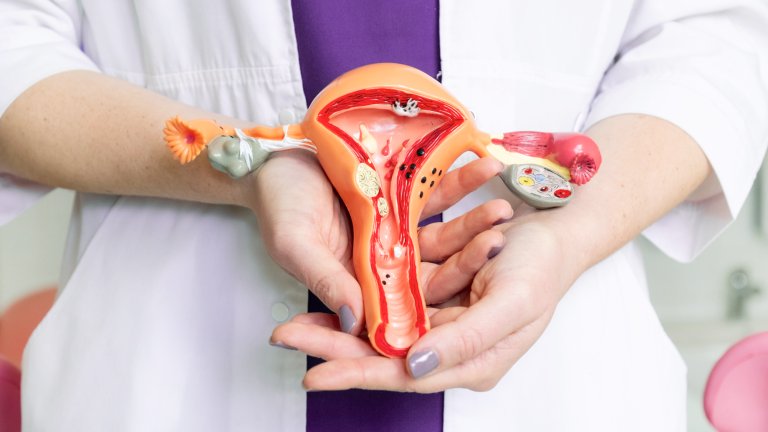
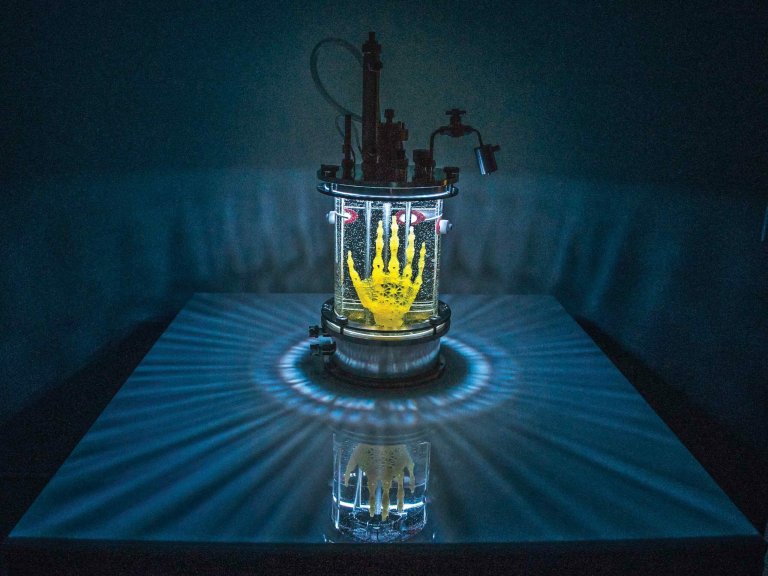
Women who bemoan their once-a-month curse may soon have reason to appreciate it: Chelsea Briganti, a senior at the Parsons New School for Design, has developed a tampon-like kit made from silicone that collects and stores adult stem cells from the wearer's menstrual blood. Curing diseases, growing organs, and thus saving the world between regular dosages of Midol? Genius!


Regardless of the "ick factor," we wonder why no one has thought of this before, as scientists are quite aware that the stem cells found in menstrual blood are more powerful than the ones found in one bone marrow. Menstrual stem cells contain embryonic stem cell markers, and can differentiate into nine different types of cell.

Briganti's invention, called Mademoicell, is priced at $75 and comes in sets of three. Usage is straightforward enough: insert, wait, remove, mark "NOT FOR CONSUMPTION," and store it in a refrigerator before mailing it to a lab.

Although Mademoicell is more of a concept than a a consumer product at this point, we imagine the controversy it would stir if it ever hits the market. Although collecting stem cells found in menstrual blood poses less of an ethical dilemma than harvesting human embryos does, it may be awhile before consumers overcome the stigma of monthly periods. Come on, people, do it for science.

[Fast Company]

13 Comments

There's actually a similar product on the market right now. It's called the Moon Cup, but doesn't collect the stem cells, just offers a medical grade silicone in place of tampons/pads.

@KH Hang on. You mean you guys get paid to donate blood?

@cjeam no no... I think he is confusing with another bodily fluid

Silicone tampons to harvest monthly menstrual stem cells are hardly a novel invention and it is completely erroneous for this concept to be represented as such.

In November 2007, a globally renowned, industry-leading stem cell preservation company called Cryo-Cell International, Inc. with over 200,000 umbilical cord blood stem cells clients worldwide, discovered and introduced menstrual stem cell technology that empowers women to collect and cryopreserve stem cells harvested from their own menstrual fluid.

The service is called C'elle and can be easily purchased on the C'elle website. Cryo-Cell collaborates with leading stem cell researchers worldwide in pre-clinical studies using C'elle stem cells and the Company has several well-respected, peer-reviewed scientific publications demonstrating the characteristics and potential of these highly prolific and novel menstrual stem cells for future treatment of disorders such as stroke; heart disease; breast cancer; and diabetes to name a few.

Cryo-Cell's C'elle technology portfolio is expansive and patent-pending. The C'elle service has been available for nearly three years.

The editors of Popular Science, Fast Company and the Parsons New School for Design should have done their basic homework and due-diligence prior to showcasing this as Chelsea Brigante's "genius idea".

Hi Sistuh Moon,

I'm assuming you are a Cryo-Cell employee and I am fully aware of your C'elle product as I have researched, used and tested its faulty contents with numerous living subjects.

Mademoicell was designed in partnership with a stem cell scientist from Columbia and a gynecologist and it differs from C'elle in 4 fundamental ways:

1. DEVICE: C'elle employs the use of a standard menstrual cup that is difficult to insert and extract. My proprietary, patent-pending design combines the ease of use of a tampon with the collection capacity of a menstrual cup, enabling the user a convenient and simple way to collect the cells.

2. COST: C'elle, as you failed to mention, is an extremely expensive kit [about 600.00] and that's not including annual storage of the cells. Mademoicell retails for around $75, therefore providing an accessible alternative and a truly mass-marketable product.

3. BANKING OPTIONS: C'elle is a private service, which means that the cells are used by the donor and possibly the immediate family ONLY. Mademoicell offers private and public storage options. There are 78 million women menstruating in the U.S, that's a lot of stem cells. Public stem cell banking is paramount if we are to truly benefit from the potential of menstrual stem cells. You cannot treat your own genetic illness with your own cells because they contain that genetic information, however with public banking it is possible to treat these diseases with a matching donor. [India opened a public menstrual bank in 2007]

4. ICK FACTOR: With Mademoicell, the collection device IS the shipping device. Women insert the tampon-like device, extract and place directly into the packaging for shipping. With C'elle, women insert an uncomfortable, difficult device, extract it, pour out its contents into test tubes, wash it off, re-insert and then repeat. From my extensive research and user testing, I found that women didn't want this experience at all. Simple, convenient and hassle-free is more like it. Mademoicell synthesizes the entire process with the power of design.

And lastly, every design has a design precedent. However, it's not THAT it's been done, it's HOW it's been done.

C'elle is not a successful product because of the reasons aforementioned.

Mademoicell is a truly a product that women will want to use. period.

OK, I can't stand it.

1. This is NOT new as evidenced by the above comments. It is an enhancement -- possibly quite significant, but an enhancement nonetheless.

2. The ick factor -- give me a break. This is a concept that could provide an important source of stem cells, which may provide immense benefit to medical science. Only a moron would have a problem wih the concept. I can see that the process has to be comfortable for all concerned, but that's true for many medical procucts, e.g. home pregnancy tests.

"Mademoicell is a truly a product that women will want to use. period."

haha, that made my night! thank you for what sounds like a great product and for the bit of levity in this discussion.

I agree that it's a bit of a stretch to say that "student invents" silicone tampons... menstrual cups have been around for ever, and this just looks like a somewhat impractical variation.
1.How is it not going to leak?
It looks like it has a very small capacity, it doesn't look like it can create a seal, if it's for women who find their own bodies "icky" how will they ever know to properly insert it so it's not above or covering their cervix? I feel like it would either be extremely uncomfortable (if the cup is very rigid) or extremely leaky (if it's soft) since it doesn't seem to be designed to create a seal, and as the vaginal walls press it together, it just looks like a mess waiting to happen. The real question here is, why try to reinvent the wheel? Cups have been used and improved over decades, why start from scratch? At least look into how and why the cups that exist work and why your product probably won't.

2. $75 is a lot for something that's one-use only. I know you get three cups in that price but still... for less than that you can get a regular menstrual cup that will last over a year. $25/ month seems pretty steep.

3. What is up with promoting that menstruation is "icky"? it's 2010, we're talking about getting stem cells from menstrual blood, get over yourselves. If you use a cup properly, it won't get messes all over you, it's easy to insert and retrieve once you learn how to do it, it helps you get to know your body, it's reusable (rather than throwing away $25 in high grade silicone every month, or on tampons or pads). Why not just "invent" a test tubes with a wide, funnel-like rim so you can pour your "sample" in there easily, and mail it out, and keep on reusing your cup (glass test- tubes are much cheaper than silicone). How are we promoting single-use, wasteful products and shaming of women's bodies, as innovative and creative, in this day and age?

For those unfamiliar with menstrual cups- here are some links to photos:
http://menstrualcups.wordpress.com/2008/07/10/cup-images/

http://menstrualcups.wordpress.com/2009/07/20/meluna-pictures/

Hi Her_Instrument,

I would be happy to speak with you further about the
rigorous user testing, research and form development that
I underwent during the process of designing and engineering Mademoicell. Mademoicell was designed in partnership with a gynecologist and stem cell scientist. Thank you and I look forward to hearing from you soon.

ChelseaBrigantidesign@gmail.com

What simply astounds me is that the raging political crucifixion of any stem cell research continues. We already know we can harvest stem cells from all kinds of places now, yet we're not getting the funding, research, or national attention.

If someone were to just go on national TV and TELL the American people that stem cells don't HAVE to come from embryo's anymore, we'd have a whole new realm of medical science.

And we're talking about who invented it first, and the "Ick" factor when we should be organizing a massive national roll out. This program could effectively end diabetes, liver disease, brain trauma, and a myriad of other medical problems.

Can we focus please?

I have been searching everywhere for how - and, more specifically, *where* - to donate my menstrual blood for scientific research or a public bank. However, all I've been able to find is "please donate," not "donate here," or information on donation for private use. Who do I contact to donate?

Not sure if anyone will still read up on this article, nevertheless, after 4 years of designing and developing a female hygiene product, I'm awaiting my patent certificate in March this year. This particular product may be applied with four different functionalities. With the hope that the Institute for Innovation and Innovators will fund the manufacturing of the first two functionalities, I hope to commercialize in the near future. The design is unique in the sense that an option is offered to use a product where the absolute minimal contact with menstrual blood is offered to the option of re-usable usage for up to 5 years, possibly longer, depending on the type of materials used. After these have been accepted by public, the other two functionalities may be introduced, i.e. one for harvesting of menstrual blood with the view to assist researchers with the extraction of stem cells from menstrual blood. The other, a medical diagnostic tool for use by medical practitioners concerning female health. Regarding one of the comments above on why re-invent the wheel ? Well, we can always do better, and we should. My invention offers a solution to a multitude of concerns. If you are interested to learn more you are welcome to write me at lourentz1511@gmail.com


June 2013: American Energy Independence

Five amazing, clean technologies that will set us free, in this month's energy-focused issue. Also: how to build a better bomb detector, the robotic toys that are raising your children, a human catapult, the world's smallest arcade, and much more.


Online Content Director: Suzanne LaBarre | Email
Senior Editor: Paul Adams | Email
Associate Editor: Dan Nosowitz | Email
Assistant Editor: Colin Lecher | Email
Assistant Editor: Rose Pastore | Email

Contributing Writers:

Kelsey D. Atherton | Email
Francie Diep | Email
Shaunacy Ferro | Email

circ-top-header.gif
circ-cover.gif