
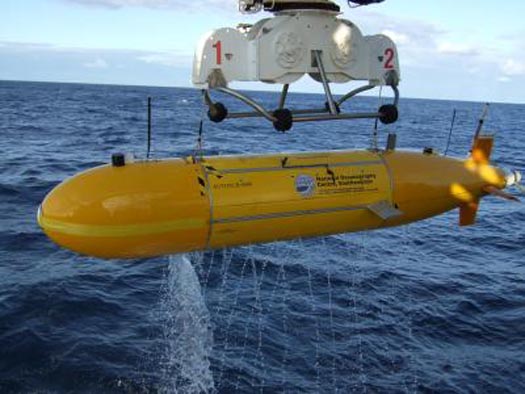
While some scientists resort to undersea drilling to find undiscovered forms of life, a new group of researchers has decided that piloting a robotic submarine into a submerged volcano was the way to go. By exploring the deepest, hottest, undersea volcano ever probed, the researchers hope to find clues to both the beginnings of life on Earth, and the possible forms of life on other planets.
The volcano, an undersea vent called a "black smoker" that reportedly emits steam hot enough to melt lead, is located near the Cayman Islands, in the Caribbean. The current record for deepest and hottest volcano dive stands at 2.67 miles, into a black smoker belching out toxic steam at 757.4 degrees F. By contrast, this new submarine, called the Autosub6000, can dive to 3.73 miles beneath the waves.
Scientists believe that the earliest life began in black smokers, with the heat from the volcanoes providing energy to an ecosystem blocked from sunlight by miles of murky deep. Similarly, the many think the best location for discovering extraterrestrial life are the undersea vents on Jupiter's frozen moon Europa. Quick word of warning though: when looking for black smoke life in tropical locales, don't mess with the Others. That tends to end poorly for scientists.

140 years of Popular Science at your fingertips.
Each issue has been completely reimagined for your iPad. See our amazing new vision for magazines that goes far beyond the printed page
Stay up to date on the latest news of the future of science and technology from your iPhone or Android phone with full articles, images and offline viewing
Featuring every article from the magazine and website, plus links from around the Web. Also see our PopSci DIY feed
Engineers are racing to build robots that can take the place of rescuers. That story, plus a city that storms can't break and how having fun could lead to breakthrough science.
Also! A leech detective, the solution to America's train-crash problems, the world's fastest baby carriage, and more.


Online Content Director: Suzanne LaBarre | Email
Senior Editor: Paul Adams | Email
Associate Editor: Dan Nosowitz | Email
Contributing Writers:
Clay Dillow | Email
Rebecca Boyle | Email
Colin Lecher | Email
Emily Elert | Email
Intern:
Shaunacy Ferro | Email
Wow. so that is almost 20,000 feet... deepest part of ocean is 36,000 feet roughly. We have a long way to go!
What is the reference on the last 2 sentances?
@Zengrath: We have devices that have gone to that depth, Challengers Deep has been visted 3 times since the 60's
Didn't they already discover there is life under the Artic in a volcanic vent?
@caradoc01: they are referencing the TV show "Lost" if you were wondering.
I am impressed that the sub can survive those kind of temperatures. Perhaps it does not go into the hottest parts of the volcano.
we have already piloted a sub to the deepest part of the ocean www.bathyscaphetrieste.com/ most people don't know about this very cool