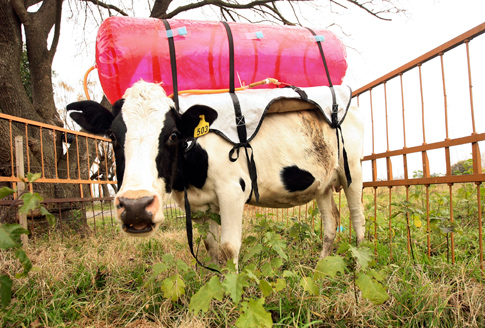
In a lush pasture near Buenos Aires, this cow and its compatriots are digesting important information: how much methane—a greenhouse gas 20 times as potent as carbon dioxide—is released by the country’s 55 million bovines. Researchers from Argentina's National Institute of Agricultural Technology connected inflatable tanks to the cows’ first stomach, where methane is made, through a small hole between their ribs. By measuring methane production directly inside each cow, biologist Silvia Valtorta hopes to more accurately determine the country’s overall agricultural contribution to global warming. According to the data, an average cow releases more than 70 gallons of the stuff every day. But a change in diet could reduce that. Cows that eat mostly grain produce 20 to 25 percent less methane than grazing cows, and adding tannin—a bitter chemical found in wine—to the feed could lower it further.
Stay up to date on the latest news of the future of science and technology from your iPhone with full articles, images and offline viewing
Featuring every article from the magazine and website, plus links from around the Web. Also see our PopSci DIY feed
Share links with friends, comment on stories and more
In our December issue, Popular Science names the 100 best innovations of the year: bombproof wallpaper, self-parking cars, the fastest helicopter, and 97 more. Plus inventor profiles and videos.
Check out the best of what's new here.
70 gallons of methane per cow, per day? And they want to reduce this? Are you kidding? Put inflatable methane collection bags on all the cows in, say, Wisconsin, and you will have a huge amount of methane that can be used to generate a vast amount of power.
If we are to replicate the cows ability to turn grass/grain into methane with some kind of device, would it create more energy or be more efficient then current ethanol facilities? use up less land, create more energy? I'm sure it's too difficult to obtain methane from living breathing cows to be worth it.
Interesting. Rather than collect it from cows, how hard would it be to identify the bacteria and enzymes involved in turning plant matter into methane, then create a digester that replicates the process? Is it feasible? Would it be more efficient than existing processes we use to manufacture or capture methane?
it'd be really funny if the cow floated away
Lets say you're a farmer who's growing cows anyway for milk, hamburger helper, steak, etc. If you can set this up I bet you could collect enough methane to generate all the electricity for the barns and run all the farm equipment. Or at least you could get pretty close, I'm sure. But I'd probably be a dumb idea to smoke around them. And you should probably hope they don't get hit by lightning, either.
Raising cattle is a lot of work already, let alone chasing them around to empty methane bags on their backs. You might as well put them on a treadmill to turn a generator for all the work it would take. Most farmers probably couldn't afford it anyway, especially in the third world. If you want heat then just burn their dried cow patties.
id hate to be the grunt that had to empty that bag.
Let's see, that's 70 gallons, which is a bit under 10 cubic feet of methane. The cost of natural gas ready to be put into the interstate pipeline system has been about $4-$8 per thousand cubic feet, depending upon the time of year. That makes about 4-8 cents worth of methane per cow per day.
You must have been thinking of an awful lot of cows for that to be a vast amount of energy. Even Wisconsin doesn't have that many.
I have seen places that use farm grop animal waste ponds as a methane producer (primarly for barn or greenhouse heating).
It is not hard to imagine a prototype dairy farm built to maximium bio efficency. The cows would be hooked to the milkers in front of a food bin (as usual in industrial dairy farms). Feed would be picked for maximium methane production which would flow from the spicket surgically placed in Bessie's side (with a connecting hose). You are now feeding the cow and milking it twice (milk and methane). Now, add a slow treadmill underneath, and Bessie can stay in her stall for months at a time (rather than have to be let out for a walk every few days like we do now). The treadmill can even be used to generate more electricity. Have waste compost in a covered pond for more methane fun, then dump the finished waste back on the feed grain field for fertilizer.
Wonderfully efficient, wonderfully green, and stupidly exspensive (not to mention PETA having a . . . well, a cow . . . if the dairy industry gave cows any less time outside).
Oakspar has the right idea of collecting the methane at the same time you milk the cow. All you'd need to do is unplug the tube to the cow's stomach, and attach another tube connected to a cheap pump to pump out the methane from the inflatable bag.
So if the energy density of methane is (according to Wikipedia) 891 kilojoules per mole, and there are about 10.8 moles of methane in 70 gallons, then we can get 9655 kilojoules of energy per cow, per day, from methane. So if we figure the average home in the U.S. uses about 100,000kJ of electricity per day, then we can figure the methane from 10 cows would produce about enough methane to power a home. If you just think about the vast number of cows in the midwest, that's a lot of electricity that can be generated.
I like the dairy farm idea, the only problem with a lot of these calculations is that they assume 100% energy efficiency through harnessing the methane btu's. If you can get a good return on a large amount of the methane produced then it could still work. If a lot of farms were eligible to do it then an economy of scale can be produced to bring the cost of the equipment down. This is starting to look like a scenario from the Matrix.
Ian1108, you're right, of course about the efficiency. But I grew up around many milk farmers that had anywhere from 1000 to 100,000 cows. That would be more than enough to run the farm and farm equipment modified to use compressed natural gas, with a decent amount of extra electricity that could be sold back to the grid.
It's pretty obvious that cows are attempting to destroy the planet through their polystomatic methane creation mechanisms speeding up global warming.
This bovine plot must be stopped, eat a steak every day and we shall prevail.
Vegans, vegetarians and whatever you call yourselves who eat poultry and fish but not red meat, you are either with us or against us.....you've been warned.
I never trusted them anyways, I say fill their methane bags to capacity and add some guidance chips to their brains. When the time comes we can launch them to shoot down incoming rogue state nuclear weapons.
First, the measurement of 70 gallons of gas is nebulous or gasious, it doesn't tell us anything since gas can be shaped and compressed. Two: Who will be more insulted by this experiment, PETA for the unethical treatment of the poor bovines or the citizens of Bolivia who will end up paying higher taxes based upon this dubios sicence married to the even more dubious fraud of carbon offset credits.
We conducted a similar experiment at UofW Agricultural Center, where we collected methane from the first stomach and used a small compressor powered by flexible solar panels (also attached to the cow) to compress and store the methane. Unfortunately a check valve in the system failed on one of the cows, and the pressure container had enough methane built up so that a large methane expulsion out the cow's rectum occurred. At the time, the cow was near an open flame, and the cow took off across the barnyard like a rocket. While the experiment was a complete failure in collecting usable methane, we did set the world land speed record (and got into the Guinness Book of World Records) for bovines.
Therein lies the difficulty in harnessing living creatures for hydrocarbon production and compression. There are thousands of details just like the check valve problem you mentioned that will make it impractical. In refineries hydrocarbon storage is always grounded to eliminate an electrical potential difference that will create static sparking. If that cow walks across a shag carpet and tries to open a door, BANG! Seriously though can't we just spend R&D money on technologies that are actually going to make a difference? Bioenergy is a waste of time and money, yes they may provide a tiny fraction of the worlds energy needs for a few niche markets but it took nature billions of years using bioenergy to create the oil we burned in 100. I know there will be disagreements about this but at the rate we use energy we should concentrate on hydro, tidal, wave, wind, solar and 'gasp' nuclear.
All science is a wast of money. Until you discover, whether by intent or accident, rubber, or antibiotics, or vaccines, or asprin, or the internal combustion engine... Usually scientists try to learn as much as they can about something new, and accidentally discover things that benefit humanity.
And Diggs was obviously not being serious, because the amount of propellent (methane, in this case) needed to propel a cow at any velocity would be quite a bit more than 70 gallons. You might get a nice fireball, but that's it.
Esbiem, of course the gas is compressible, but I did those calculations for room temp at atmospheric pressure at sea level. Though I treated it as an ideal gas, the results should be really close. If we know the atmospheric pressure, and the temperature, and the volume, we can easily find the number of molecules of the methane present. And what does carbon offsets (fraudulent they may be, and I'm inclined to agree with you there) have to do with methane producing cows?
Also, this would be super easy to set up, because tapping a cow's first stomach to release excess gas is commonplace, and you wouldn't need to liquefy it to do work, just compress it a bit, so because you're not transporting it anywhere, you could use it as is, without even needing to purify it, to generate electricity, right there on the farm.
Though you would indeed have to worry about cows rubbing their feet on the carpet and zapping each other into hamburger helper.
I bet that some vandals would blow the cows up since there's so much methane on their backs.
Wow, great work guys.... I just realized that when I "fart" I contribute to global warming coz I release methane gas as well into the environment. So it's not environmentally friendly to "fart" anymore.
Why blame it on just cows? If all people "farted" all at the same time then does this mean that our planet is doomed because of the "gas" that is being released. But it's just one of those things that cannot be helped. It's just human nature and it's just "cow" nature.
Maybe there's a way to harvest all this methane gas buildup in the atmosphere that could help ease this "contributor" to global warming. In the same way as we harvest other gases by liquifying them and putting them in storage tanks. Maybe we could do the same as well to the other "harmful" gases then put them to good use.
Here's to an unsupressed "right to fart" society. "Farts outside coz it stinks.... hehehe"
'
I do agree with you joshweb that science is beneficial regardless if it has an immediate purpose, it is not my intention to say that biofuels can't make up a small part of the strategy. Unfortunately we don't have a lot of time to mess around with technologies that aren't going to get us off fossil fuels. These fuel shortages lead to commodity shortages which in just about every historical case leads to a population dwindling war. It is not global warming Im worried about, I just don't want to get drafted to lead a bayonet charge towards 100000 screaming chinese. So to be diplomatic and fair, I take back what I said, it is not a total waste of time, it just seems to me there are technologies with more potential that should take priority.
from hamilton, on
Laurenra7 Please contact me if you get this.You're a brilliant person.
i think that if they can get it from cows then we would have to use the other stuff that we are using.i think this is a cool way to get gas from somewhere else
i think that the cow loses alot of gallons aday and might be to many to lose because the cow would prodeley lose alot of weight or be sick
i believe that this story is weird.Because of the pink tank thingy on the cow.its cool that it collects the gas from the cow though.also how much methane a cow can make.
i never knew that cow could let off that much methane.
this might be usefull.
I think it is a good idea to do that because you can make money on the cows in several different ways by them making milk and food and now you could use them for methane gas.
wow this could be the next nasa dont get me rong i live on a farm and did not no that cows made that much methane thats funny
I thinl its a cool idea cuz u can use cows for so many dif things in the world.
I think it is great that they are finding ways to use are resource so that we dont wasted them all and if they get this on alot of cows we will have alot of methane but the problem is dose it hurt the cow or any thing like that
Make sure you do your homework class
from Canal Winchester, Ohio
If i had that cow i would eat the cow and use the gas to cook it.
70 gallons of methane per cow, per day? And they want to reduce this? Are you kidding?
i never knew that cow could left off methane.
from Groveport, Ohio
i think its bad, because if you put the cows a diet where will we get are milk.
its a great idea jus wondering why it wasnt thought of earlier...because we have known bout methane in cows.anyways 70 gallons is crazy money at 20 to 25 cent
it was a good article
I find this sickening. It's is utterly cruel to drill a hole into a cows ribcage and stick a tube in and mount a bag on it's back.
These people should have a hole drilled into their rib cage.
These people should be in jail for cruelity to anamils.
Not that I agree with this method but why not instead insert a tube in the cows rectum? Lot less painful.
I highly doubt cow methane is a real problem compared to cars and factorys.
I think the money for this research could of been better spent on something more useful.
Sick sick SICK!!!!!