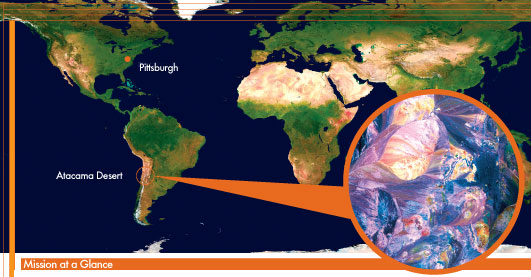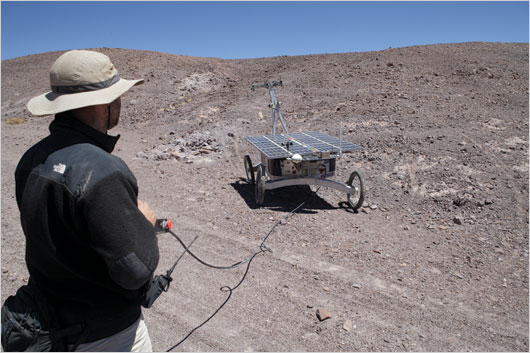
When we catch up with the robot, it is poking along in a herky-jerky and rather flummoxed fashion through the Atacama Desert, which covers much of far northern Chile. The Atacama is reputedly the driest place on Earth, with rainfall measured in millimeters per decade. It is a rough place for man or robot, a tawny maze of high plateaus and shaley foothills under constant sun and an enormous cobalt-blue sky. And so here is where a group of engineers from Carnegie Mellon University have come to test their creation, a six-and-a-half-foot-long, 440-pound robot built to detect life in seemingly lifeless environments. The robot features a cutting-edge system for identifying organic molecules, but it looks less than high-tech, more like a robotic patio table built with spare bicycle parts. And although its knobby wheels can soak up flat terrain at a brisk human walking clip, right now it´s in trouble.
“Ah, that´s the angle of refusal,” says Carnegie Mellon roboticist David Wettergreen. The robot-named Zo, the Greek word for “life”-had been making its way up a steep ridge, but suddenly its navigation software called for a complete stop. Zo is stranded on an impassable slope of rock and sandy dirt. A discreet 100 yards away, two young engineers are sitting in the cab of their 4×4 tapping away at Dell laptops, accessing Zo´s sensing software over a shared wireless network. On their screens, they see the world as the robot does, a field of black, white and gray tones; the whiter the terrain, the steeper, the higher-the better to avoid. There is a lot of white.
Wettergreen plugs a cable into the robot to temporarily switch to manual control. At his end of the cable there´s a joystick-like lever that he uses to steer the ´bot around the worst of the steep bits-to all appearances, a man walking his supersize dog. Chris Williams, a Carnegie Mellon mechanical engineer who, along with Wettergreen, has been trudging beside Zo, shares robot-
wrangling duties. “It´s my hours of work I´m going to lose if she falls off something,” he says.
It´s no wonder that Wettergreen´s team dreads trashing the machine they´ve invested 18 months of their lives to assemble. But Zo´s ability to navigate autonomously is just one half of this mission. NASA, the project´s underwriter, wants to see if Zo can perform scientific tasks for a team of geologists and biologists who are managing it remotely from Pittsburgh, 4,900 miles away. A life-seeking mission to Mars is planned for sometime around 2016. If all goes well in this test run, a techno-descendant of Zo will be onboard.
But here on Earth this October afternoon, in terrain that´s about as similar to Mars as one can find, the programmers share a look of dismay. This morning, when they inputted Zo´s daily mission plan, they had their doubts. Now that they´ve gotten an up-close look at the hills and drainage channels it´s supposed to be driving through, they´re convinced. The scientists in Pittsburgh who tell Zo where to go have lost their collective minds.
From Little Green Men to Little Green Bugs
The 1970s and early ´80s were the heyday of extraterrestrial life-think of celebrity astronomer Carl Sagan´s books and Tonight Show appearances, the Spielberg movies Close Encounters of the Third Kind and E.T. throbbing with adolescent yearning to connect with . . . something out there. But for all the countless hours that radio astronomers spent trying to intercept electromagnetic frequencies from some superintelligent intergalactic civilization, the yield to date has been exactly zip. Popular culture moved on to other obsessions.
But NASA and its independent contractor the SETI (Search for Extraterrestrial Intelligence) Institute haven´t abandoned the search; they´ve merely refocused it. The new watchword is “astrobiology”: looking for microorganisms on other planets. The search for little green men has given way to the search for little green bugs.
If bacteria are lacking in E.T. cachet, at least there is an outside shot at finding them on Mars, our second-closest planetary neighbor and, in many respects, the most Earth-like. “If life did start twice, independently, in our solar system,” says NASA senior research scientist Chris McKay, “that tells us that life starts pretty easily in the universe. If so, why shouldn´t it develop intelligence somewhere else?” The discovery of little green bugs could be considered the biological equivalent of the Copernican revolution, when humans realized that the universe didn´t revolve around them. What if we´re not alone?
The device that stands the best chance of answering that question is goofy-looking Zo. Because life on Mars is a needle-in-a-haystack proposition, we need a detection system that can reduce the haystack to manageable size. Zo´s is the leading technology under development that combines a nimble robotic platform with a scientific instrument that detects microscopic life. No need to collect and time-consumingly analyze soil samples; just point, shoot, and keep on rolling, about 20 times as fast as the rovers Spirit and Opportunity currently trundling around Mars. Zo marks its search territory in canine fashion, spraying special dyes on the ground to make organic molecules fluoresce, then trying to capture them on camera.
In a real Mars mission, scientists won´t have a bunch of engineers on location to look under the hood, so com-munication between the Chile-based field team and the Pittsburgh-based science team is kept to a minimum. Still, they must collaborate closely. Magnified by geographical distance, the natural gulf between engineers and life scientists is given every chance to widen.
The scientists in Pittsburgh throw around words like “mystical” and “nirvana”; they tend to focus on the far-out implications of the mission. French-born SETI planetary geologist Nathalie Cabrol, 42, who heads the science team, dreams that she´ll someday be able to live in a space station on Mars and do planetary science for several years at a stretch-although the most optimistic estimated date for a first human mission to Mars is 2025.
In contrast, the on-the-ground engineers are, well, practical. To them, the Chilean desert is an unusual and pretty cool place to work on a robot, nada mas. “To the scientists, the desert is this ultra-pristine Mars analogue with fascinating little bacteria in the soil,” Williams muses. “For them, the rover is just a tool. For us, it´s what we´ve been working our asses off for, 50 hours a week.” Zo must drive right through the middle of that intellectual divide.
Extremophile science
The clutter of classroom chairs and laptop computers that is the Remote Mission Control room on the fourth floor of an office building at Carnegie Mellon University in Pittsburgh looks like nothing much, which is exactly the point. As far as humanly possible, the team of 20 or so biologists, geologists and instrument specialists who work here are supposed to be living inside Zo´s head. They generally arrive at 1 p.m. to go over the previous night´s data and take care of odds and ends. Then, when the new end-of-day data stream arrives around dinnertime-Pittsburgh and the Atacama are in the same time zone-they go into high gear.
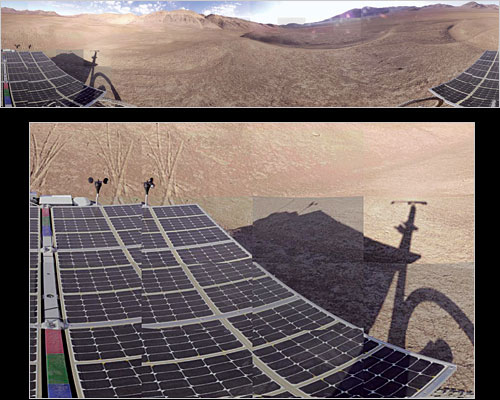
At the end of every working day, Zo takes shots that are later stitched together into a panoramic image. The Pittsburgh scientists pore over this image as if it were a sacred rune. From the landmarks visible in the shot, they must determine the robot´s precise location. This spot becomes the starting point for the next day´s travels, which the Pittsburgh scientists will plan, then upload to a server. Their plan describes the route that Zo should take the next day to access the most biologically propitious spots (on a good day, the robot can cover seven miles). Zo will find its way or collapse trying, and it can choose its own route. The engineers intervene only in emergencies.
To develop each day´s itinerary, the Pittsburgh team plows through instrument data and photographs from Zo´s fluorescence camera. By 1 a.m., or sometimes 2, they call it quits. Most of the scientists are on loan from other institutions, such as the NASA Ames Research Center in California, so they walk together the five blocks to the Holiday Inn, where they decompress in front of their respective TV screens and hope that this time their internal clocks will let them sleep in. “It is sensory deprivation,” NASA and University of California at Berkeley biologist Kim Warren-Rhodes says cheerfully.
The routine may sound dull, but the Pittsburgh scientists see themselves as caught up in a great detective story, a search for life whose modus operandi can be summed up as “Follow the water.”
The formula for life as we know it is carbon plus water plus an energy source. Scientists think that 3.8 billion years ago Mars plausibly had all three. It had (and has) carbon dioxide in abundance, it almost certainly had water (the famous Martian canyons and channels are thought to have been carved by flowing water), and there is evidence but not yet proof that the polar caps could have trapped geothermal heat that would have first stirred the pot of life. “The point is, Mars has been a geologically dynamic planet, water-enriched . . . you follow me?” says James Dohm, the science team´s burly, excitable geologist. “It´s very tantalizing, so much so it´s hard to sleep at night.”
Some 3.5 billion years ago, Mars got a lot less hospitable, but astrobiologists speculate that primitive life could have adapted to the worsening conditions, hiding out in spore form just under the surface or sloshing around in aqueous underground caverns whose existence is suspected but as yet unproved.
The recent discovery of bacteria on Earth in the most unlikely spots-under the ocean floor, in rivers orange with dissolved iron-has lent support to the argument that if life can make it there, it can make it anywhere. The technical term for these almost perversely hardy bacteria is “extremophiles.”
Pittsburgh team leader Nathalie Cabrol, who radiates the toughness of an expedition climber, would seem to be their human counterpart. When the Zo mission ends in mid-October, she will say goodbye to the Holiday Inn, and, again under the aegis of NASA, make her fourth ascent of the 19,731-foot Lincancabur volcano on the eastern side of the Atacama. “I´m not a daredevil,” she tells me in accented English, “but I am free-diving in lakes at 20,000 feet, so you understand where I am coming from.” At an altitude that would tax most people´s ability to stay upright, she intends to dive into a crater lake near the summit to measure with various instruments the lengths to which life will go to stick around.”I´ve been around the block, the extreme block, a couple times, and I have yet to find a place where I didn´t find life,” she says. “Everywhere you find a hurdle, you find a way life found to get around it.”
Zo and the Boys
The wind is a steady 25 mph, and the temperature is mild even if the sun is burning a hole through our silly brimmed hats. Today conditions are pretty good in the Atacama for people-though not for robots. “I think the plan was to shoot the gap between these hills,” Wettergreen tells a new arrival, “but the science team´s heading was a little off. They said something about flats, and there aren´t any around here, so we´re gonna call it a day when the robot runs into something it can´t handle.”
Zo has two stereoscopic cameras about two thirds the way up its mast that possess a 60-degree field of view. Like human eyes, they provide depth perception. Since the mast turns as one unit with the front axle, whatever direction Zo goes, it “sees” seven meters ahead, and it takes five photographs of the terrain roughly every second. One of its three onboard computers evaluates those seven meters, and adjusts direction and speed accordingly, before being presented with the next seven meters-and a brand-new set of decisions to make-a fifth of a second later.
The contours of the Atacama have been sculpted by wind and water over millennia. Today Zo has been nobly traversing the edge of a drainage channel. But following the merciless dictates of the Pittsburgh scientists´ plan, it is now being asked to climb the channel´s bank, some 10 feet high. Its wheels dig into the soil, and it moves upward like a mountain goat for a couple feet before losing traction and sliding down. The robot tries again at a slightly different attack angle, and again and again. It´s like watching a bad but determined driver attempt to parallel park. As Wettergreen puts it, “Zo is very persistent based on its limited knowledge.”
Trey Smith and Dominic Jonak, the 20-something programmers in the 4×4, consider tinkering with Zo´s navigation algorithm so it can better handle the unexpected terrain. Or they could rewrite this part of the Pittsburgh scientists´ plan on their laptops and download it to Zo. But according to the rules of the game, they mustn´t override the science team unless it´s absolutely necessary. If all else fails, there´s always the joystick. “OK, we´re not going to learn anything else,” Wettergreen calls out. “Let´s get this thing turned around.”
On the bright side, the robot hasn´t done any violence to itself, no end-over-end flips or collisions with intervening large rocks. “That used to be the kind of problem you worked on endlessly,” Wettergreen says, “getting the robot not to crash into stuff.”
Still, as this incident suggests, Zo´s autonomous navigation is hardly foolproof. The problem is long-range vision: It doesn´t have any. The integration of the pan-tilt camera unit with the navigation system is still on the to-do list. Hence, big-picture decisions-which slope to climb, how best to cross the drainage area-are beyond the ´bot.
“We´re pushing every system in this robot so hard, breakdowns are inevitable,” Wettergreen tells me. “I like to have 80 percent of things working. More than that, and we´re not trying enough.”
Life Under the SpotLight
Zo´s capacity to drive itself is the fruit of years of robotic-autonomy research. In contrast, its life-sensing system, the camera that descends from the undercarriage on vertical rails to capture fluorescent images, was recently developed by Carnegie Mellon´s imaging guru, Alan Waggoner.
Under the right conditions, organic molecules fluoresce in specific ways that can be captured photographically. In the past two decades, fluorescence microscopy has helped decode the human genome and given us a fast, reliable HIV test. But that sort of technology is done in darkened lab conditions, and Zo, being solar-powered, doesn´t like to work nights. Waggoner´s solution: He outfitted Zo with a high-powered flash that blasts the ground with light, timed to the camera´s 1/50,000-of-a-second exposure. In that moment, the flash imparts enough energy to excite the organic molecule-chlorophyll, say-to fluoresce, while overwhelming any confounding effect that ambient sunlight would otherwise have on the image.
Next problem: Desert organisms shut down energy production in the heat of the day, when Zo is most active. Waggoner´s solution: After taking an initial set of images, Zo lowers a set of plastic nozzles that squirt water, encouraging any microscopic life to awaken and bloom in the next series of images.
If Zo gets a chlorophyll hit (in the Atacama, probably lichen), it engages in what Cabrol proudly dubs “science on the fly.” The ´bot “decides” the area is worth more of its time and enters intensive imaging mode to look for harder-to-detect bacteria. It prepares the ground by squirting diagnostic dyes, each of which bonds with one of the four basic macro-molecules of life-protein, lipid, carbohydrate or DNA. Once attached to a dye, these organic molecules fluoresce when bathed with the flash and will show up as bright patches on the black-and-white images sent to Pittsburgh.
“It´s lit up like a Christmas tree,” exclaims Warren-Rhodes, the NASA and U.C. Berkeley biologist, when a lively image comes in to the Pittsburgh office from one of Zo´s intensive spraying, dyeing, filtering, and shooting sprees. The excitement in the room is palpable whenever the yield looks to include bacteria, which unlike lichen are invisible to the naked eye. These are moments in which the scientists can learn more about the Atacama remotely via Zo than by going there themselves with rock hammer and pail in hand.
One evening in Pittsburgh, Warren-Rhodes is studying a series of fluorescent images on her laptop screen like a radiologist worrying a problematic MRI: Is that lipid or just background fluo-rescence? Cabrol can´t say-her training is in planetary geology, not terrestrial biology-but she reminds Warren-Rhodes to look for overarching patterns. “Is there any predictability here?” Cabrol asks. “How can we transform that into an autonomous process that Zo can learn how to do?” I ask Warren-Rhodes who is the better Atacama biologist, she or Zo. “I am,” she says without missing a beat. “I´ve spent so much time in extreme deserts.” And in a few years? “Oh, it will be like Kasparov playing IBM´s Deep Blue. By game 6, I´m outta here!”
Parallel Universes
When Zo´s solar panels have absorbed the last rays of twilight, the engineers retreat to site camp, a bunch of unheated wooden shacks left behind by a Chilean gold-mining concern. (The rooms are chilly at night, and the toilets stop working one by one, but for Wettergreen, 40, a man perfectly adapted to the field, this is suspiciously soft living compared with tents or sleeping under the stars at previous sites.)
On Friday, October 7, as the team is uploading data to Pittsburgh in the communal communications shack, Dominic Jonak, the young Carnegie Mellon engineer, looks up from his e-mail incredulously: “They´re asking us which valley have we come from. Like where have we been the past few days.” Williams, the mechanical engi-neer who built much of Zo, cracks up: “Are we on this half of the map or this half of the map?´ We´re being commanded by a lost science team!”
And now all the snafus of the past few days suddenly make sense. The Pittsburgh scientists didn´t send Zo into brutal terrain because they´d gotten
sloppy or cavalier. They meant to steer the ´bot along the most passable route-only they were living in a parallel universe. They thought Zo was in a valley with clear sailing to the west, when it was actually in another valley nine miles away. When the Pittsburgh team told it to head west, it ran smack into the foothills between the two valleys.
Young techies don´t tend to be especially forgiving of other people´s glitches. But as comprehension sank in, so did an appreciation for the science team´s plight. “When you´re in a bunch of rounded hills like we´ve been in,” Smith says, “one peak looks just like another.”
When the scales fall from the Pittsburgh team´s eyes later that evening, the stakes are higher and the casual locker-room atmosphere is notably absent.
Remote Brain, Desert Body
All along, the Pittsburgh team has appreciated that it is a brain in a jar, sending commands to an entity whose location it can only infer. Zo´s field season consists of three mini missions that start from different “landing sites” in the desert. Just as NASA scientists have only an approximate idea where their spacecraft will land on Mars, when Zo is moved to a new site in the Atacama, the Pittsburgh team isn´t told exactly where it is. All they know is that the ´bot is somewhere within a red circle drawn on a map.
Because Mars lacks the satellites necessary for GPS to work, the Pittsburgh team has to locate Zo the old-fashioned way, triangulating its position using identifiable landmarks. To do this, the team constantly compares two images that are projected on screens in the front of the room: Zo´s most recent end-of-day panoramic photo, and a satellite image of the section of the Atacama that contains the current “landing” site. They identify three prominent points on the panoramic image and then locate those same points on the orbital map. When the position they choose for Zo on the orbital map has the same geometry relative to the three chosen map points as Zo does to the three pan-photograph points, then the robot has been found in the real world. Or, if they´re not careful, lost in the real world.
James Dohm is the team´s lead triangulator. During field operations, he spends his days and nights hunched over a laptop, mapping geologic “units” onto satellite imagery of the Atacama-a reprise of the countless hours he´s spent producing five published maps of Mars. “I´ve had a lot of all-nighters,” he says.
Dohm´s accuracy has been good-to-excellent these past three weeks, but ever since Zo got to its final site at the beginning of October, he hasn´t felt his usual assertive self. On October 7, around the same time that Jonak and his colleagues in the Atacama realized that the two teams were out of sync, an observer from the University of Iowa based in the Pittsburgh office picks up the startling nine-mile discrepancy. Soon e-mails are shooting back and forth between Pittsburgh and the desert. As the engineers cackle in their chilly communications shack, Wettergreen and Cabrol come to a mutual understanding: For the past four days they´ve been traveling in separate realities. Cabrol doesn´t rise from her chair. “You´re in the wrong valley,” she tells her team calmly, eliciting gasps and nervous laughs, then a collective wave of relief. “It was like being in this other world that´s so similar, so reasonable that you can´t get out of it,” Warren-Rhodes says later. “But you´ve always got this nagging in your head, â€Something isn´t right.´ “
After the fact, the Iowa observer, Geb Thomas, notes that the landing-site circle was near the edge of the map and the Pittsburgh scientists never requested the adjoining map. “They were trying to solve the puzzle with the pieces in front of them, and nobody thought to get the other puzzle off the shelf.”
Proof of Concept
This was the last year of a $4-million, three-year grant from NASA for the Zo project. If NASA is satisfied with the results, Wettergreen and Cabrol hope that the agency will look favorably on a new grant proposal for further development and testing. They could be back in the desert by 2007.
As for the days Zo spent running around lost in the Chilean desert, it´s a useful lesson but not a major cause for concern: On a real Mars mission, NASA experts would have additional tools at their disposal for tracking the ´bot, including more-sophisticated radio data and descent imagery.
There are plenty of technical issues still to be resolved, however. Zo´s still-raw life-detection technology doesn´t catch every sign of life. Moreover, the sprinkler system, which does such a fine job of revivifying the Atacama, would be hopeless on Mars, where atmospheric pressure is so low that water exists only as ice or vapor. Zo, as presently constituted, would freeze its nozzles off.
Cabrol is unfazed. “I think we are pushing doors, one by one,” she says. “This is more of a proof of concept.” Zo has made considerable strides. Last year the camera box was so much less sophisticated that every time the robot stopped for fluorescent imaging, Waggoner, who is 64, had to get down on his hands and knees to squirt water and dyes (then only two) from common garden spritzers.
My last day with Zo, October 9, the robot is heading to work with three of the team´s 4x4s following behind when we meet a truck carrying the mine´s security staff. Far from being nonplussed by the robotic procession, they regard Zo as something of a local celebrity. “This is a great thing for humanity, to test a robot in Chile,” the driver says in Spanish. “I´m taking a photo now so when this robot goes to Mars, I can show my friends.” After the Chileans depart, Chris Williams shakes his head.
“I´ve said this many times. This robot is not going to Mars,” he says. “But the technology may.” Such is the fate of a robotic prototype and the tenor of an engineer´s “show me” pragmatism. Back in Pittsburgh, though, Nathalie Cabrol sees Zo´s fledgling efforts in a grander light: “Thousands of generations have been wondering about life elsewhere. Were they disappointed that they didn´t get a response? The answer is, they kept asking the question. What is different is that our generation might have the technological ability to find it.”
Joseph Hooper, a PopSci contributing editor, writes frequently about robotics.