Drones based on maple seed pods might act as portable scouts for soldiers

Drones have become big business for today's military, whether they come in the form of Hellfire-spitting Reapers and Predators or large airships that can hover over battlefields. Then, there's this small monocopter that flies like a maple seed pod.

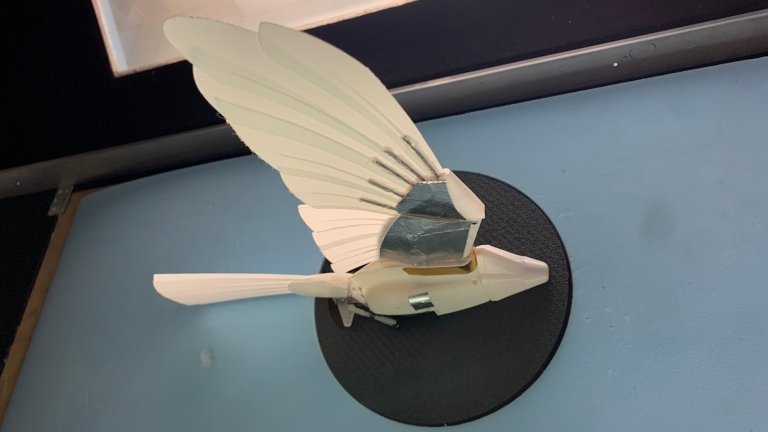
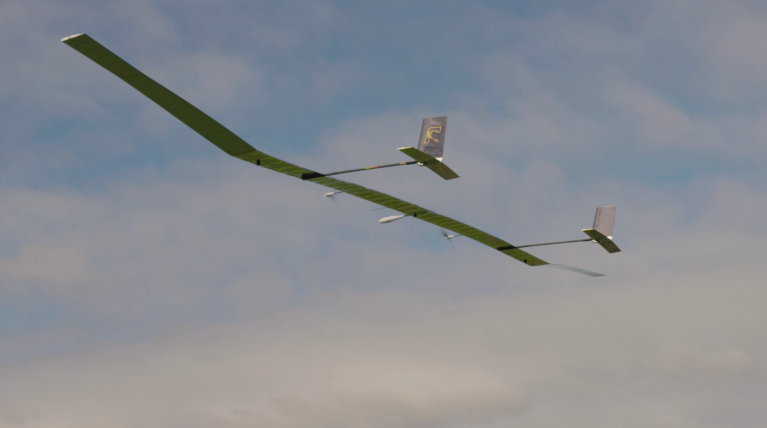
The SAMARAI system from Lockheed Martin takes its name from the samara seedlings that fly off of trees. Original plans called for a seed pod-sized drone that could somehow send back stable streaming video and deliver a 2-gram payload. Funding for the system supposedly dropped out after a phase 1 DARPA contract, but now here's this recent video of a larger test prototype with a 30-inch wing span.

[via BotJunkie]

Want to read more articles on the military, aviation, and space? Subscribe to Popular Science today, for less than $1 per issue!

9 Comments

Wow this is really quite interesting. The sound of it is odd yet awesome. Imagine if we put even more wings on it. More lift i guess. It shows promise. I do wonder how it will handle in the wind though.

I believe that the maximum lift is created by a wing passing through clean (non-turbulent) air, therefore a single wing provides the most efficient lift as a second wing would pass through turbulence created by the first, it is just more difficult to counter balance a single wing.

Wanna take a ride? Ehhh, No...

how do you put a camera on that?

How about a camera on the wing tip that snaps a picture on each rotation of the wing? Then based on the timing of the camera in the wing you could take a picture facing any direction. By taking pictures in sequence you would get video - might be a little choppy if the rotation speed of the wing was slow.

ya very cool, but i dont think adding any more wings would help. it may even be the vehicle of the future clean, but with the steering inside.

It doesn't look stable and a live feed camera would look like crap from that. However if you built it so that the wing rotaits from a seperate unit or disk, then attach a camera to the central non-rotating unit, then a camera would be a lot more probable. However there are still balance isues to be worked out then.

Extra blades on the rotor would thus render the 'mono' part of the name nul wouldn't it? As a test vehicle this seems very promising considering the intended payload is only 2 grams. I wonder what type of payload would be only that light however; with a vehicle that small it wouldn't be hard to deploy a room sized blast of chemicals...?

There have been several very asymmetric aircraft, my own favorite being the Blohm & Voss BV-141 of WW II Germany. It had a pod for the crew on the right, and a full fuselage on the left that held the engine, propeller and equally asymmetrical tail. The tail extending to the left of the fuselage, helping to balance the aerodynamic drag of the crew pod.

The configuration was not capricious-- it had excellent visibility due to the lack of props and engines fore and aft of their cabin, making it rather ideal for reconnaissance. Its air handling was apparently not a problem-- its odd appearance was its only downfall, giving the plane little support among military higher-ups. I can imagine it would have been difficult to convince a crew to trust their lives to such an unconventional design.


June 2013: American Energy Independence

Five amazing, clean technologies that will set us free, in this month's energy-focused issue. Also: how to build a better bomb detector, the robotic toys that are raising your children, a human catapult, the world's smallest arcade, and much more.


Online Content Director: Suzanne LaBarre | Email
Senior Editor: Paul Adams | Email
Associate Editor: Dan Nosowitz | Email
Assistant Editor: Colin Lecher | Email
Assistant Editor: Rose Pastore | Email

Contributing Writers:
Rebecca Boyle | Email
Kelsey D. Atherton | Email
Francie Diep | Email
Shaunacy Ferro | Email

circ-top-header.gif
circ-cover.gif
bmxmag-ps