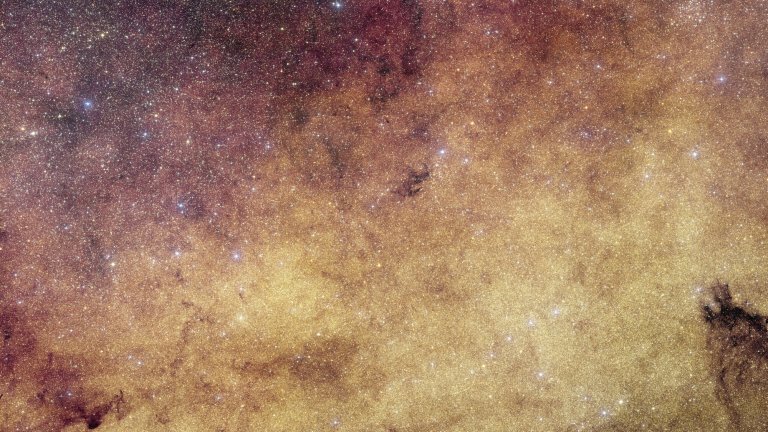
The first in a series of three images slated for release this month, the 800-million-pixel (or, 0.8 gigapixel) image captures the entire southern and northern celestial sphere. From Earth, we see the galaxy on its edge, cutting a horizontal path across a cosmic backdrop of faraway luminous galaxies and the empty void of space. As such, the image makes it appear that we are viewing the galaxy from outside, though the photos were captured with a Nikon D3 sporting a 50 mm lens from the deserts of Chile and the Canary Islands. Each image required six minutes of exposure, for a collective exposure time of more than 120 hours.
French astrophotographer Serge Brunier collected the photos between August 2008 and February 2009, while fellow Frenchman Frederic Tapissier and a handful of ESO experts processed the 1,200 raw photographs into the seamless panorama, which represents nearly 300 unique fields of view. As the photography was conducted over a series of months, several celestial objects can be seen moving through the galaxy, including a bright green comet. Jupiter and Venus, as well as other planets, are particularly visible.
The Gigagalaxy Zoom project was initiated as part of the International Year of Astonomy 2009. The second image, a 400-million-pixel image of a smaller swath of sky was taken through a hobby telescope by astrophotographer Stephane Guisard and will be released September 21. The third image, exhibiting the power of high-powered professional astronomy, was taken with the Wide Field Imager at the ESO’s observatory at La Silla, Chile and will be released September 28.
For a higher resolution look, click here.
[GIGAGALAXY ZOOM via ESO]
138 years of Popular Science at your fingertips.
Each issue has been completely reimagined for your iPad. See our amazing new vision for magazines that goes far beyond the printed page
Stay up to date on the latest news of the future of science and technology from your iPhone or Android phone with full articles, images and offline viewing
Featuring every article from the magazine and website, plus links from around the Web. Also see our PopSci DIY feed
Science is reinventing play, from extreme sports to gamification to ridiculous roller coasters to the playgrounds of tomorrow, and this issue is chock full of fun. Also, on a less fun note: Did global warming destroy my hometown?
Seeing the Milky Way sprawled across the sky on a clear night is one of the most awe-inspiring and humbling spectacles in nature. I'm glad someone put this together for the rest of us with too much light pollution to appreciate it.
This makes me want Google Galaxy, how cool would that be?