
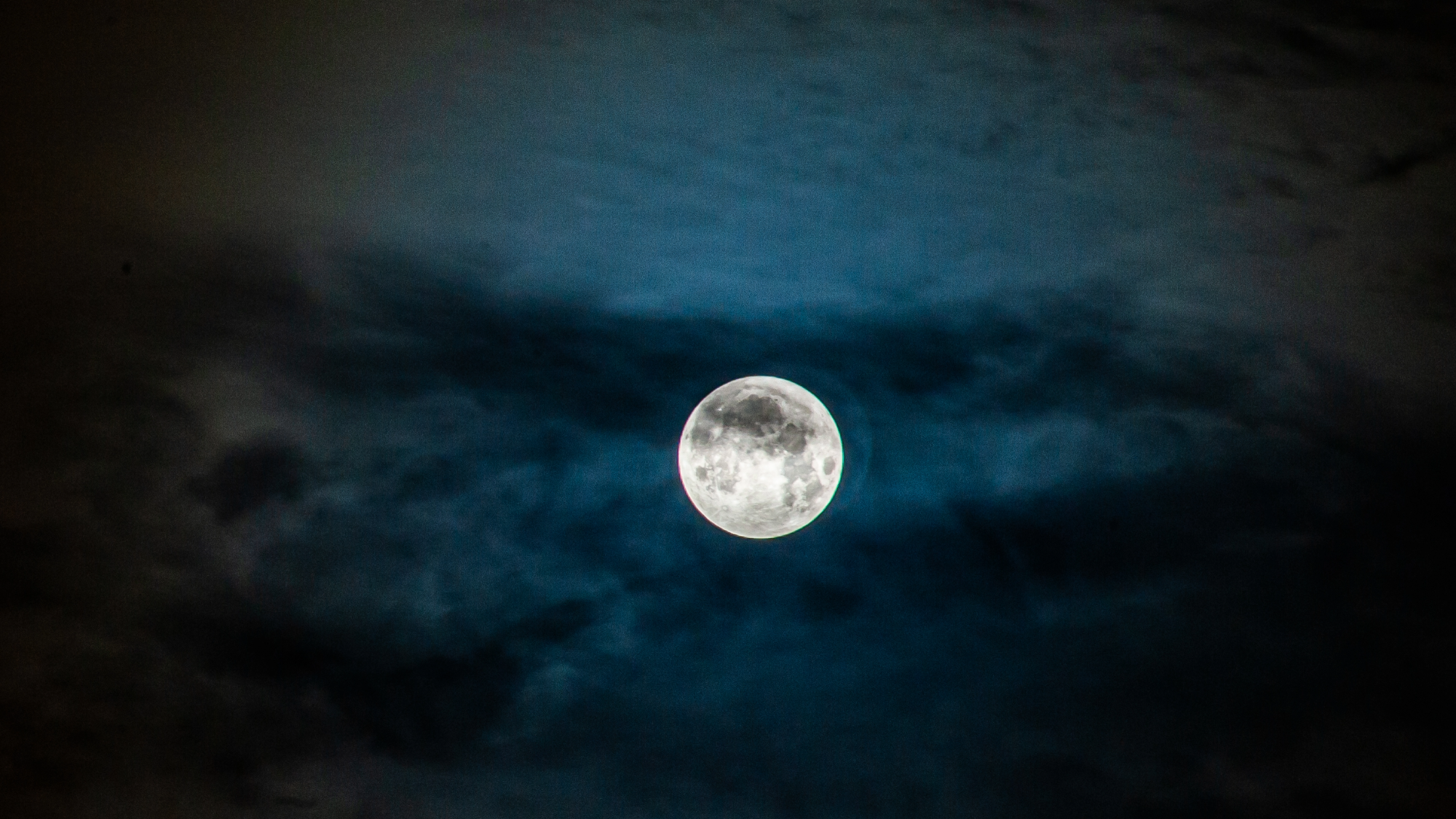
This weekend, Earth will be treated to a nice blue moon. Our planet’s only natural satellite won’t put on a pleasant azure hue (indeed, blue moons have nothing to do with color). Instead, it will be the second full moon for the month of May, following the full Flower Moon on May 1. The blue moon will reach peak illumination at 4:46 a.m. EDT on Sunday May 31.
Seasonal vs. calendrical
According to the Farmer’s Almanac, there are two definitions of a blue moon—a seasonal blue moon and a calendrical blue moon.
A seasonal blue moon is one extra full moon within an astronomical season, or the dates between solstices and equinoxes. A typical astronomical season has three full moons within it. If it has four full moons instead, then the third may be called a blue moon.
A calendrical (or monthly) blue moon is the one most of us are familiar with. It is the second full moon to fall in one calendar month—like in May 2026. It takes the moon roughly 29.5 days to complete one cycle of phases (new moon to new moon). So if a full moon falls on the first of the month on the calendar, there will be a second full moon at the end of the month. The only month in which a calendrical blue moon cannot fall is February.
How rare are blue moons?
Blue moons are not quite as rare as the phrase “once in a blue moon” makes it sound. Calendrical blue moons happen every 2.5 years (or 30 months) on average, and seasonal blue moons fall about once every two to three years.
The last calendrical blue moon was on August 31, 2023 and the next calendrical blue moon will rise just in time to ring in the new year on December 31, 2028.
Two blue moons can also occur in one year. In 2018, January and March both had two full moons, with no full moon in February. The next time two blue moons will fall in one calendar year won’t be until 2037.
Why is it a micromoon?
May’s blue moon will also be a micromoon and the smallest micromoon of the year. Micromoons have nothing to do with size and everything to do with distance. Typically, the moon is about 238,855 miles away from Earth. Micromoons are further away, and this month’s micromoon will be 252,360 miles away. With the further distance, a micromoon may appear a bit smaller and dimmer than usual.
On the opposite end of the spectrum are supermoons, which are closer to Earth at only 225,130 miles away.
How to watch and photograph a blue moon
If you want to see the blue moon rise over a historic city, the Virtual Telescope Project will broadcast the event live from Italy.
NASA has also put together a handy lunar photography guide if you want to snap that perfect moon pic. If using a smartphone, NASA recommends stabilizing the device, turning off the flash, and tapping the moon on screen to focus the camera directly on it instead of the sky. Your brightness also needs to come down and taking pictures at twilight or as the moon clears the horizon will give the sensor less contrast.
