
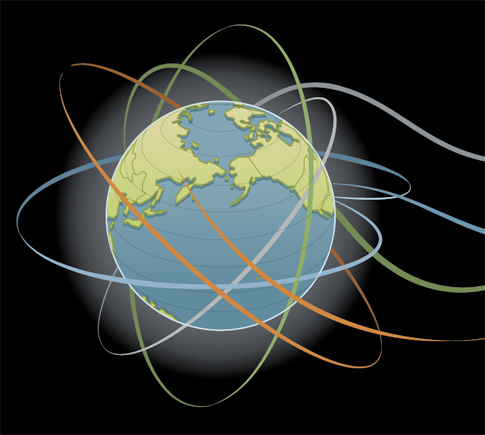
The competition to land a man on the moon could create tensions within NASA

The New Space Race Xplanations by Xplane (See it big: part one; part two)

Fifty years ago last month, NASA opened its doors. The launch of Sputnik the year before had rattled the United States’ faith in its technological superiority and pushed it to assert itself as the leader in space. In the decades since, that dominance has scarcely been challenged. But as NASA phases out the space shuttle and International Space Station operations to transition into Constellation—the program that will use Orion spacecraft to return astronauts to the surface of the moon and, eventually, Mars—the country finds itself starting over at a time when other nations have announced their own lunar programs.

With critics questioning whether the benefits of manned spaceflight (both scientific and geopolitical) are worth the risk and cost, NASA faces serious challenges. It needs to transition quickly from the shuttle to Constellation, beat China and Russia to the moon, and do it without cannibalizing its non-manned programs. Here, in two parts, our timeline of the best-laid plans of the U.S., Russia, China and India.

Part One

Part Two

The Next Four Years

For five years after the space shuttle retires in 2010, American astronauts will have to hitchhike their way into space. NASA plans to buy rides on Russia’s Soyuz for trips to the ISS, but diplomacy issues in the wake of Russia’s war with the republic of Georgia could preclude orbital carpooling.

In addition, NASA must balance the demands of its manned space program—which uses facilities strategically spread across a multitude of congressional districts—with the needs of the science community. Spacecraft like this year’s triumphant Phoenix Mars lander, not to mention the now-venerable Hubble Space Telescope, reveal the most universe for the money. Will NASA strip those programs to pay for Constellation?

Want to read more articles on the military, aviation, and space? Subscribe to Popular Science today, for less than $1 per issue!

4 Comments

Why is the ESA completly left out of this?, they have a far larger budget for space programmes then China/India/Russia, an actual capability to get meaningful crews to Mars (the evolved ATV), China has not even done manual docking in space, the ATV did it automatically, a pre-requsite for Mars mission's, India has only sent one small probe to the Moon, and suddenly they are in the manned race to space?

I know PS has something of tech blindness toward's Europe, but it's getting ridiculous now.

Not only did the article ignore ESA, it ignored commercial spaceflight. What if the Google Lunar prize spurs a company to make it there before a government? What if Russia (or another country) buys Bigelow inflatable habitats instead of building a new space station on their own? True, it is difficult to predict how sucessful these commercial efforts will be or even if they will be sucessful at all, but if the point of the article is tension at NASA caused by competition, ignoring commercial competition is silly.

You know all this money we are spending to bail out these people that signed contracts and now do not want to hold up their end. Forget them. Spend that 700B dollars on a trip to Mars, the moon, where ever. No it is not safe. Coming to America in 1492 was not safe. Some may die. Get over it. If we wait to cross all the t's and dot the i's we will never get anywhere. Seat belts, helmets, one third the cost of an auto is gov. compliance. Man is losing his ability to challenge the unknown, because someone says you cannot take that chance. Well it is my life to live or die the way I choose. If I choose to try for Mars and die. I went well. MAN up America, get a life.

Yes I know I can't spell. Oh well.

I say AMERICA NEEDS TO EXPAND MANIFEST DESTINY in a sense. We cannot scrap everything for the Constellation program. I like wzjx77 thinking.

Private space industries will really benefit NASA in the long run I believe. As much as NASA has allowed private industries to grow, NASA will also be helped through their research.

Ideas like the space cannon mentioned a few days ago are just some of the great ways the space age is going. If it is possible to create a space elevator, we will figure out how to.

In order for humans to become a space-faring race, we need to cooperate with other countries. Yes, it would be great to be the first one on Mars or an asteroid, we should swallow some of our pride and help and get help from other countries... and private space companies


June 2013: American Energy Independence

Five amazing, clean technologies that will set us free, in this month's energy-focused issue. Also: how to build a better bomb detector, the robotic toys that are raising your children, a human catapult, the world's smallest arcade, and much more.


Online Content Director: Suzanne LaBarre | Email
Senior Editor: Paul Adams | Email
Associate Editor: Dan Nosowitz | Email
Assistant Editor: Colin Lecher | Email
Assistant Editor: Rose Pastore | Email

Contributing Writers:

Kelsey D. Atherton | Email
Francie Diep | Email
Shaunacy Ferro | Email

circ-top-header.gif
circ-cover.gif