geology

Will Drilling Into a Volcano Trigger an Eruption That Destroys Naples?


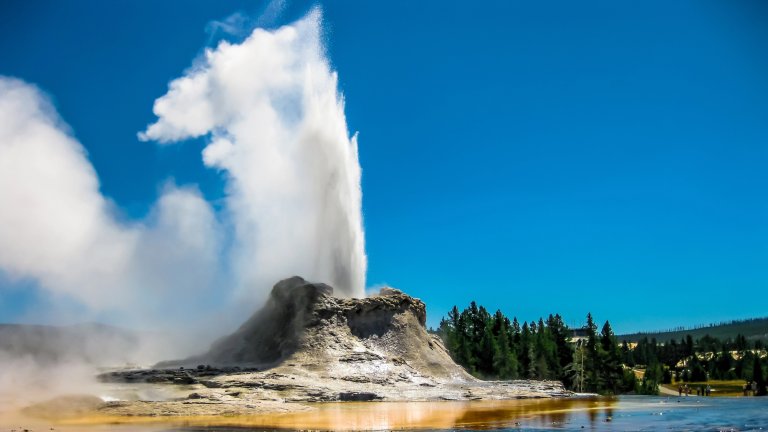
Scientific research has helped humankind avoid or mitigate many of nature’s best attempts to send us to a violent end, but what do researchers do when the pursuit of research could trigger the very disaster from which science is trying to protect us? That’s the question facing geologists in Naples, Italy that will begin sinking seven four-kilometer bore holes into the Campi Flegrei caldera, the site of a “supercolossal” volcanic eruption 39,000 years ago.

[ Read Full Story ]

New Technology Could Drill Deeper Into the Earth Than Ever Before

An adaptation of oil drills for deep water could bring scientists closer to the goal of drilling all the way through the earth's crust to the wonders beneath

In 2005, we came the closest we ever had before to drilling into the mantle: the layer beneath the Earth's crust. Now, with new drilling technology adapted from the oil and gas industry, scientists might finally be ready to reach that holy grail of depth.

[ Read Full Story ]

A 7.1 Earthquake Rattles the Central American Morning; Could've Been A Lot Worse!

Strike-slip, you're out

This morning, a 7.1 magnitude earthquake struck Belize and Honduras, resulting a few fatalities and some property damage.

Paul Earl, a seismologist with the United States Geological Survey, told Popsci.com that the quake emanated from the Swan Island Transform fault, a strike-slip fault not unlike the San Andreas fault in California. Both the location -- 80 miles off shore -- and the type of fault helped minimize the destruction caused by the event.

[ Read Full Story ]
Missing Links

The Dangers of Rocks

Causing disappointment and vertigo left and right

If you're tired of fretting about swine flu, here's something else to think about: dislodged "ear rocks" -- loose crystals made of calcium carbonate that can cause dizziness. These little guys are usually valuable, helping us stay balanced, until an injury or virus triggers a "rock slide."

Also in today's links: a levitating air conditioner, horse surgery, and more.

[ Read Full Story ]

Hammer Of The Gods, Indeed

Townsfolk fight locusts with the power of rock, Vice gets technical, and students break down geology on the M-I-C

As a respite from the nonstop flu blogging, I decided it was time to have a little fun and show the lighter side of science.

First up is a story from the Wall Street Journal about the residents of Tuscarora, Nevada, driving off a swarm of insects by blasting Led Zeppelin.

[ Read Full Story ]

A Baby Earth

Why does the planet act like a giant magnet? One scientist is building his own Earth to find out

Dan Lathrop needs a bigger Earth. His old one is two feet across and 500 pounds, about 20 millionths the size of the real thing. And after four years of tests, it failed to generate a magnetic field similar to the real Earth’s, which shields us from the sun’s radiation and guides some navigation systems by pointing compasses north.

[ Read Full Story ]

Prehistoric Explosions Wiped Out Ocean Life-- And Created Petroleum

Much of Earth's oil reserves can be traced to a single volcanic eruption, scientists say

A new study by the University of Alberta suggests that a massive undersea volcano eruption 93 million years ago was the source of much of the world’s oil.

Researchers Steven Turgeon and Robert Creaser were alerted to the prehistoric blast when they found specific levels of osmium isotopes (indicators of volcanic activity in sea water) in black shale rocks off the coast of South America and in the mountains of central Italy.

[ Read Full Story ]
READ MORE ABOUT > , , , , ,

A Molten Blizzard Beneath Mercury's Surface

Scientists suggest that an iron "snow" falls inside Mercury—the work could explain the planet's strange magnetic field

Mercury's magnetic field is about 100 times weaker than that of the Earth - a curiosity that scientists have been trying to make sense of for years.

Recent observations of Mercury's rotation suggest that the planet has a partially molten core, and scientists at the University of Illinois and Case Western Reserve University developed laboratory experiments to model what might be happening beneath the surface.

[ Read Full Story ]

Engineered Earthquakes

Could we avoid the big one by setting off smaller quakes?

An earthquake is a sudden release of stress that has built up along a fault line, where rock faces push against each other. If that stress could be released over a longer period of time—with a series of smaller quakes—the result might be less catastrophic.

Engineers have known for 40 years that injecting fluids deep into wells can accidentally trigger mini—quakes by lubricating “sticky” rock faces. Since that time, there have been numerous proposals to pump fluids into stressed fault lines.

[ Read Full Story ]
READ MORE ABOUT > , , ,


Download Our iPhone App

Stay up to date on the latest news of the future of science and technology from your iPhone with full articles, images and offline viewing


Follow Us On Twitter

Featuring every article from the magazine and website, plus links from around the Web. Also see our PopSci DIY feed


Become a Fan On Facebook

Share links with friends, comment on stories and more


December 2009: Best of What's New

In our December issue, Popular Science names the 100 best innovations of the year: bombproof wallpaper, self-parking cars, the fastest helicopter, and 97 more. Plus inventor profiles and videos.

Check out the best of what's new here.

Popular Science Photo Pool


Share your photos in the Pop Sci pool at www.flickr.com!
tags_sprite.png
POP_embeddedForm_cover_May09.jpg