
Anyone who’s used an overhead ceiling fan knows it can be a pain to work. Yanking its chain gets the motor running, but there’s no easy visual indication of what speed setting the fan is on. The blades can also take a frustratingly long time to reach their full speed. The result is many annoyed fan owners tugging vigorously on the chain, only to have their fan suddenly turn into an in-home airplane propeller. Most people would simply accept the ceiling fan’s inefficiencies as a headache and one of life’s unavoidable realities. But DIY makers armed with 3D printers aren’t like most people.
In this case, a maker and content creator going by the handle Super Valid Designs decided to tackle the “ceiling fan guessing game” head-on. Using a commercially available 3D printer, he designed and fabricated a custom mounting device that attaches to the fan and provides a clear visual indicator for each speed setting. Once installed, every pull of the chain rotates a circular drum displaying the numbers zero through three. The maker (whose name is Jeff) says his motivation for spending more than 10 hours designing the over-engineered part stemmed from his own personal annoyance.
“Frankly, I just don’t want to have to think about it anymore,” Jeff says in a YouTube video detailing the process.
And while he acknowledges there are other, much more straightforward ways to solve this pesky problem, he seems to relish the inconvenience.
“Yes, I could have got a remote, or installed a wall dial,” Jeff wrote in a post on Reddit. “Yes I could use the setting 2 only hack or the ‘feel the vibration through the chain’ method, but this was way more fun!”
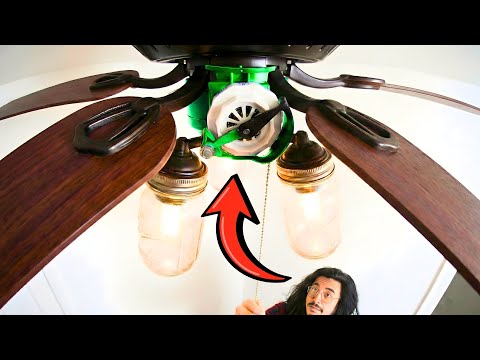
I Over-Engineered a fix to the most annoying thing
Studying balls and yanking chains
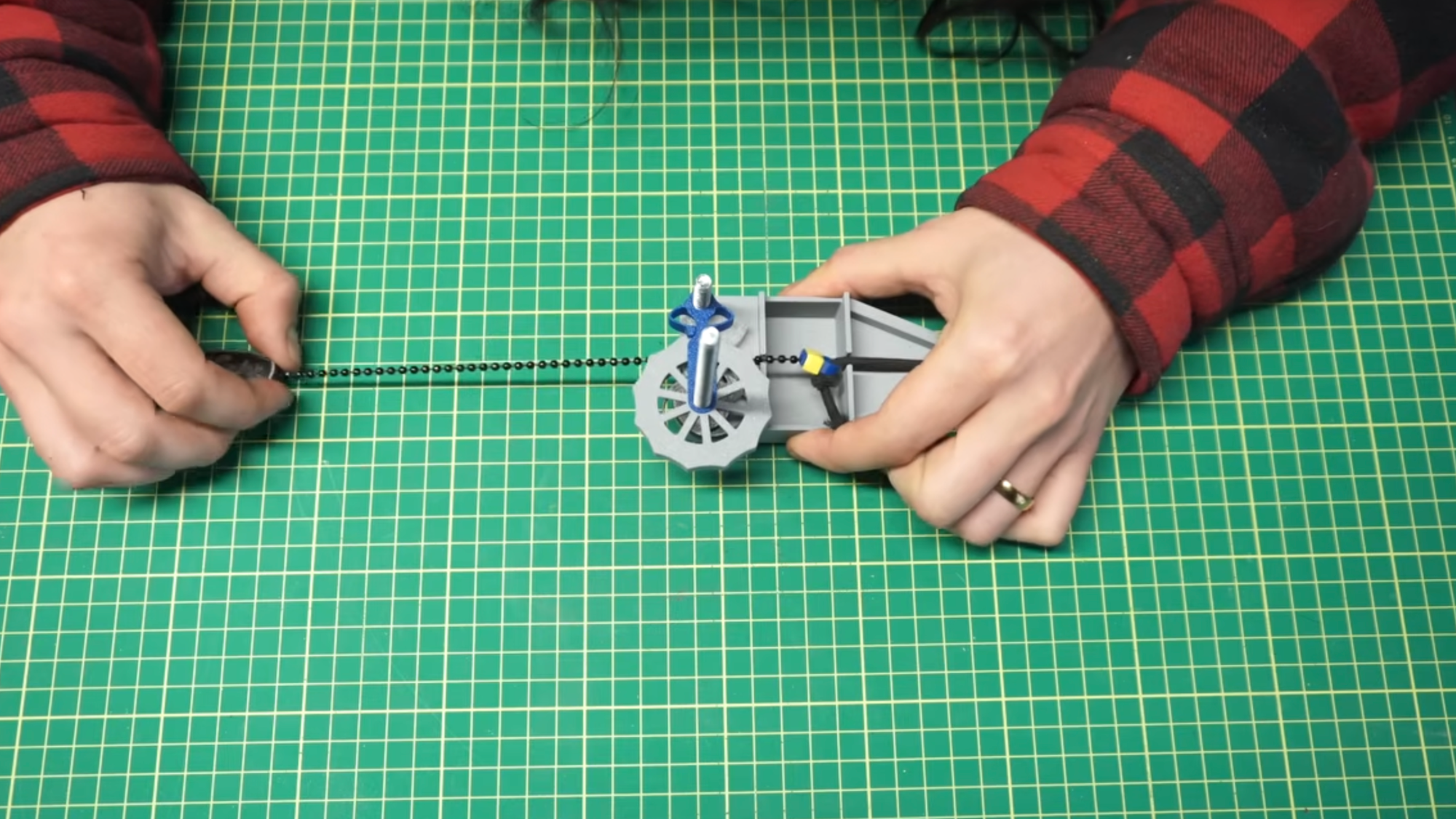
Jeff began to build his contraption after closely inspecting the fan’s pull chain. After measuring the spacing of its ball bearings, he noticed that a single pull of the chain corresponded to a movement of three balls. Using those measurements, he printed a small plastic mount with divots sized to capture the balls. He then turned his attention to designing a mechanism that would hold the balls securely in place.
Next, he scanned the fan’s irregularly shaped base in 3D—a step completed entirely using a smartphone app. With the digital scan as a reference, Jeff created partial gears that sit on either side of the pull chain. But he quickly ran into a problem. While the gears rotated in the correct direction when the chain was pulled, they would inevitably spin back in the opposite direction once it was released. For the mechanism to work, he needed to design a way to hold the partial gears in place as they returned to their starting position.
To keep those gears in place, he modeled a set of plastic teeth that work like a ratchet mechanism. He also designed a spring-loaded piece to hold the numbered drum in place while the gears rotated back.

All of this is much easier said than done. Jeff printed iteration after iteration of his design, with some parts coming out slightly too large and others too tight. That fine-tuning required countless trips up and down a ladder to test each revision on the fan itself. Eventually, sick of constant climbing, he took an extra section of the fan’s pull chain, removed it, and incorporated it into a smaller test rig that mimicked the fan’s movement on his workbench. No ladder needed.
After hours of trial and error, Jeff eventually settled on a three-tooth design that provides enough force to advance the numbered drum, while still using a minimal number of teeth to allow the gears to rotate back with little resistance. For the drum itself, he opted for a stepped design, with a larger outer section displaying the numbers and a smaller inner section containing the groove where the chain wraps around. He says he did this in an effort to prevent the chain from rubbing against the numbers and gradually wearing them down or making them difficult to see.
“Coming from a background as a musician, I’m used to experimenting just for the sake of it,” Jeff says in the video. “I like approaching engineering in the same way. For me, engineering isn’t always about finding the quickest fix, it’s about the joy of problem solving and discovering a different path to the same destination.”

He isn’t the only one with that tinkerer’s mindset. Makers using 3D printers to solve seemingly mundane problems are all over the internet, from custom desk clamp bins and DIY webcam risers to replacement parts for broken deodorant stick bottoms. Jeff, meanwhile, says there’s never been a better time for people without an engineering background to get into making.
“With tools like 3D printers and modeling software becoming so readily available, I’d love to see more people getting into experimenting with building and inventing things just for the fun of it,” he said. “When you can finally hold something functional that only previously existed in your head, that is the best feeling in the world.”
In The Workshop, Popular Science highlights the ingenious, delightful, and often surprising projects people build in their spare time. If you or someone you know is working on a hobbyist project that fits the bill, we’d love to hear about it—fill out this form to tell us more.
