Crossword puzzles range from those easy elementary school-level varieties up to nightmarish labyrinths of text. But crafting even the most simple versions remains its own artform. Seamlessly combining dozens of answers into a coherent, functional grid often requires years of practice, but digital strategist and creator Tex Jernigan has designed an impressive tool to level the playing field, so to speak: Crossword Generator.
“Making my own puzzles is something I wanted to do for my neighborhood coffee shop, and [I] started working on it many years ago,” Jernigan, who also recently debuted a vintage Blockbuster VHS sleeve maker, tells Popular Science. “I thought I would be able to have a huge list of theme words, but it can be quite difficult to get more than a small handful of theme words to work.”
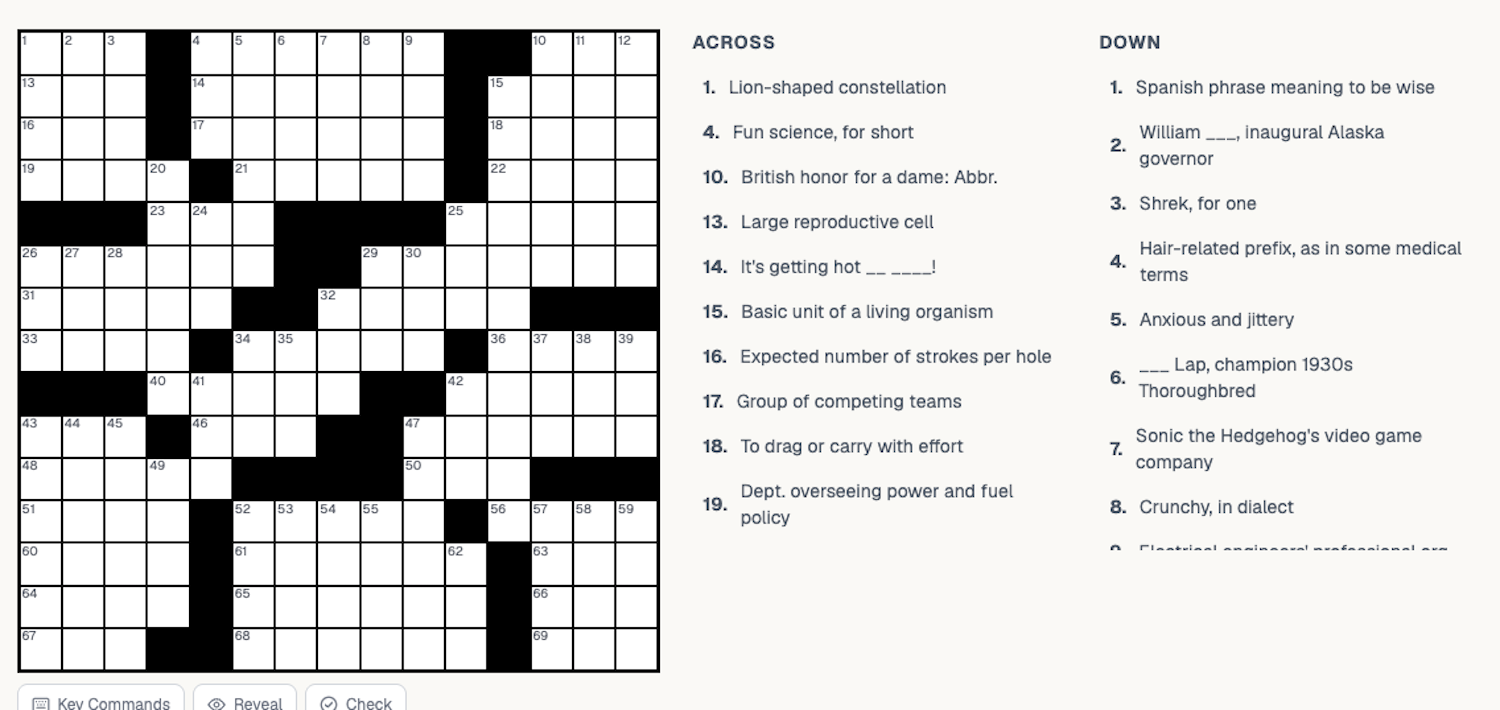
To use Crossword Generator, creators first pick a grid size, then choose either a pattern with pregenerated or manually entered black squares. Next, creators have the option to fill the grid with a few specific words, or simply let the program create an entire puzzle itself. Either way, Crossword Generator employs a constraint solver to scour a database of hundreds of thousands of words, then starts plugging in potential options on a trial-and-error basis. Preference is given to more common, everyday words instead of particularly obtuse selections. Any words entered by a user remain locked in during the generation process, and the prom works around those as it fills in the blanks. Crossword Generator starts in English, but supports 27 other languages including Spanish, Russian, and Japanese.
While Jernigan’s constraint solver doesn’t rely on artificial intelligence, another generative program does use Google Gemini to crossmatch every word with a dictionary-based clue. That said, anyone can simply erase those and create their own hints to ensure their customized crosswords are as human-centric as possible.
“In my experience, AI isn’t very good at building a crossword from scratch, because it can’t reliably make every word cross,” Jernigan explained on his website. “It works much better as a partner to the solver.”
Crossword Generator is free for creating and printing up to 13×13 puzzles, but a subscription service opens up New York Times-style grids ranging from the 15×15 through 23×23 Sunday editions. But if solving crosswords is more your thing than creating them, you can start working on Jernigan’s exclusive Popular Science-themed puzzle.