
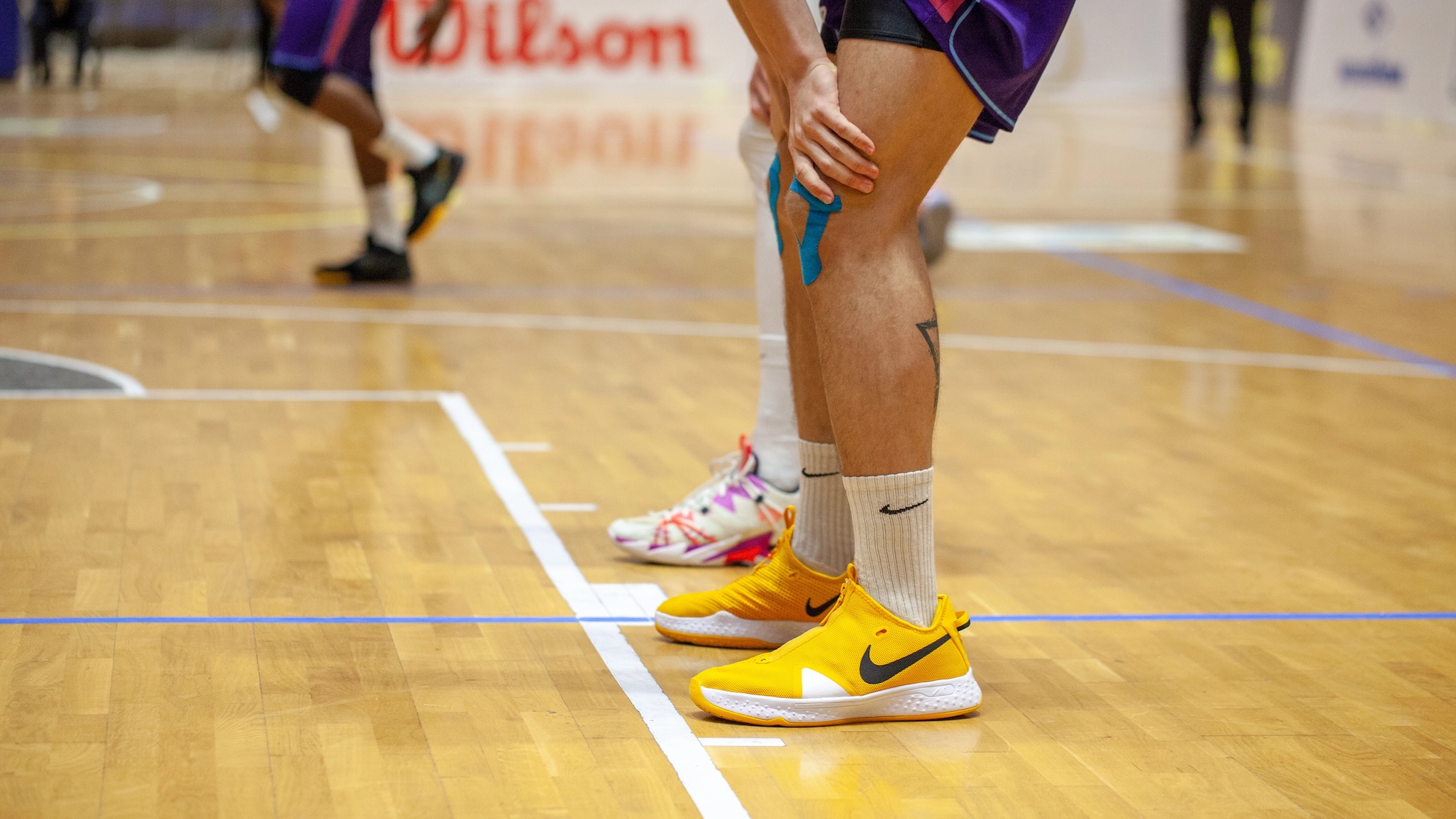
It’s difficult to imagine watching a basketball game without the sound of sneakers squeaking across the court. The high-pitched noises are as instantly recognizable as they are inevitable—thanks to the physics of friction. But while similar tones are audible far beyond NBA games, or on screeching tires, aging bike breaks, and windshield wipers, there is surprisingly little research into the detailed dynamics of squeaky surfaces.
What researchers do know is that the sounds come from stick-slip friction—the regular cycles of two objects adhering and moving between one another. However, that explanation doesn’t fully encompass every influence. To learn more about the dynamics, an international research team recently examined these physics relationships in detail. Their findings, published today in the journal Nature, reveal a never-before-seen dynamic that both explains the underlying mechanics of squeak, while also opening up new possibilities for making more advanced materials and even in seismology.
“This project started with a simple question: why do basketball shoes squeak?” Adel Djellouli, a study co-author and materials scientist at Harvard’s School of Engineering and Applied Sciences (SEAS), said in a statement.

Researchers recreate 'Star Wars' song using squeaky friction
Figuring out the answer required Djellouli’s team to rely on advanced technology while also drawing inspiration from none other than Leonardo da Vinci. Among the iconic polymath’s many (many) achievements, the 15th century thinker is famous for devising an angled contraption to help his experiments exploring friction physics.
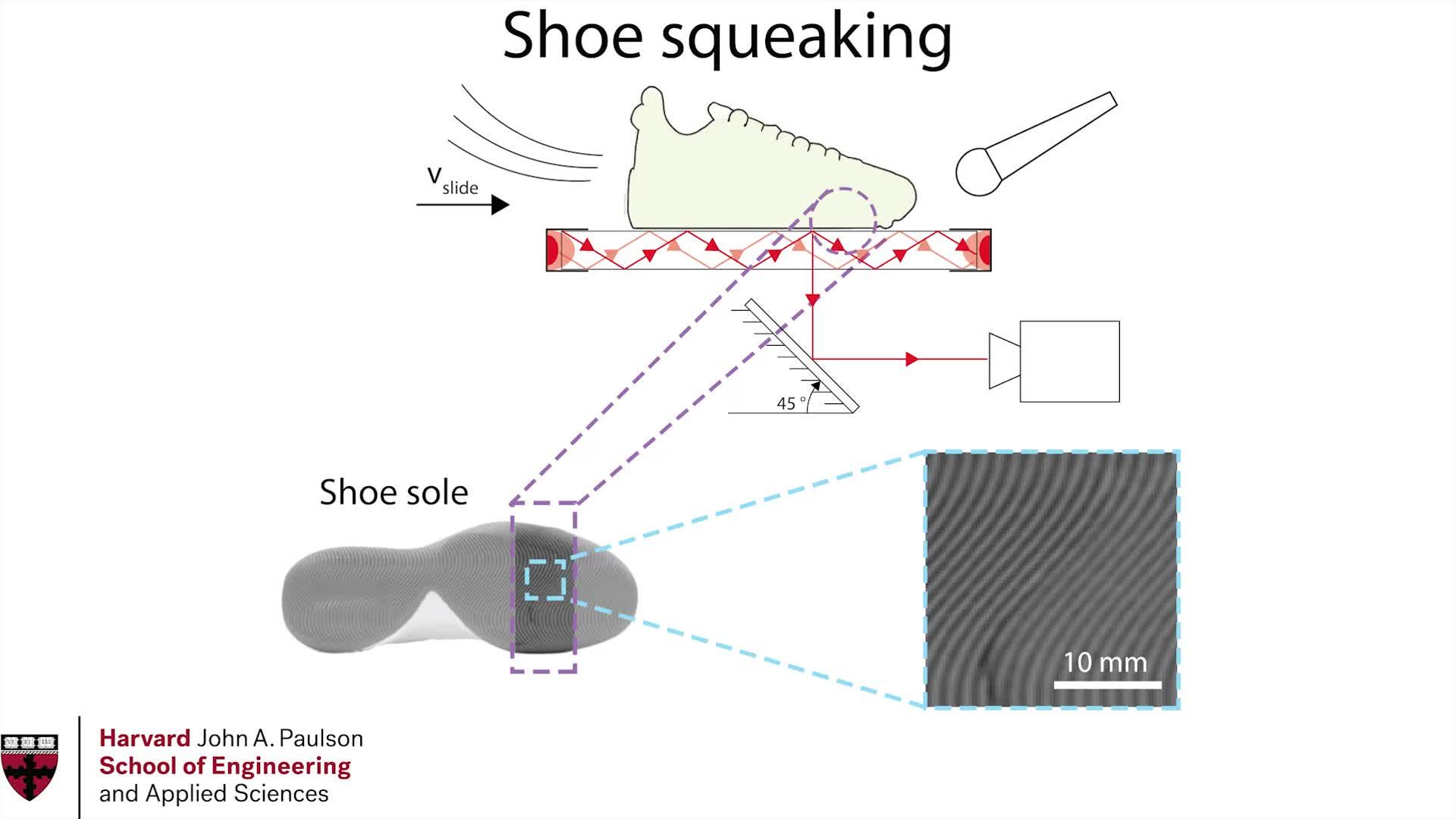
Going off of over 500 years of friction research, the team used internal reflection imaging along with cameras capable of recording at one million frames per second to document the shifting contact points between rubber sneaker soles and a glass surface. Meanwhile, delicate tools measured the audio produced during each and every tiny squeak.
Surprisingly, the results contradicted long-held theories about stick-slip events. Instead of occurring randomly, squeaking sound frequencies are determined by the repetition rate of propagating pulses. This repetition speed, in turn, is dictated by the rubber sneaker’s stiffness and thickness. Additional experiments using flat-sided rubber blocks on glass also produced far more complex and irregular noise pulses resembling broader, swishing noises. This proved geometry is a major factor in how friction squeaks generate.
“We were surprised that tiny surface features could so strongly reorganize frictional motion,”added study co-author and University of Nottingham materials scientist Gabriele Albertini. “These results challenge the assumption that friction can be fully captured by simplified one-dimensional models.”
Djelloui, Albertini, and their colleagues eventually understood these relationships so well that they managed to arrange rubber blocks at various heights and play Darth Vader’s theme song from Star Wars by hand.
Coincidentally, the team discovered another friction consequence that recalled events in a galaxy far, far away. Occasionally, slip pulses created triboelectric discharges—basically, tiny instances of force lightning.
Beyond engineering quieter sneakers, the new findings will help improve some of the world’s most advanced engineering materials.
“Tuning frictional behavior on the fly has been a long-standing engineering dream,” explained SEAS materials scientist and study co-author Katia Bertoldi. “This new insight into how surface geometry governs slip pulses paves the way for tunable frictional metamaterials that can transition from low-friction to high-grip states on demand.”
The ramifications also touch on much larger subjects. The same physics in slip pulses are seen during earthquakes, when tectonic faults produce high-speed ruptures that sometimes move faster than the speed of sound.
“These results bridge two fields that are traditionally disconnected: the tribology of soft materials and the dynamics of earthquakes,” said physicist Shmuel Rubinstein. “Soft friction is usually considered slow, yet we show that the squeak of a sneaker can propagate as fast as, or even faster than, the rupture of a geological fault, and that their physics is strikingly similar.”
