
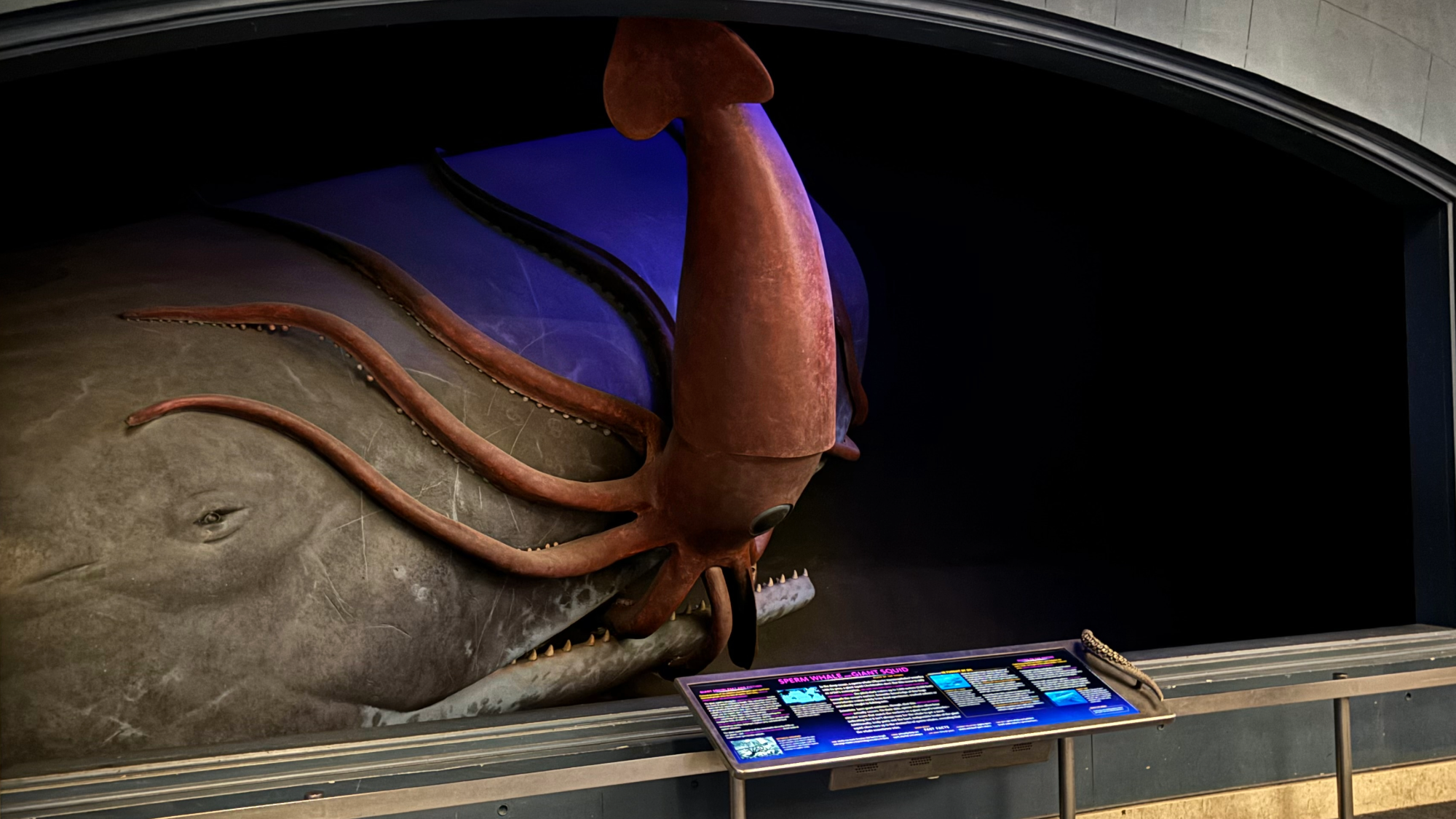
An unusual black box near the American Museum of Natural History’s (AMNH) iconic blue whale lures unsuspecting visitors to one of the museum’s most dramatic displays. A light that only shines every few seconds reveals a row of sharp teeth and reddish tentacles, as a sperm whale chomps down on a giant squid in an otherwise inky black exhibit. The morbidly curious Sperm Whale and Giant Squid Diorama is a startling depiction of one of nature’s most mysterious predator-prey relationships.
But how does an open diorama like this get clean? It can take one person up to four hours just to maintain the diorama. In a video recently posted on social media, AMNH Exhibition Maintenance Janet Spiller uses a backpack vacuum with fiber pole attachments to clean all of the nooks and crannies inside the exhibit.
Unlike the other displays in the New York City museum, this one does not have glass. Reflections create a mirror effect against the dark interior, so early visitors believed that the exhibit was empty. It is kept purposefully dark to recreate the dark conditions of the deep ocean, which has zero sunlight.
Sperm whales (Physeter macrocephalus) will dive more than 6,500 feet (or 4.5 Empire State Buildings on top of one another) and then stay under water for more than 60 minutes just to pursue a giant squid (Architeuthis dux). The evidence for this clash of oceanic titans comes from sperm whale skin and stomach contents. The whales sometimes have circular marks on their skin, which are potentially sucker marks from fighting off giant squid. Scientists have also found giant squid beaks (its biting apparatus) in sperm whale stomachs.
Since scientists only documented giant squid in their natural habitat for the first time in 2005, many mysteries about their lives remain in this deep ocean realm.
