
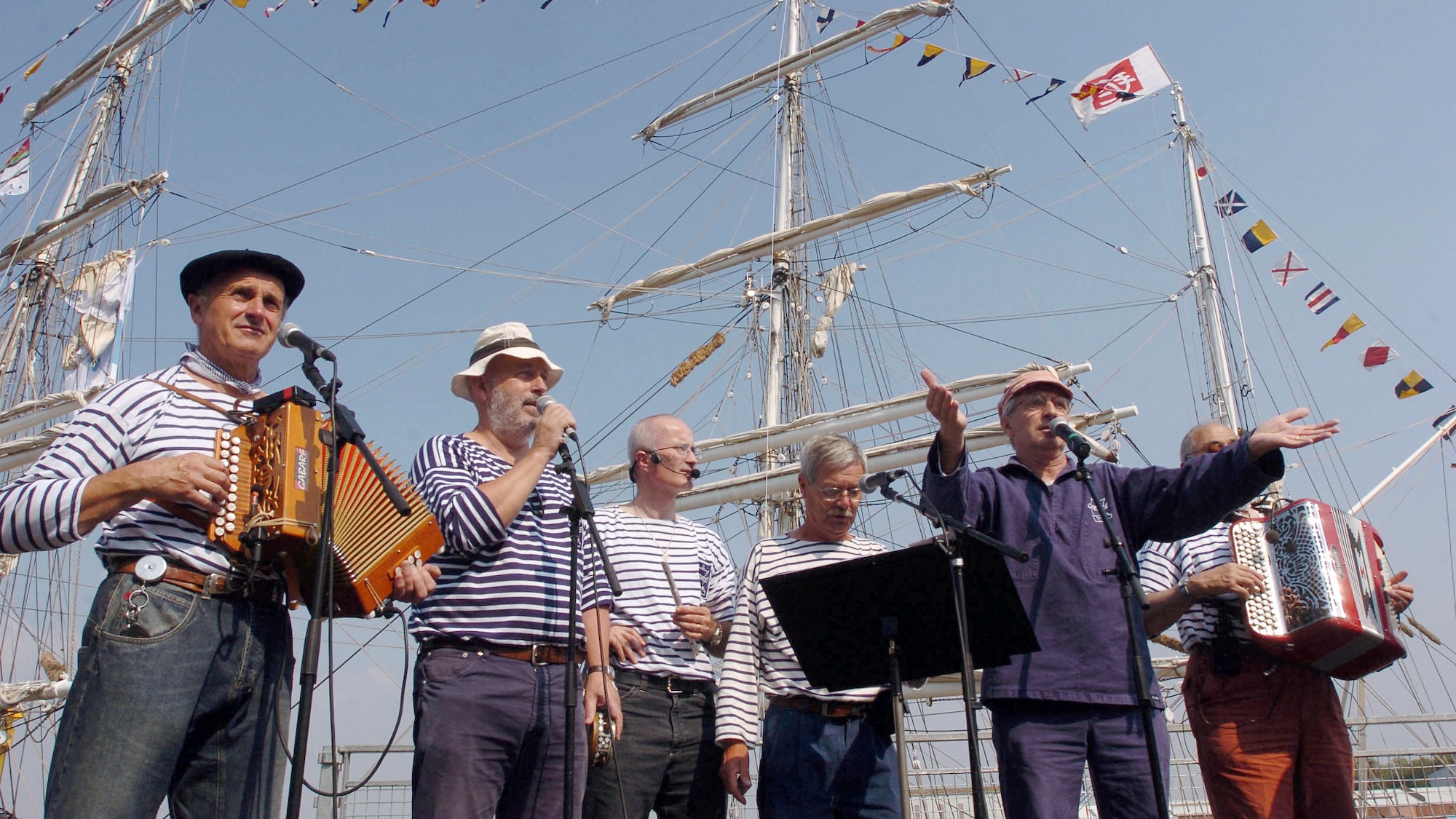
A few years’ back, a viral trend overtook social media that nobody saw coming: ShantyTok. Seemingly overnight, TikTok and Instagram were inundated with posts celebrating the niche world of maritime sea shanties. The fad ostensibly began with the spread of Scottish singer Nathan Evans’ version of “Wellerman,” a New Zealand whaling shanty with historical roots stretching back well over a century.
As newcomers dove into a vast backcatalog of songs, many quickly highlighted just how catchy these tunes really are. But while early sea shanty composers didn’t envision ever reaching the top of the charts, they certainly wrote them to be earworms. The sea shanty is only one variant of a work song—rhythmic melodies designed to help laborers keep pace with one another during repetitive, often backbreaking jobs. Other types of work songs developed over generations among Appalachian coal miners, prison chain gangs, and British textile workers, just to name a few examples.
While there are extensive anthropological studies on the folk tradition’s influence and importance of work songs, there isn’t as much empirical research into its efficacy during actual work. At Austria’s Central European University, a team of cognitive scientists recently delved into how songs like shanties may affect the laborers’ performance. Their findings, published in the Proceedings of the Royal Society B, provides strong evidence that work songs not only maintain collective timing among team members—the shared tempo prevents individuals from accidentally quickening the pace.
Groups often unintentionally speed up shared tasks, so much so that there is even a term for it: joint rushing. Don’t feel bad if you’re a victim of it, however. You’re not alone.
“This can happen even when they try to keep a steady tempo, and even among trained musicians,” cognitive researcher and study co-author Thomas Wolf told Phys.org on May 12.

Stan Rogers sings "Barrett's Privateers" in One Warm Line documentary
Wolf, like many other listeners, became curious about work song traditions amid the #ShantyTok era. While reading Ted Gioia’s seminal book, Work Songs, he noted how the tunes were frequently described as “keeping the pace.” One prominent example was the Scottish tradition of oyster dredging, whose workers often sang to keep the right tempo while rowing.
Wolf and his colleagues decided to examine work songs under controlled laboratory conditions. They paid particular attention to two frequent aspects that they believed helped keep tempo—solo vocalization and metric subdivision.
“Many work songs are sung either by a lead singer or in call-and-response patterns, meaning that at least part of the vocalization is produced by only one person,” he explained, adding that the songs also regularly include “musical events between the instrumental actions.”
For instance, a work song for a task requiring an action like pulling a rope or swinging a hammer may include additional notes or syllables that coincide with the task itself. These musical subdivisions lower the chance of varied timing, which is known to cause joint rushing.
To test their theories, Wolf’s team asked pairs of volunteers to tap along to a metronome’s tempo, then continue to keep time once the device was turned off. They then compared their performances to those undertaken during a “work song condition” in which one person counted off “one, two, one, two,” (and so on) with the metronome. Taps needed to match the one, while the “two occupied the space between taps. Although their past research showed joint rushing is difficult to control even among groups of trained musicians, the results were completely different in the latest experiments.
“What was striking in this study was that, just by having one person count in a specific way, joint rushing was not only reduced, but statistically speaking, it was completely eliminated,” said Wolf.
Their findings indicate even simple vocalizations can strongly influence group coordination. According to the study’s authors, this means that work songs are not only popular because they keep people aligned. They also prevent the speedier ones from throwing everyone else off their groove. Although interesting from a historical standpoint, this research could help inform solutions to coordination problems that many people deal with today in sports, occupational safety, high-stress situations, and physical rehabilitation. So while sea shanties and other work songs helped laborers during a bygone era, the psychology behind them can still help people for generationst to come.
