
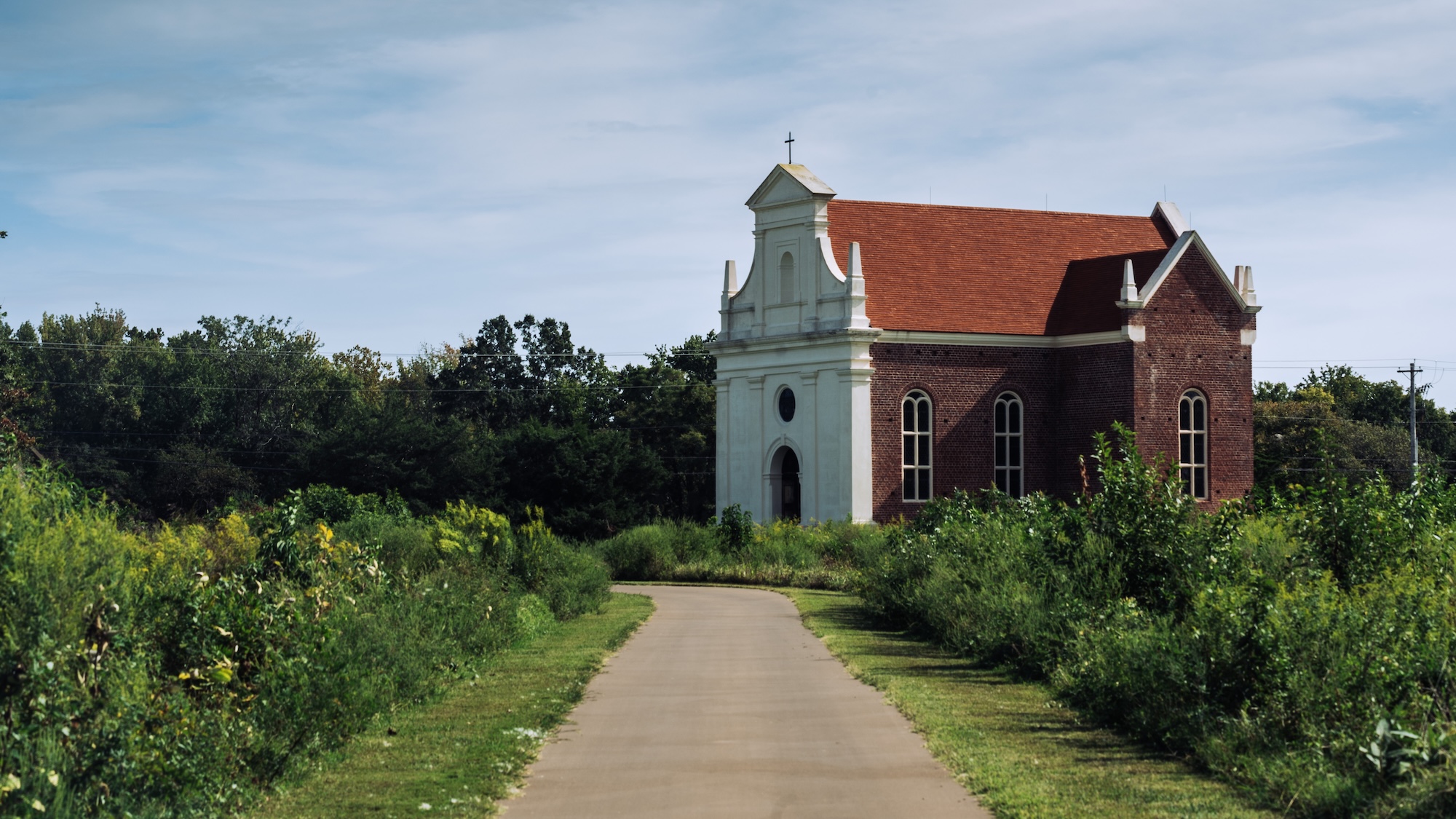
In 1634, English settlers established St. Mary’s City as the first permanent outpost in the colony of Maryland. Many of these early residents were ultimately buried in the town’s Chapel Field cemetery, including 49 colonists between the town’s founding and 1734. Recently, geneticists collaborating between Harvard University, the Smithsonian Institute, and genetics company 23AndMe analyzed these previously unidentified remains as part of a larger genealogical project tracing colonial migration across the United States.
Their findings illustrate how such a small original population can have vast genetic influences over time. According to the team’s study published in the journal Current Biology, over 1.3 million living descendents can be traced directly to the handful of settlers buried at St. Mary’s City. What’s more, researchers believe that they potentially identified remains belonging to Maryland’s second governor.
The results come after decades of work that began with the excavation of a trio of extremely rare lead coffins from the cemetery’s Brick Chapel in 1986. These were later revealed to contain the bodies of Philip Calvert, his first wife Anne Wolseley Calvert, and an infant son from Calvert’s second wife, Jane Sewell. Calvert served as Maryland’s fifth governor, and came from one of the colony’s most prominent and influential founding families. Later DNA analysis tied the Calverts to three more bodies buried nearby.
“Although additional work is needed to determine exactly how these individuals were related to Philip, this finding is significant given that several members of the extended Calvert family, including Philip’s half-brothers Leonard (1610–1647) and George (1613–1634), died in St. Mary’s during this period,” explained Douglas Owsley, the Smithsonian’s biological anthropology curator.
Further genetic examinations identified relatives among five other families, including one that spanned three generations.
“Because mortality was so high in the early days of the colony, finding a multigenerational family was a surprise,” Owsley said. “It’s a discovery that simply wouldn’t have been possible without genetic study.”
From there, the team was able to move forward through the centuries by comparing the DNA information at St. Mary’s City with more than 11.5 million participants from the 23AndMe genetic database. The results show that there are now around 1.3 million living relatives of Maryland’s first European residents. They were also able to corroborate a major migration that occurred between 1780–1820, when many of the colony’s Catholics fled south to Kentucky due to economic stressors and anti-Catholic sentiments.
One of the study’s more groundbreaking facets involved researchers’ ability to assess unknown remains through a combination of genetic material and multiple family trees that include still-living individuals. First, they identified people in the database who shared the strongest genetic relationships to the three related cemetery bodies. They then examined overlaps in anthropological information and known lineages to narrow down the mystery remains. Based on their findings, the team now believes the remains belong to colonial Maryland’s second governor, Thomas Greene, his first wife, Anne, and their son, Leonard.
“This is the first time that ancient DNA has been used to help identify unknown individuals, without any prior knowledge of who they might have been. And it just so happens that one of those individuals turned out to be one of colonial Maryland’s most prominent figures,” said Éadaoin Harney, a senior scientist at the 23andMe Research Institute.
Study co-author and Harvard Medical School geneticist David Reich added that their latest work showcases how vital ancient DNA analysis can be to expanding our understanding of history.
“While written records are extraordinarily rich, genetic data can still address gaps in that record and yield surprises,” said Reich.
