
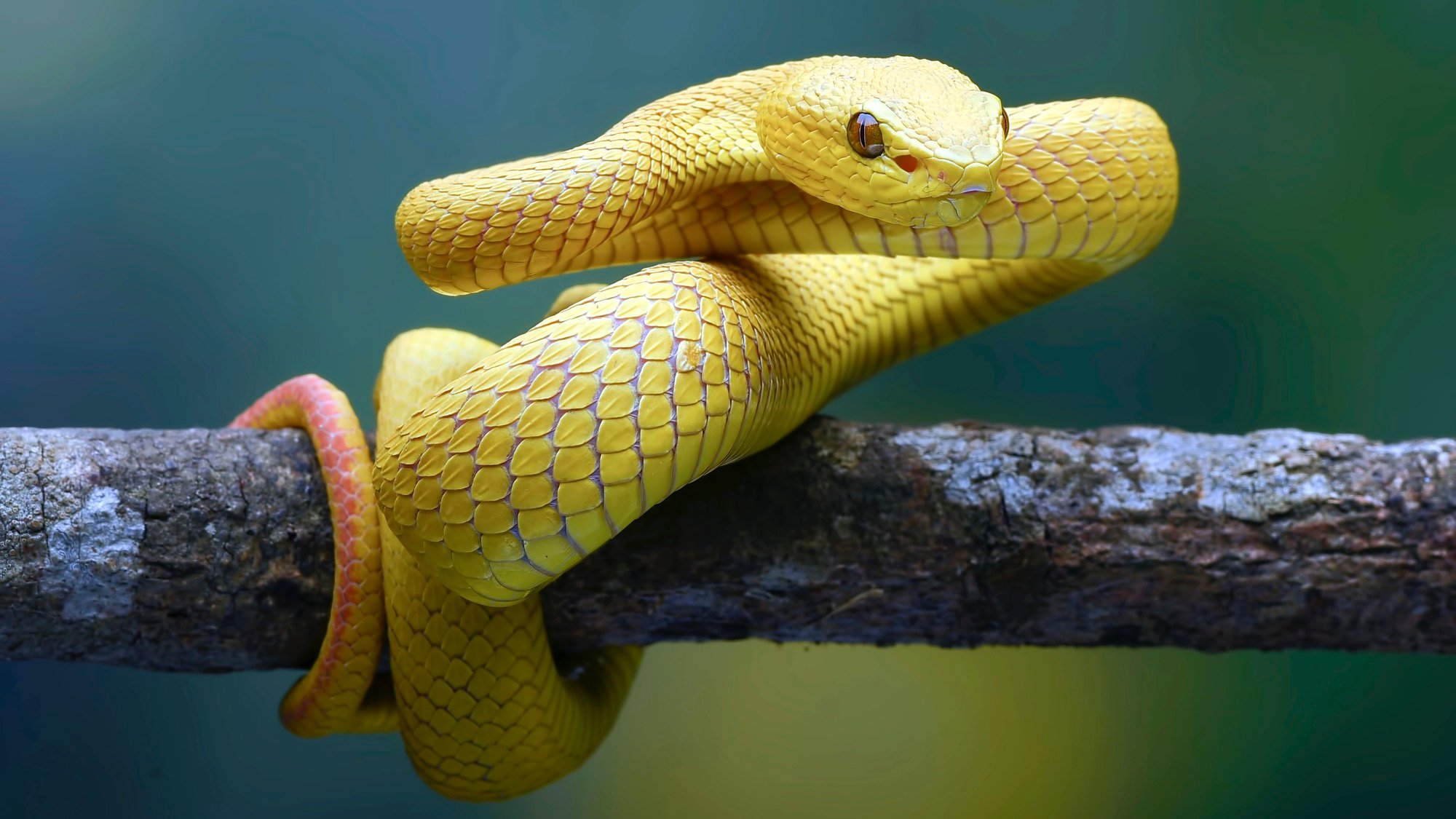
You know that scene in Harry Potter and the Sorcerer’s Stone where Harry accidentally frees a boa constrictor from the zoo? The snake gracefully glides out of its enclosure as if by magic. But there’s nothing supernatural about how snakes move. So how exactly do they get around without legs?
They do it by coordinating hundreds—in some cases many hundreds—of muscles that connect to their vertebrae (the individual bones that make up the spine), ribs, and skin, says Jessica Tingle, a biologist and assistant professor at Brown University’s Department of Ecology, Evolution and Organismal Biology. Put another way, when a snake moves, it does a full body workout.
How snakes slither
It’s not just these muscles that allow snakes to move the way they do. Their skin also plays a role. “Most snakes have invisible-to-us finger-like projections on their belly scales,” Tingle says. These create just the right amount of friction to let them slide smoothly forward without slipping backward or sideways.
When most people think of a snake in motion, they picture the classic S-shaped slithering movement. This is what biologists call “lateral undulation” (which literally means “side-to-side waves”). All of the around 4,000 existing snake species can move this way, Tingle says. On uneven surfaces, their bodies may also rise and fall to navigate bumps (this is called “vertical undulation”). But slithering is only one tool in their movement toolbox.
Snakes can move like an accordion
“Beyond slithering, they have at least a dozen or so other ways to move,” Tingle says. “Most of them can do a class of movements called concertina, which involve repeatedly scrunching and extending the body, like an accordion.”

Snakes can use this concertina technique to squeeze through a tight tunnel, climb a trunk, or inch along a branch, she explains.
Some snakes can also move sideways or in a straight line
Some snake species use other bizarre techniques to move, such as rectilinear and sidewinding motion, Tingle says. In rectilinear motion, the snake keeps its backbone straight and uses its belly muscles to creep forward in a smooth line. It’s a useful way snakes navigate tight spaces.
In sidewinding, snakes lift sections of their bodies up and forward as they travel more or less sideways. The sidewinder rattlesnake (Crotalus cerastes) and the Peringuey’s adder (Bitis peringueyi) can travel at speeds up to 18 miles per hour.

“It seems that only some species use rectilinear or sidewinding motion,” Tingle says, “but given that we know very little about many of the circa 4,000 species, it’s hard to tell just how unique or widespread these motions are.”
Snakes can swim, fly, and even cartwheel
“Snakes can also swim quite well, and some are expert burrowers,” she says. “Beyond that, some species do various wacky things, like gliding between tall trees in the rainforest.”
Snakes in the group Chrysopelea are commonly known as flying snakes—yikes. They have a special technique which involves flattening their body before they leap and wiggling their body in mid-air to help them glide smoothly.

Brown Tree Snakes in Guam use “lasso locomotion” to wriggle up smooth poles. The snake wraps its body into a lasso shape, gripping the pole, and uses small lateral bends within the loop to shuffle its body upwards, allowing it to reach prey in treetops—possibly explaining why these snakes drove ten native bird species to extinction.
Two Southeast Asian species (Xenophidion schaeferi and Pseudorabdion longiceps) have been seen cartwheeling. Yes—literally rolling like a wheel. Researchers speculate that they may do it to startle and confuse predators.
How snakes strike prey
Besides the movements that carry snakes from point A to point B, there’s also another form of movement that snakes use when hungry or under threat: the strike. A strike begins with the snake coiling tightly, then firing its head forward in a lightning-fast lunge.
A 2016 study found that rattlesnakes and other species strike in just 48 to 84 milliseconds. For comparison, it takes about 200 milliseconds for a human to blink, and mammals need anywhere from 60 to 395 milliseconds to start moving when surprised. In other words, snakes strike faster than prey can react.
Snake robots can slither, too
Snake motion is also a source of inspiration for scientists. Engineers have been working on snake-like robots for about 30 years, Tingle says. “Such a robot could be great for getting through cluttered, uneven, or sandy environments, where a wheeled or limbed robot would get stuck.”
For example, a snake robot developed at ETH Zürich can enter confined spaces that humans, dogs, drones, and traditional robots cannot access, allowing it to wind its way through debris in a collapsed building until it finds and helps the people trapped inside.

“At the moment, snake-like robots don’t come close to the abilities of real snakes,” Tingle says. “By learning more about the science behind real snakes’ movement, we can learn some important principles to improve the robots.”
Even snake skin could inspire new materials, she notes, “since it is so multi-purpose and has interesting material properties, but so far people have left that potential mostly untapped.”
Evolution has given snakes some seriously impressive ways to move, and scientists are only beginning to unravel—and borrow from—their astonishing repertoire.
In Ask Us Anything, Popular Science answers your most outlandish, mind-burning questions, from the everyday things you’ve always wondered to the bizarre things you never thought to ask. Have something you’ve always wanted to know? Ask us.
Related Ask Us Anything Stories
