
What’s the weirdest thing you learned this week? Well, whatever it is, we promise you’ll have an even weirder answer if you listen to PopSci’s hit podcast. The Weirdest Thing I Learned This Week hits Apple, Spotify, YouTube, and everywhere else you listen to podcasts every-other Wednesday morning. It’s your new favorite source for the strangest science-adjacent facts, figures, and Wikipedia spirals the editors of Popular Science can muster. If you like the stories in this post, we guarantee you’ll love the show.
FACT: Male ratfish have retractable teeth growing out of their foreheads
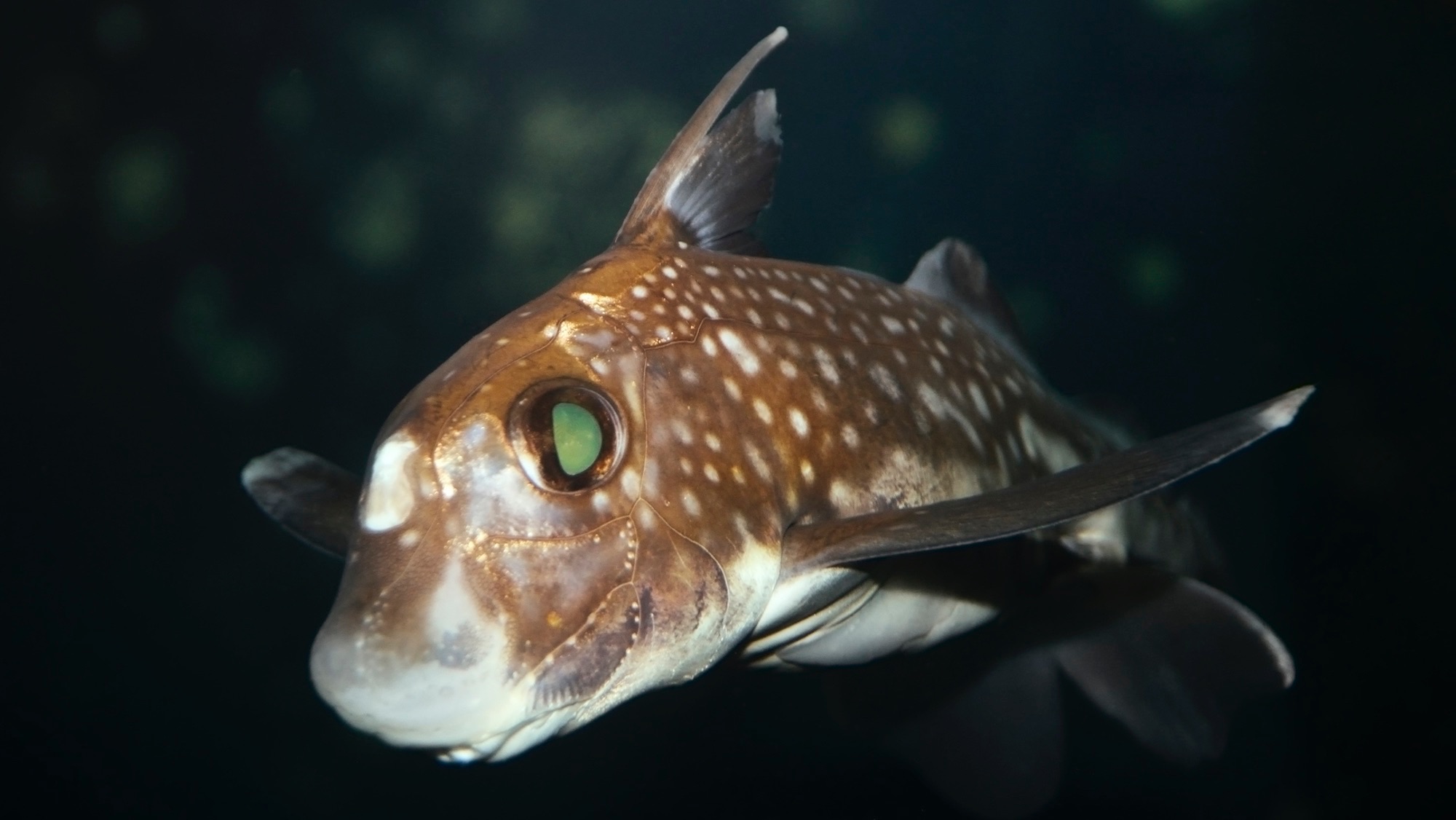
Ghost sharks (also called chimaeras) are already weird. They have special electrical-sensing pores for navigating the deep sea, and one species literally looks like Zero from The Nightmare Before Christmas. But the spotted ratfish takes things to another level with its forehead sex appendage.
Male ratfish have a structure called a tenaculum, which is essentially a retractable rod tipped with a chandelier of teeth that springs out of their forehead to grip females during mating. Both male and female ratfish grow this structure as juveniles, but in females it just stays as a little pimple-like nub and never fully develops. Scientists wanted to know what kind of teeth they were. Given their out-of-mouth placement, it would make sense for them to be similar to the sandpapery dermal denticles covering true sharks.
After analyzing the tissue, researchers discovered these are actual mouth teeth growing out of the forehead. They found dental lamina (the structure that sprouts new teeth in jaws) and confirmed mouth tooth genes were active in the forehead tissue. They also found evidence of similar structures in the fossil record from more than 300 million years ago, suggesting this bizarre evolutionary adaptation has been useful enough to stick around for hundreds of millions of years. The fact that females have vestigial versions suggests it was originally for something other than mating, but we may never know what. Listen to learn why ratfish deserve better publicity photos and what other mouth-tooth mysteries might be lurking in the deep sea.
FACT: Giant rats with pouchy cheeks are out here detecting landmines and being literal heroes
This week’s episode features special guest Carly Anne York, an animal behaviorist and physiologist who studies how animals interact with their environments. She’s also the author of several science books, including the recently published “The Salmon Cannon and the Levitating Frog (And Other Serious Discoveries of Silly Science).”
For her Weirdest Thing segment, she introduced us to some of her favorite silly-looking science heroes: African giant pouched rats. These rodents are around three feet long, equipped with cheek pouches for snacks and blessed with an incredible sense of smell. They’ve also saved hundreds of thousands of human lives.
These “hero rats” are trained by an organization called APOPO to detect landmines by scent, then give a little scratch to alert their handlers. They’re light enough not to trigger the mines themselves, making them perfect for this dangerous gig. (Though they do get weekly weigh-ins to ensure they stay under the detonation threshold while enjoying plenty of treats.)
To date, these rats have collectively detected around 160,000 landmines. One late hero rat named Magawa cleared more than 1.5 million square feet of land, sniffed out more than 100 explosives, and became the first rat to receive a tiny gold medal equivalent to the highest British award for human bravery. An upstart named Ronin just broke Magawa’s record at only five years old by uncovering 109 landmines.
For more on these adorable heroes—which are also being trained to sniff out tuberculosis in humans—check out this week’s episode.
FACT: Wild chimps basically drink a couple of cocktails every day
About 10 million years ago, our common ancestor with chimps and gorillas evolved an enzyme to break down alcohol. This makes sense when you consider that fermentation happens regularly in nature. When yeast and sugar get smooshed together in overripe fruit, alcohol production is a given. Enter the “Drunken Monkey Hypothesis,” which suggests that fruit-eating animals are routinely getting a little buzz.
Scientists recently followed wild chimpanzees in Uganda and the Ivory Coast, scooping up the freshly fallen fruit chimps liked to munch on and testing its alcohol content. They found that over the course of a day, chimps consume about 14 grams of pure ethanol—roughly equivalent to one or two standard drinks for humans, when you adjust for body size.
Before you picture drunk chimps swinging through trees, keep in mind that they eat 10 pounds of fruit per day to get this much sauce. That means they’re basically having a couple drinks spread out over an entire day while also eating a massive amount of fiber. In other words, no one’s getting wasted in the jungle (at least not on a regular basis). Scientists are now collecting chimp urine to see if the primates are actually metabolizing the alcohol. Listen to learn why captive chimps might be missing out on crucial fermented nutrients.
