
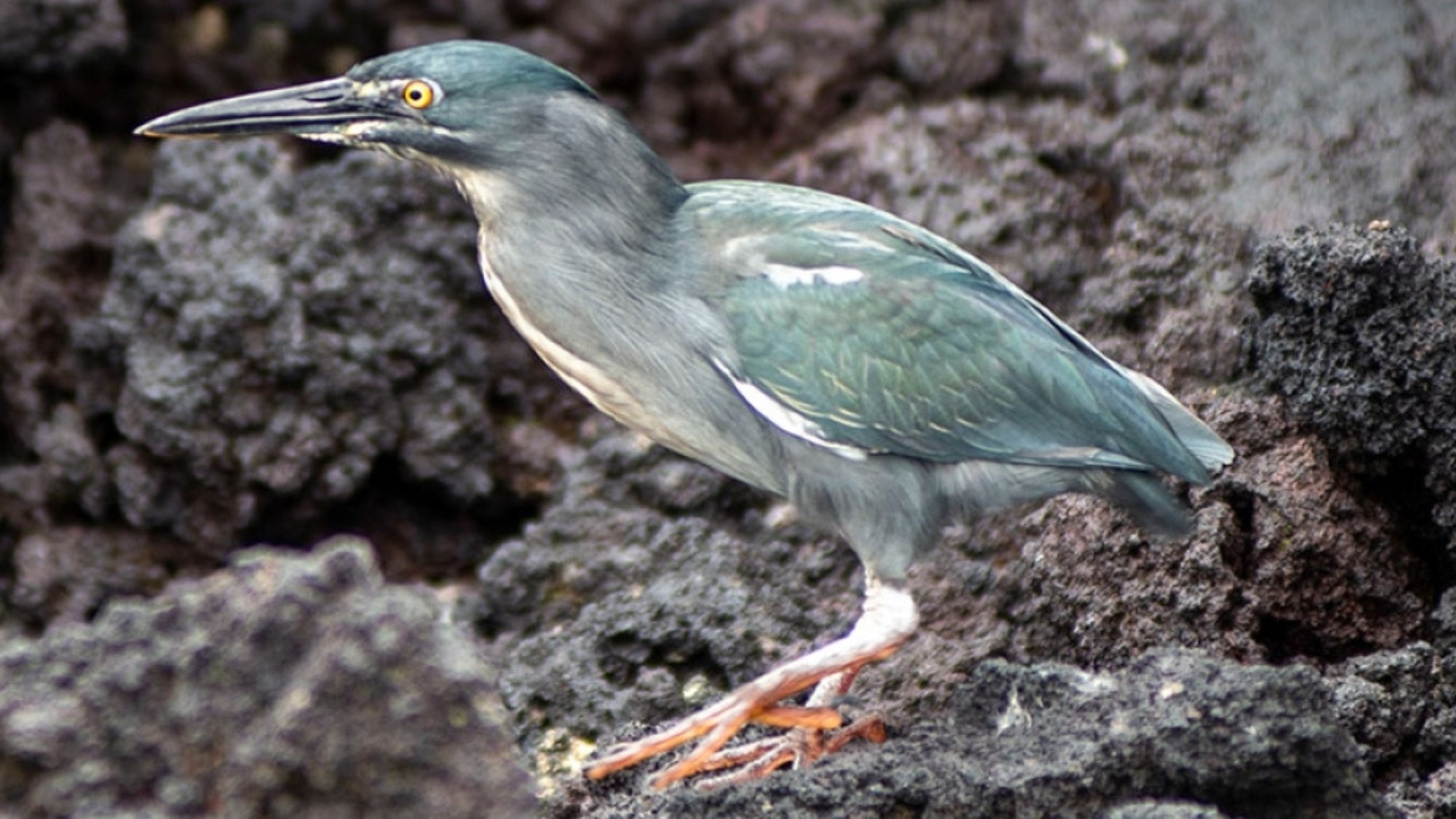
Almost 200 years after Charles Darwin’s groundbreaking trip to the Galápagos islands, a graduate student from San Francisco State University (SFSU) in California discovered a new Galápagos bird species. Ezra Mendales found that the Galápagos lava heron (Butorides sundevalli) is actually a distinct species, and not a subspecies of the South American striated heron (Butorides striata), as scientists previously believed. The bird is described in a study published in the journal Molecular Phylogenetics and Evolution.
“I feel super lucky with this project. I think we fell into this beautiful story that is really rare,” Mendales, who completed this project as part of his Master’s thesis, explained in a statement. “For any biologist, it’s a dream to be able to go to the Galápagos. We are still learning things about some of the most investigated systems. There’s always going to be mysteries to solve.”
The Galápagos lava heron is one of 72 new species recently described by researchers with the California Academy of Sciences (Cal Academy). At about 14 to 19 inches tall, Butorides herons like the lava heron are among the smallest of these leggy birds. By comparison, the Goliath heron (Ardea goliath) towers at almost 5 feet-tall and is the world’s tallest heron. Lava herons primarily eat small fish, frogs, and aquatic insects, and nest and breed in wetlands.
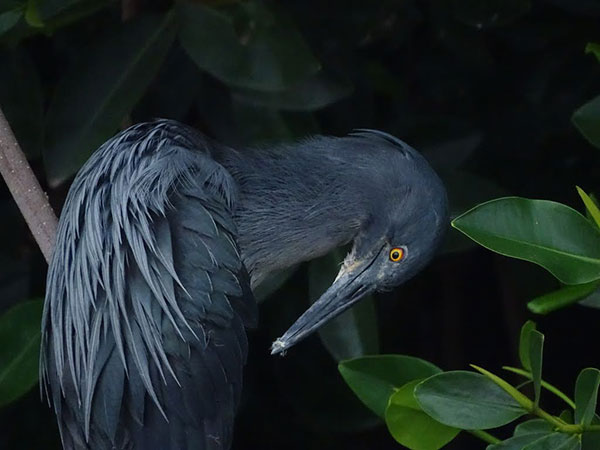
Unlike many discoveries of uncovering hidden species, the lava heron is actually a common sight in the island archipelago off the coast of Ecuador. Scientists had been studying them for decades, trying to explain their appearance and feathers, but did not have a definite answer.
“There was always this bird that shows a lot of variation in its plumage, and for a long time there was questions of whether this was a separate species or a subspecies of a bird that lives on the mainland,” added Jaime Chaves, a biologist at SFSU.
Mendales eventually joined Chaves’ lab and took on this puzzling bird challenge. In 2022, the pair traveled to the Galápagos to collect samples with California Academy of Sciences Ornithology Curator Jack Dumbacher. The team also added preserved specimens from Cal Academy, the American Museum of Natural History in New York, and the Field Museum in Chicago to get insight into how their plumage changed over time.
Mendales used advanced genetic analyses at the Academy’s Center for Comparative Genomics to study the bird’s DNA. And the proof was in the genes–the Galápagos lava heron is its own species that’s more closely related to the North American green heron (Butorides virescens) than it is to the South American green heron.
Chaves is Ecuadorian and first visited the Galápagos with his family when he was only six years old. The people, culture, and wildlife became constants in his life, which now drives his research work. “You have to have this collaboration with the locals,” Chaves said. “Somebody who really knows the birds on the ground.”
For this discovery, the local expertise came from Jason Castañeda. The Parque Nacional Galápagos ranger helped the team catch the herons so that they could collect the blood samples needed to help analyze the DNA. Castañeda is a co-author of the paper for his “substantial collaboration.”
Mendales is now a doctoral student at the University of Montana, but already has an honor many scientists dream of. Or as Dumbacher puts it, “I’d say the vast majority of ornithologists alive today have never been part of a new species description.”
