
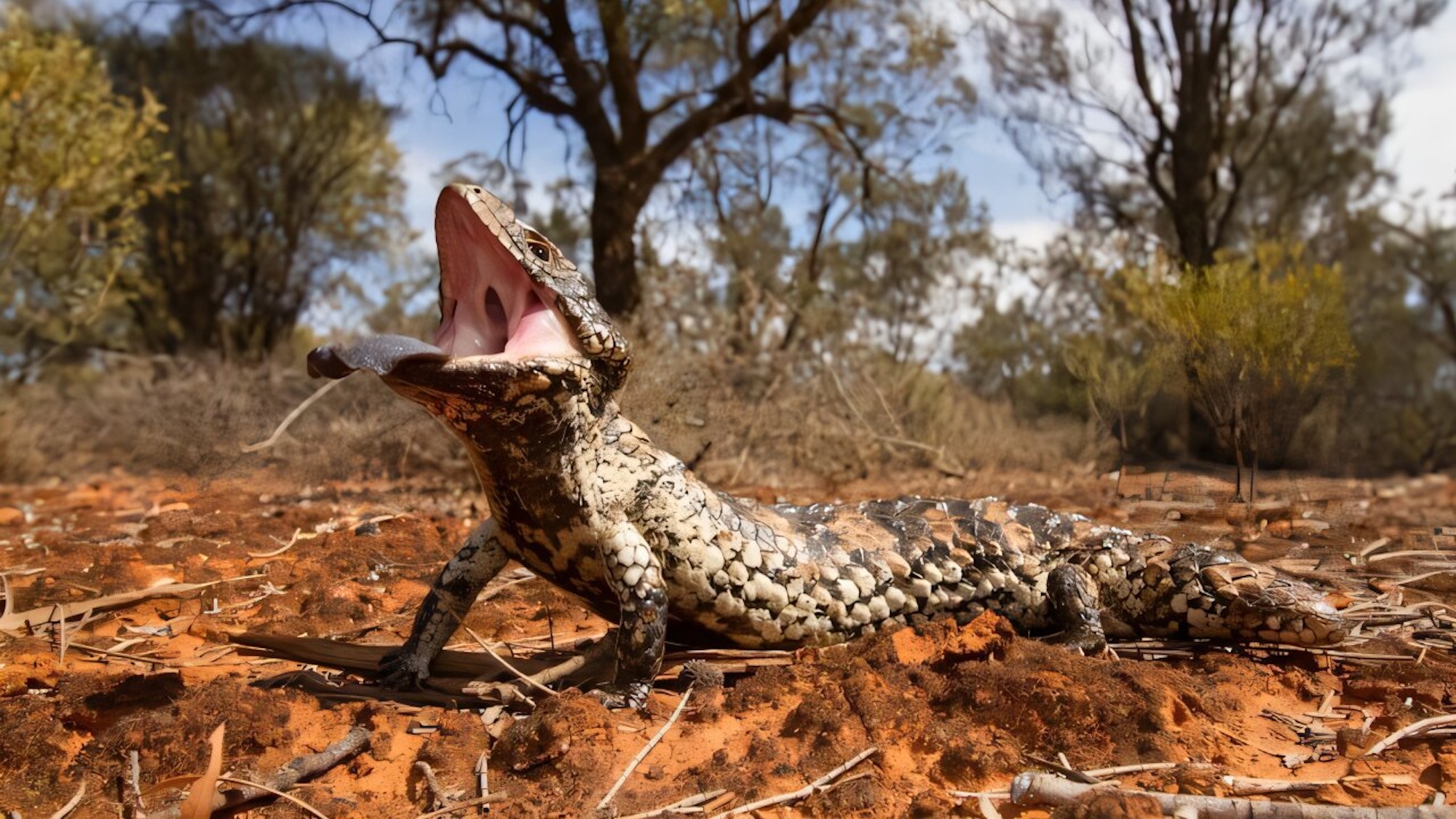
Millions of years of evolution have taught some reptiles the importance of the old adage, “Where there’s smoke, there’s fire.” Take the sleepy lizards (Tiliqua rugosus) of Australia. Researchers at Macquarie University found that these small, stubby-tailed reptiles become agitated after catching a whiff of something burning. But as they explain in their study recently published in the journal Biology Letters, there are still limits to the animals’ sensory cues.
The theory that certain reptiles innately recognize the dangers associated with smoke is supported by years of anecdotal evidence. One of the odder examples occurred completely by chance at the Audubon Zoo in New Orleans. After staffers accidentally burned their lunch, they noticed that the facility’s sleepy lizards started frantically tasting the circulating air with their tongues. Their agitation was so severe that the lizards even attempted to escape their enclosures. Meanwhile, other nearby reptile species remained calm despite the smell.
What made the incident even more striking was that most of Audubon Zoo’s sleepy lizards were bred in captivity, implying the reaction was an innate response instead of learned behavior. Since then, multiple studies have explored potential evolutionary explanations to the responses. But reptiles aren’t the only animals documented to possess a sensitivity to smoke.
“Many animals from fire-prone regions, such as Australia, appear to have this miraculous ability to survive their homes being burned,” Macquarie University animal behavioralist Chris Jolly explained in a statement.
In the case of sleepy lizards, Jolly and colleagues decided to test this direct correlation in a controlled environment. To do so, they safely exposed a group of the reptiles to the scent of smoke and sound of crackling fire separately, then combined together. It soon became clear that the sleepy lizards would flee if they smelled a fire, but did nothing if they simply heard the flames.
“Our study demonstrates that some lizards innately recognize smoke as a cue of approaching fire and respond by running away,” said Jolly.
The theory’s confirmation is particularly significant as climate change continues to increase the frequency and intensity of wildfires in Australia and around the world. A common assumption is that animals caught in these dire emergencies rarely escape harm, when many species already possess lifesaving evolutionary strategies.
This is not to say that wildlife is suited to handle the climate crisis—mountains of evidence clearly show otherwise. But understanding that species like sleepy lizards may have at least some advantages helps inform ongoing conservation efforts.
“As fires become more frequent, intense and unpredictable—including in habitats that rarely burned in the past, like rainforests—we need to know which species can respond to fire cues, and which are most vulnerable,” said Jolly.
