This article was originally featured in Knowable Magazine.
Pregnancy was a singular innovation for mammals. Live birth emerged just once — likely during the Jurassic period. Critters that kept their offspring safely inside until full term became the predominant mammals.
Like the emergence of vision much further back, this was a monumental change that involved many alterations to biology. Evolutionary biologists would like to know what environments made pregnancy advantageous, how animals changed their reproduction to make it work, and what genes were updated in the process.
But the one-off, long-ago emergence of mammalian birth makes that a difficult puzzle to crack.
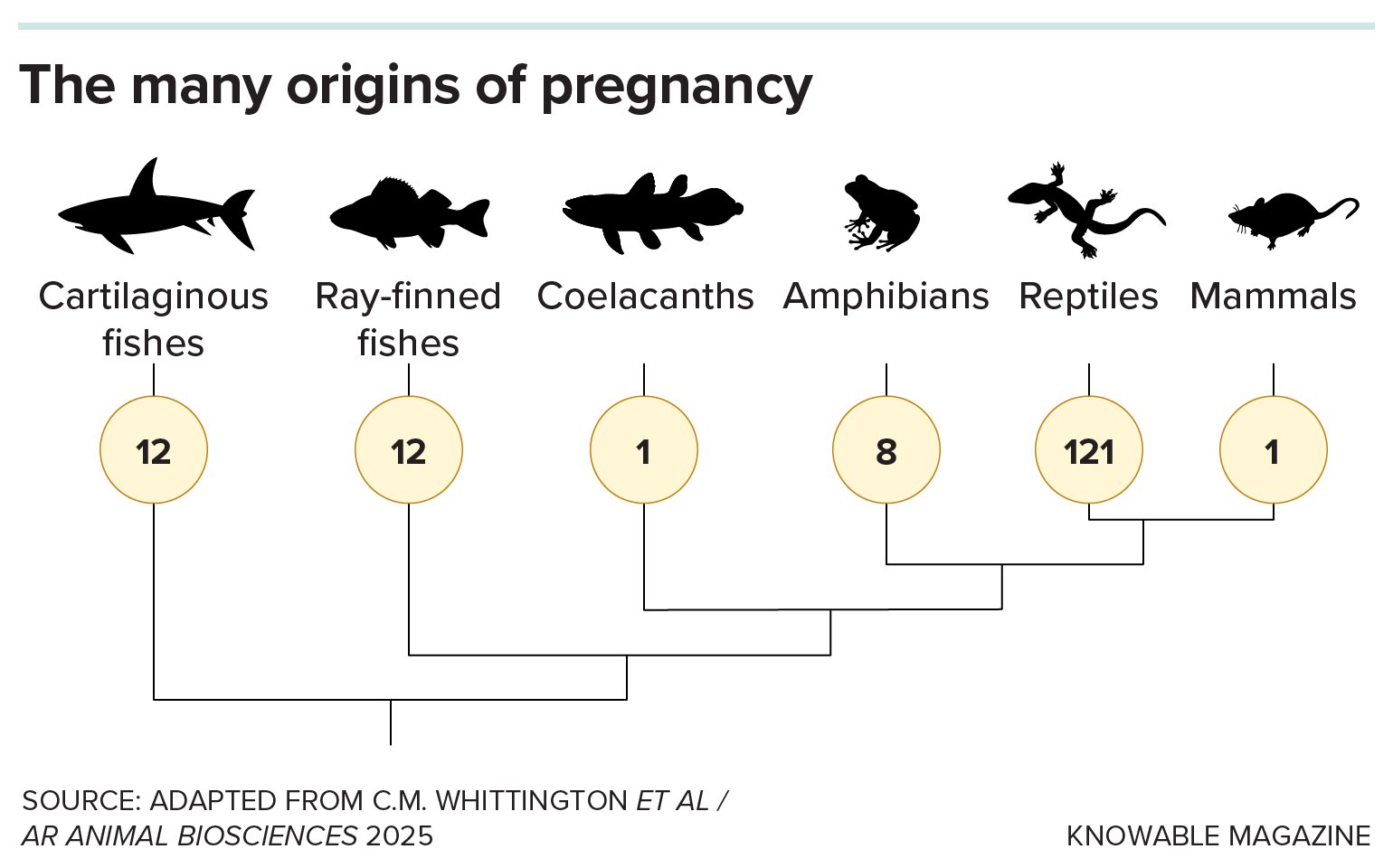
Fortunately for curious scientists, pregnancy wasn’t such a rare development in other groups of animals. “It seems to be something that happens with remarkable frequency,” says Rick Shine, an evolutionary biologist at Macquarie University in Sydney, Australia. Egg-laying fish switched to live birth a couple dozen times; amphibians did it a handful of times. The champions are lizards and snakes, a group that scientists call squamates, which evolved pregnancy an estimated 121 distinct times.
The multiple instances when pregnancy emerged make it a prime example of convergent evolution, where the same feature (like flight, opposable thumbs or camera-like eyes) arises in different lineages. Scientists can seek patterns in these numerous reproductive switcheroos: What steps, features or genetic changes do they share? The answers might offer clues to how pregnancy evolved in our own mammalian case.
Moving on from eggs
Though there’s some debate, most scientists believe that egg-laying is the ancestral form of reproduction among vertebrates. Switching to pregnancy offers clear advantages: Secure within mom, young are protected from predators and harsh environments.
There are also obvious costs. A pregnant animal will be heavier and slower, for a longer time, than an egg-layer. That makes it harder to seek food or escape from predators. And a pregnant animal — scientists use the term “viviparous” — can probably birth one litter per season. Egg-layers might manage two or even three clutches.
Perhaps this is why viviparity doesn’t seem to have been worthwhile for some animal groups: No birds give birth, nor do crocodiles or turtles. “There must be some extraordinary pressures to push you from an egg-bearing thing to a live-bearing thing,” says Daniel Hughes, an evolutionary biologist at Tarleton State University in Stephenville, Texas.
It helps that some animals already possess the essential biology. The necessary first step toward pregnancy is mating with internal fertilization, like reptiles do, rather than spawning sperm and eggs into water like many fish and frogs. And even lizards and snakes that lay eggs generally hang onto their embryos for about the first 30 percent of development, much longer than, say, birds. So they’re primed for the transition.
But other factors must have made the challenges of pregnancy worthwhile — especially in the case of snakes and lizards, which have taken this evolutionary journey so many times. For them, there are a number of hypotheses, but the one with the most evidence is linked to temperature.
Lizards and snakes that bear live young generally have a history of living in cold climates, even if they inhabit the tropics today, says Shine. It makes sense: When their egg-laying forebears migrated to chillier higher latitudes or altitudes, they risked their eggs’ dying or developing very slowly, delaying hatching, he says. Retaining them inside presumably solved the problem because pregnant females could move about to bask in the sun, keeping their embryos cozy.
Fish pregnancy is a different story, says Hughes, who recently investigated the origins of viviparity in sharks and their kin, a group called the Chondrichthyes, or cartilaginous fishes. A bit more than half of Chondrichthyes give birth. And Hughes was struck by the range of approaches the animals took — particularly in how mothers provide for the offspring growing inside them.
Some use placentas, like mammals do, transmitting nutrients in and wastes out across this special organ. Some secrete a milk-like substance into the uterus to nourish their young. And in some shark species, the growing embryos eat their mother’s eggs or their own embryonic siblings. “They have really taken pregnancy, as you would traditionally define it, and tested every variation that’s out there,” says Hughes.
Hughes speculates that the diversity is because the Chondrichthyes are truly ancient. They’ve been around for more than 400 million years, since the Devonian period, so they lived and adapted to their environment as Earth underwent the fusion and separation of the supercontinent Pangaea, the meteor strike that killed the dinosaurs, and diverse climate swings over millennia. They’ve had lots of time to explore diverse niches in the evolutionary space of pregnancy. In fact, Hughes’ research, published in 2024 in Biological Reviews, suggests 12 independent origins of pregnancy in this group.
But it’s still not clear what drove cartilaginous fishes toward viviparity so many times; it’s hard to study these ocean-dwellers in detail. In fact, though there are around 1,200 known species of chondrichthyans, Hughes could find definitive reproductive patterns for only 782 of them.
Based on a separate analysis published in 2023 in the Journal of Evolutionary Biology, Balázs Vági, a postdoctoral fellow at the University of Debrecen in Hungary, speculates that pregnancy in sharks might have arisen in species that live in open water rather than at the bottom of the sea. Live birth, he reasons, might save open-water sharks the trouble of finding a place to lay their eggs.
Viviparous sharks also tend to be larger and bear fewer, bigger babies than egg-layers; the larger size could position their offspring to quickly assume their place at the top of the food chain, he suggests, rather than be in a position of prey with nowhere to hide. But with so many gaps in shark reproductive data, it’s hard to say with confidence.
Amphibians also arose in the far-distant Devonian period. But though some of them care for their young and have evolved viviparity a handful of times, true live-bearers are “super-rare,” says Eva Ringler, a behavioral ecologist at the University of Bern in Switzerland. And as with sharks, it’s hard to say what pressured certain groups to give up egg-laying — but long winters were probably a factor in temperate species, she says.
Challenges of transition
With so many origins of pregnancy to study, scientists can investigate how the transition went down in those cases — and from there, infer how it might have happened for mammals. For squamates, at least, the process likely began with mothers holding on to their eggs a bit longer — and longer, and longer — until they were incubating babies right up to term, suggests Camilla Whittington, an evolutionary biologist at the University of Sydney who wrote about the evolution of pregnancy for the 2025 Annual Review of Animal Biosciences.
“It sounds kind of simple,” she says, “but that’s actually very complicated, physiologically.” Once the egg was cocooned inside the female reproductive tract, other changes would be required. One of the biggest challenges would be to deliver oxygen to developing embryos and take away carbon dioxide. A thick eggshell would get in the way, so that had to thin or disappear.
And the mother, the embryo or both had to reshape their tissues to be close enough to facilitate exchange of gases as well as nutrients. A placenta, for example, puts their blood flows in close contact.
Another big challenge would have been the mother’s immune system, because embryos contain paternal elements that make them appear foreign. So mothers must have evolved ways to tune their immune systems not to obliterate their own young. In mammals, that involves rebalancing inflammation. Less is known about how reptiles and other creatures fine-tune immunity during pregnancy.
While the necessary changes are clear, one major question is their sequence over evolutionary time, says Hans Recknagel, an evolutionary biologist at the University of Trier in Germany. “I would think that it just has to evolve very quickly,” he says, “so once you have one switch, there’s strong selective pressure to also have these other traits.”
The role of different genes
Scientists say the genetics behind the evolution of pregnancy is the exciting question in the field these days. A decade or so ago, they assumed that the transition would have involved major changes to the same or similar genes in each case where pregnancy arose. That view has changed. There are more genes that can change to create pregnancy than researchers thought.
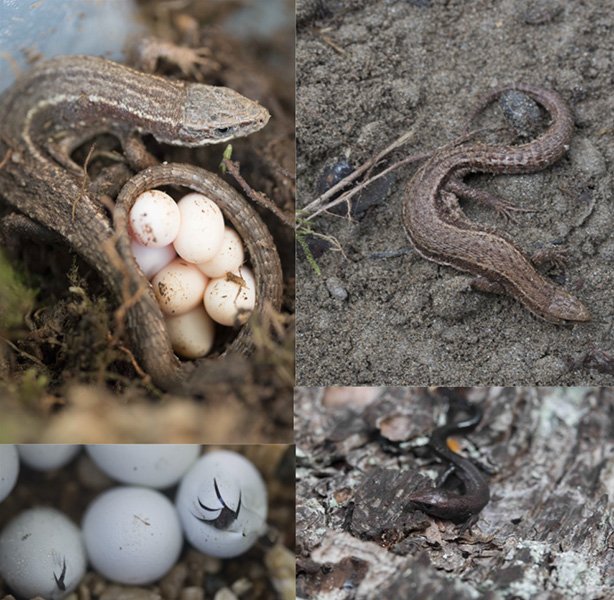
The new view is partly due to studies of a trio of lizard species that seem to be in mid-transition. In Australia, Shine, Whittington and others have been studying two species of skink that each have three populations: egg-layers, live-bearers and in-between forms. Whittington and colleagues even observed a three-toed skink (Saiphos equalis) that laid three eggs and then, more than a month later, gave birth to their fully developed sibling. “We have no idea why,” she says. In a 2020 study of the three-toed skinks, Whittington and colleagues reported in Molecular Ecology that the egg-laying and viviparous versions differed in how they used genes involved in key reproductive processes like gas and water exchange.
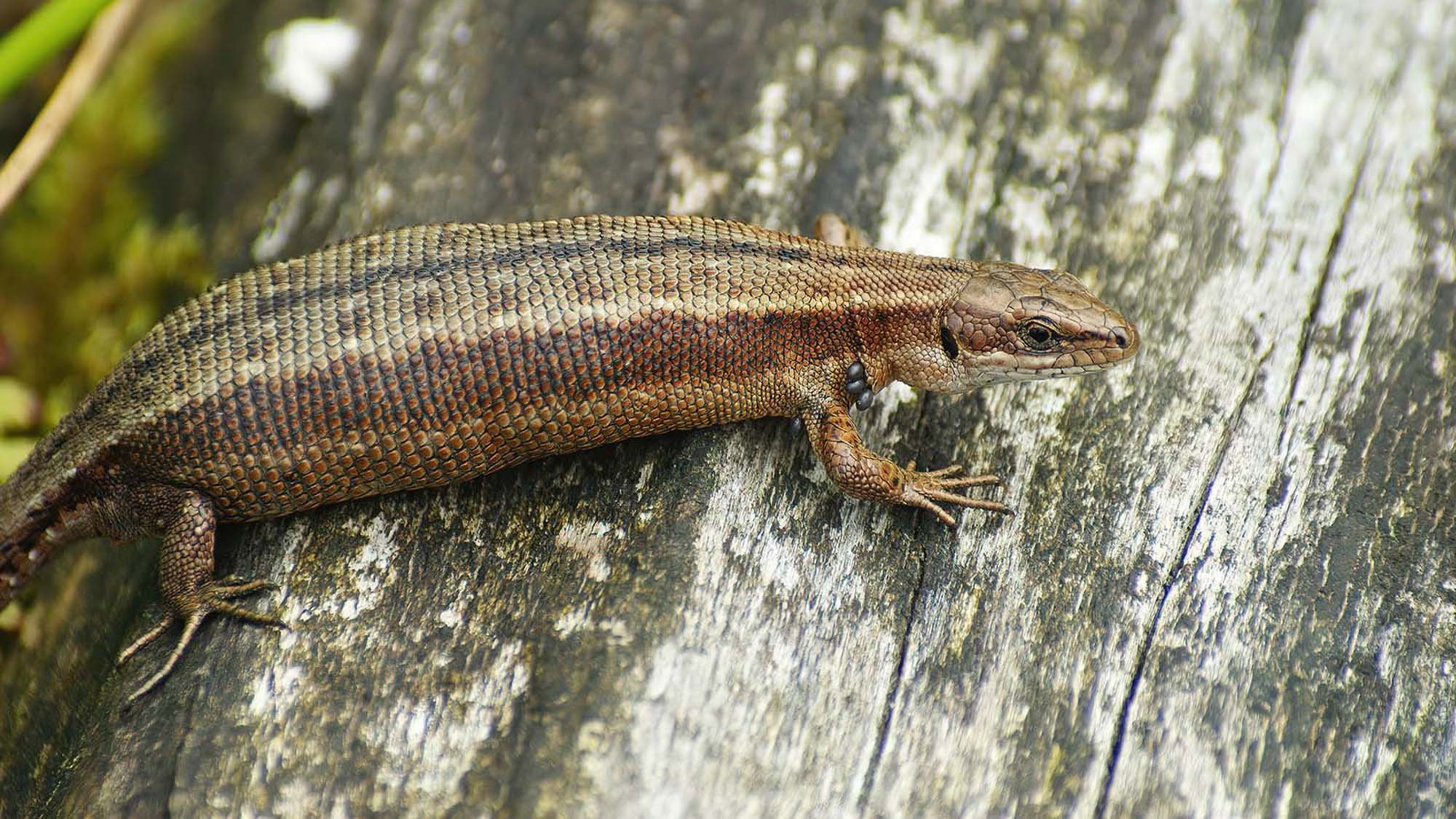
Additional revelations came from the other side of the globe, where the European common lizard, Zootoca vivipara, comes in both live-bearing and egg-laying forms. Live-bearers inhabit colder places than the egg-layers, but in 2010, herpetologists reported a startling find: a sliver of land in the Austrian Alps where the two groups overlap. And in that area, they observed suspected hybrids: a couple of females that, to a greater or lesser extent, laid thin-shelled eggs with embryos that were further along than those laid by the usual egg-laying variety.
That 2010 report caught Recknagel’s eye when he was a graduate student working with evolutionary biologist Kathryn Elmer at the University of Glasgow in Scotland. The hybrids provided a perfect natural experiment, the pair recognized: They would offer more clues about gene changes associated with pregnancy than merely comparing the genomes of pure egg-laying and viviparous animals. Within the hybrids are a bunch of gene variants shuffled this way and that way from individual to individual, like a deck of cards, and the scientists could investigate which genetic variants matched with features like how advanced the embryos were at the time of egg-laying, how long the eggs went before hatching, and how thick their eggshells were.
Those correlations could point to genes involved in the transition to pregnancy.
In 2013, Recknagel headed for the Alps and started catching lizards. After analyzing them, he and Elmer identified hundreds of genes that differed in sequence or activity between egg-layers and live-bearers. Comparing their findings to other viviparous animals, including mammals, reptiles and fish, they confirmed, writing in 2021 in Nature Ecology and Evolution, that the evolution of pregnancy involves changes in genes related to remodeling tissues, building blood vessels and controlling immunity — fitting nicely with the challenges that biologists had already noted.
Sometimes, the exact same genes seemed to be involved, such as one called LYPLA1 that has evolved to be less active in the viviparous lizards and, in cows, has been linked to pregnancy functions. Other times, different gene changes were probably behind the development of key evolutionary steps, like egg de-shelling or immune alterations, from one species to the next. Every species’ version of pregnancy seemed to involve a different set of genetic changes.
The complexity of the story uncovered so far holds lessons about convergent evolution and how early mammals first got pregnant. Creatures may take the same steps, such as thinning eggshells, to get where they’re ultimately going. They’ll most likely co-opt genes involved in related functions to get there — which, in the case of pregnancy, would be genes already relevant to egg-laying and reproduction. “It can’t just appear out of nowhere,” says Recknagel. “It has to have a history.”
Perhaps, he speculates, that’s why no crocodiles or turtles get pregnant; they may lack the right genetic starting materials.
But they don’t have to use the same genes every time, just as builders can reach the same goal with different tools, says Whittington. “You can hammer in a nail with a hammer; you can also use a mallet.”
And once it was done, it was done. Although scientists are still investigating, the transition to viviparity seems to have been a one-way street. “It’s difficult,” says Recknagel, “to re-evolve a hard-shelled egg.”
This article originally appeared in Knowable Magazine, a nonprofit publication dedicated to making scientific knowledge accessible to all. Sign up for Knowable Magazine’s newsletter.