
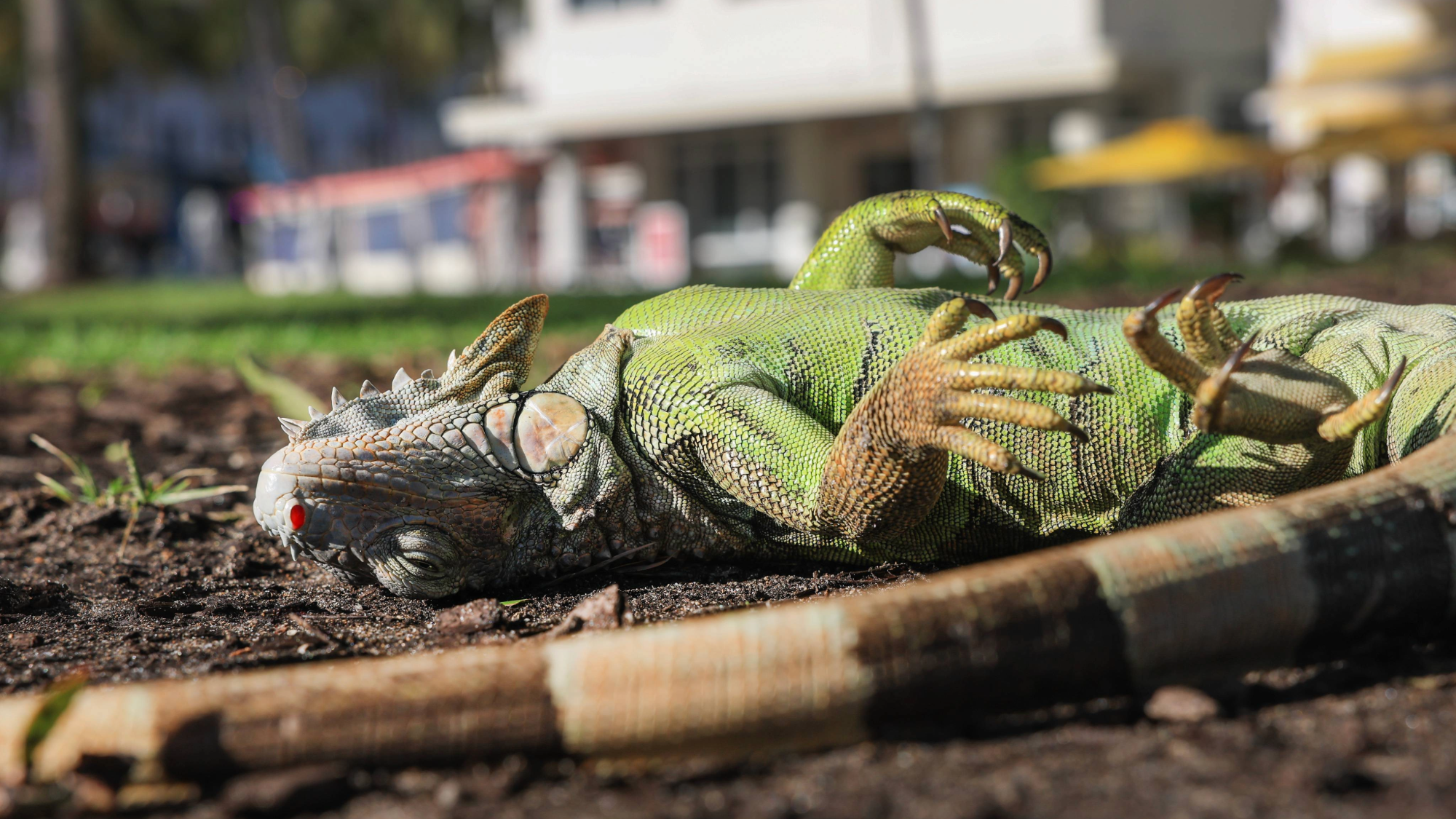
To state the obvious, it’s been a particularly frigid winter across most of the eastern United States. Winter’s icy grip has not even spared the Sunshine State, where a total of 5,195 frozen green iguanas—an invasive species—have been removed from the ecosystem and euthanized.
Green iguanas (Iguana iguana) are considered an invasive species in Florida. They were introduced in the state during the 1960s and can harm native fish and wildlife, cause damage, and may pose a threat to human health and safety. According to the Florida Fish and Wildlife Conservation Commission (FWC), nonnative reptile species like green iguanas and Burmese pythons are only protected by anti-cruelty laws and “can be humanely killed on private property with landowner permission.”
Cold weather can make things interesting when it comes to iguanas, and Florida has had no shortage of cold this winter. Miami saw its coldest February 1 on record at 35 degrees Fahrenheit, with wind chills down to 26 degrees. Reptiles like iguanas are cold-blooded and rely on external environmental conditions to regulate their body temperature. Since the outside temperature has such a drastic effect on their bodies, cold-blooded animals often adapt their behavior as a response. When air temperatures get below 50 degrees Fahrenheit, the reptiles will get stunned (or freeze), lose their grip, and fall from trees. After they fall from a tree, they may appear to be dead, but their body functions remain intact.
In response to the record-breaking cold, the FWC implemented Executive Order 26-03, which temporarily allowed people to remove live, cold-stunned green iguanas from the wild without a permit and transport them to wildlife officials. As a result, residents brought in 5,195 frozen iguanas between February 1 and 2. The iguanas were then euthanized.
Related Stories
“As an invasive species, green iguanas have negative impacts on Florida’s environment and economy,” FWC Executive Director Roger Young said in a statement. “The removal of over 5,000 of these nonnative lizards in such a short time span was only possible thanks to the coordinated efforts of many staff members in multiple FWC divisions and offices, our partners, and of course the many residents that took the time to collect and turn in cold-stunned iguanas from their properties.”
Frozen iguanas are also a uniquely Florida problem, since green iguanas primarily live in climates that are warmer. At up to seven feet long and weighing upwards of 30 pounds, a falling iguana can be dangerous, so pedestrians should exercise caution when walking under palm trees in colder weather. If you see a frozen iguana on the ground, do not rush in to warm them up. In normal circumstances, you may be fined for moving it somewhere else. Instead, it’s best to just leave the iguana alone since it should bounce right back once the temperatures hit 50 degrees again.
