
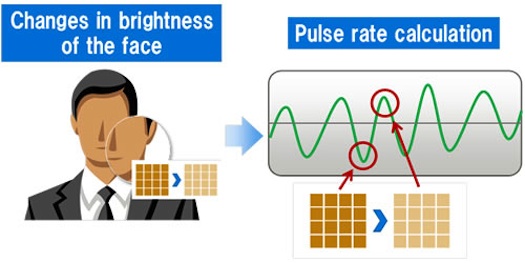
New software under development could let more smartphones, tablets and security cameras take people's pulses by recording their faces for 5 seconds.
Japanese technology company Fujitsu announced today it's working on the pulse-recording technology, which could help people track their own health, or spot suspicious reactions at concerts or at the airport, the company said in a statement. Fujitsu wants to have the tech ready for practical use within a year.
The new software uses cameras in devices to watch for the subtle color changes in people's faces when blood rushes in with every pump of the heart. A recent iPhone app from MIT works similarly. MIT has also developed software that exaggerates that color change so it's visible to the naked eye.
It's hard to tell exactly where people would use this. An easy pulse-checker for workouts would be cool, but MIT's Cardiio app already works for that. The Fujitsu statement suggests 9-to-5ers track their pulse throughout the day, but I've never been curious about my pulse during meetings or email-composing.
Tracking people at security checkpoints sounds interesting, but the technology would probably have to clear stringent tests showing its effectiveness before any country or agency would want to install something new and train all its employees for pulse-monitoring. At first glance, the technology sounds like it could mark too many people as suspicious for airport security. What if people have elevated heart rates just because they're nervous about traveling, for example? We'll see how much Fujitsu can do in a year.

[Fujitsu]
Five amazing, clean technologies that will set us free, in this month's energy-focused issue. Also: how to build a better bomb detector, the robotic toys that are raising your children, a human catapult, the world's smallest arcade, and much more.


Online Content Director: Suzanne LaBarre | Email
Senior Editor: Paul Adams | Email
Associate Editor: Dan Nosowitz | Email
Assistant Editor: Colin Lecher | Email
Assistant Editor: Rose Pastore | Email
Contributing Writers:
Rebecca Boyle | Email
Kelsey D. Atherton | Email
Francie Diep | Email
Shaunacy Ferro | Email
My last pay check was $9500 working 12 hours a week online. My sisters friend has been averaging 15k for months now and she works about 20 hours a week. I can't believe how easy it was once I tried it out. This is what I do,..business3.MEL7.Com
I hope the Japanese company is properly licensing the technology from Cambridge and MIT. The timing of this announcement is just too close to the release of the MatLab code release to be coincidental.
As far as usefulness, I think this technology will eventually be incredibly useful in all sorts of ways. Example good uses: emergency first responders assessing who is still alive at a glance; baby monitors. Example "bad" uses: secretly measuring changes in heart rate to gain advantages in negotiations, poker, dating, etc..
The breakthrough here is that the technology is simply software that uses existing ubiquitous technology, and is cheap as a result. Imagine adding inexpensive cameras to your bedroom and other living environments, configured to simply measure heart rate (not record video). It would be an interesting way of producing a log of your health by way of heart rate (resting heart rate when you first wake up, etc.). You'd forget that the monitors were even there since they'd require no interaction ... no wrist straps, etc..
The possibilities are many. It's very exciting technology.
well i wont b!tch around for the first time that new tech is going that fast into masses!
any android versions for the future?...
or hell i thing that by that time ill switch to ubuntuOS for my phone as samsung is patening this sh!t...
---
No facts, No response...