
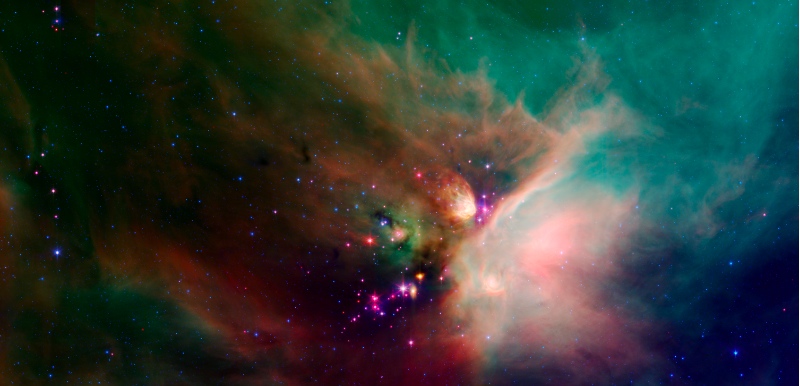
In space, loose clouds of gas generate spontaneous laser emissions all the time. Now, physicists are for the first time creating lasers from gas clouds here on Earth--lasers unlike any gas-based laser we've ever seen.

Creating Lasers From Clouds Of Gas Out in the cosmos, planetary and stellar atmospheres occasionally generate natural lasers from light bouncing around within clouds of gas. Now, physicists have replicated that process on Earth for the first time. via ArXiv

Astronomers have long been baffled by lasers that occur naturally out there in the universe, sending bursts of intense optical and microwave light streaming across the cosmos at specific frequencies. Scientists quickly realized that the atmospheres of stars and planets were generating laser light since they first began detecting them fifty years ago, but the mechanisms by which they do so have remained a mystery. Until now, that is. Physicists here on the home planet have created the first Earth-based laser made from a cloud of gas, reproducing for the first time these naturally-occurring space lasers.

Lasers are nothing more than a contained group of atoms (that emit light at a certain frequency) that are excited by inserting energy into the system. This light emission is triggered by bouncing light back and forth past the atoms, generally by placing mirrors at either end of the group of atoms. Sometimes the atoms are contained in a crystal, other times in an optical cavity that contains gaseous atoms, but the setup is generally the same: confined atoms plus light bouncing between mirrors through said atoms equals an emission of specifically tuned light.

But out there in space there are no mirrors, nor are the atoms in stellar or planetary atmospheres contained within a crystal or cavity--and this is what puzzled astronomers. But researchers have found another route to lasing that provides a clue. So-called random lasers have been developed in recent years that employ some kind of unconfined, disordered medium like a semiconductor powder to create laser emissions. In random lasers the light bounces around inside the medium based purely on the medium’s disorder without having to be confined or book-ended with mirrors.

It turns out naturally-occurring space lasers work the same way, but there’s still a catch: The powdered mediums used in random lasers are very different than gas clouds in space. And that’s the facet that researchers at the Institut Non Linéaire de Nice in Southern France have finally figured out. Using a cloud of rubidium atoms contained within a magneto-optical trap, the team has created an Earth-based laser from a gas cloud for the first time. When the team introduces light tuned close to rubidium’s expected emission frequency it goes bouncing around inside the gas cloud at random--just as it does in natural space lasers.

The ability to recreate this phenomenon in the lab will allow astronomers and physicists to examine this mechanism up close for the first time, but it could also have broader implications. Such a natural laser could lead to new kinds of artificial light made with gaseous atoms that currently haven’t been explored as potential laser light sources. That could spell new kinds of artificial light--the same kinds manufactured by the cosmos but on a much smaller scale.

Much more on this over at Technology Review.

[Technology Review]

9 Comments

I beat Robot here. lol

relieht.evad.
Your profile is 11 minutes old and you are pre-occupied with posting prior to me.

Look, I read the article and found it interesting. For the moment, I could not think of anything to say so I paused in posting. I could have posted exactly when the article showed, but chose not to.

Please forget me, read the article, come back later and post something relative to the article.
Take care. ;)

I do find this article fascinating that laser light does occur naturally!

As long as someone is wrong on the Internet, my pseudo intellect will persevere.

My long-winded responses will grow.

"The Commenting" shall continue.

I wish I could remove this and the above 3 comments.

Out in space there are no mirrors. How do they parallel park?

The Phantom Zone was a perfectly good mirror before General Zod broke out.

I do find this article fascinating that laser light does occur naturally!

Do not give up Robot! The forces of darkness and misery may seek to blot out your genuinely cheerful posts, but you can not give up now.

Together, we shall hold. Together, we shall continue to bring light and peace to a world which needs it desperately.

As your people would say, "beep boop, bop beep", Brother.

No one cares.

Pretty Cosmos Cosmic Picture!

......................
SPOOKY!...... Life is


140 years of Popular Science at your fingertips.


Popular Science+ For iPad

Each issue has been completely reimagined for your iPad. See our amazing new vision for magazines that goes far beyond the printed page


Download Our App

Stay up to date on the latest news of the future of science and technology from your iPhone or Android phone with full articles, images and offline viewing


Follow Us On Twitter

Featuring every article from the magazine and website, plus links from around the Web. Also see our PopSci DIY feed


February 2013: How To Build A Hero

Engineers are racing to build robots that can take the place of rescuers. That story, plus a city that storms can't break and how having fun could lead to breakthrough science.

Also! A leech detective, the solution to America's train-crash problems, the world's fastest baby carriage, and more.


Online Content Director: Suzanne LaBarre | Email
Senior Editor: Paul Adams | Email
Associate Editor: Dan Nosowitz | Email

Contributing Writers:
Clay Dillow | Email
Rebecca Boyle | Email
Colin Lecher | Email
Emily Elert | Email

Intern:
Shaunacy Ferro | Email

circ-top-header.gif
circ-cover.gif