It would take a light-speed craft 4 billion years to get from one side of the group to the other.

The Largest Structure In The Universe
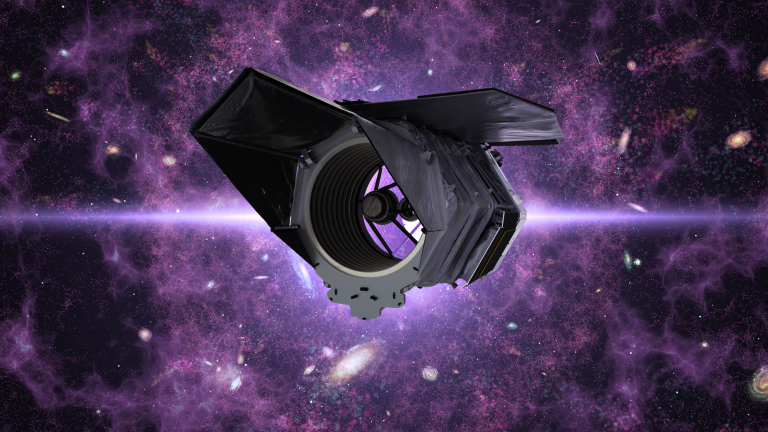
The Largest Structure In The Universe And the brightest. Artist's rendering, of course. ESO/M. Kornmesser

Behold, the largest structure in the universe. An international team of astronomers has discovered a large quasar group (also known as an LQG) that is some 4 billion light years across. For comparison, that’s something like 1600 times farther than the distance between the Milky Way and the “nearby” Andromeda Galaxy.That’s huge.

It’s also really far away. Quasars are the cores of galaxies during the early days of the universe. Periodically, these cosmological artifacts emit huge amounts of extremely bright light, which makes them visible across vast distances of space. This LQG is so far away that it looks as it did when the universe was just 770 million years old. It is hands down the brightest object we’ve ever observed out there, so bright and huge that it actually challenges one of the underpinnings of modern cosmology: the Cosmological Principle.

The Cosmological Principle is the assumption that the universe, if viewed from a large enough scale, looks the same no matter where you are viewing it from. It’s one of those things that fits in with the work theorists like Einstein and others who have vastly influenced 20th- and 21-st century cosmological thinking, but that we obviously can’t observe. Cosmologists (generally speaking) just believe it, or at least recognize it. But the Cosmological Principle, when factored into the prevailing theories of cosmology, suggests that astrophysicists shouldn’t be able to find anything bigger than 370 megaparsecs (again, for scale, the distance from here to Andromeda is roughly 0.75 megaparsecs, or 2.5 million light-years).

This new LQC appears to average more like 500 megaparsecs across, with its longest dimension reaching up to 1,200 megaparsecs. That doesn’t necessarily mean the Cosmological Principle is toast, but we may have to take what we think we understand about it back to the drawing board.

19 Comments

"...but that we obviously can’t observe. Cosmologists (generally speaking) just believe it, or at least recognize it. "

As with most things in cosmology...

In the broader flux of the Universe what we can observe is nothing more than a spec of dust in an exponentially larger Universe and were actually just a part of a finger of an organism in that Universe--ad infinitum. The size of the Universe is infinitely large and small and no limits to either.

As the universe expands so should our cosmological view of the universe.
Static in an ever changing plane of existantce.. is just outdated.

as the article says this object is so far away it existed during the early life of the universe so the laws of physics may have been a bit differant then, but even if the laws of physics have not changed if we could somehow see what that part of space looks like today we might find it is very much like local space basically theres no way of knowing if that rule is good or not becouse it is so far away we will never know what that part of space actually looks like right now !

Wonders, Wonderful, WoWzers the painting of discover science makes that our dear Lord has made!

Will someone please fix the Special Relativity howlers that accompany this story?!

In the standfirst:
"It would take a light-speed craft 4 billion years to get from one side of the group to the other"

Erm, no. For starters, only particles with zero rest mass can be accelerated to the speed of light. And even if we could put a clock on a photon, a photon has no frame of reference.

Alternatively, let's imagine what would happen if we were travelling in a spacecraft crossing the Large Quasar Cluster at *very close* to the speed of light...

We would experience extreme time dilation etc, and so only a few seconds would pass for us as travellers (depending on how close we are to the speed of light).

In other words:
"It would take a near-lightspeed craft just a few seconds to get from one side to the other, in the spacecraft's frame of reference. But meanwhile, more than 4 billion years would pass for observers not travelling near the speed of light."

Don't they teach Special Relativity in schools any more? Has no-one watched Carl Sagan's Cosmos? Perhaps it is almost rocket science, but really not that hard...

Sure, I know the original press release for the LQC discovery contains the same howler - but for the love of spaghetti monsters, I wish folks would think about what they're writing rather than just copying!

Oh, I'm sure larger objects exist. Do you think a bacterium living in our intestine can perceive our size and how we look?

quatra1001,
Ah, to envision the space surrounding all that we discover. What is the boundary of space, let alone the extreme large objects found inside of it? WOW!

SPACE!

We humans always focus on the tangible and often in life we are disappointed when we cannot see GOD, the tangible.

What if our Dear Lord is "SPACE"?

Now if your look about you as you sit here reading my words, considers the space that surrounds you and you suddenly will learn our Dear Lord is with you and is always with you!

Now you know, you are never really alone. Our Dear Lord is always with you, always.

Robot,

aah robot... i have to view an article every week for "current events" and on almost every interesting article you make a comment. i always look for your comments and read them cause honestly, your the most lively user on this website. Anyway, lets wrap this up... I made an account just to say hi to you basically and i would like to be your apprentice! LOL

Robotron,
Number 1 rule package of apprenticeship. Forget me, be yourself, comment often and encourage others to comment too. If others insult you or make fun of you, still encourage as many as possible to comment. On occasionally my buttons do get push and I become badly in my responses – learn to let go and still encourage as many possible to comment.

I see life connected and so when I read an article it may seem I go off on tangents, but if you know my personality, I am really just being myself. Because of this personal view, people sometimes consider me trollish. I do not want to be a troll and do not encourage its behavior.

Finally, remember this is PoPSCi home, not yours or mine; their rules apply, mine do not.
Keep good manners. Take care. ;)

Why is this surprising? Of course course there were going to be new galaxies close together way in the past. This thing doesn't even exist any more. In the time it would take to make it across it would already have changed into modern galaxies.

If a piece of LQG isn't supposed to be able to influence the content of space over 370megaparsecs away, how can it veto another such large adjacent volume of space also happening to contain an LQG?

The finding of that extremely vast quasars group at very faraway is the advantage to "Cloud & rain model" rather than "The Big Bang theory".

When they develop a new science about just studying space, I want to be the first applicant for this job.
I have lots of experience contemplating all day long about nothing, lol. ;)

can someone tell this nitwit that its measured in light years so at the speed of light it will take 4 billion years to traverse.

This is just God's way of showing us how limited our knowledge is and how vast his ability is. I don't believe in aliens yet but this quasar has made me ponder about the possibility a bit more.

@alexthependant
if the scientists choose to imagine an idealized light-speed craft that takes 4 billion years to traverse the LQG, perhaps you should let it go. Besides, more than likely we will achieve greater than light speed when we figure out how to induce negative mass. If such a thing were possible, there would be no maximum speed and eventually traveling to any spot in the Universe would be instant with no time dilation. Regarding that, at light-speed it really doesn't matter what perceived time the travelers experience unless they plan to never stop. Once they return to their original reference frame, 4 billion years will have passed.

I wonder if this release is more sensational than it needs to be. Looking at the graphic in the original publication, it seems to me that the other quasar group shown is also quite large. The cosmologists probably expect to find more 'objects' in this size range keeping their principle intact.

I contemplate and behold, I am there, time travel and the furthest edges of space. POOF!

@Bagpipes100
I do not believe the the Cosmological Principle is in any way make belief. It is simple logic based on everything cosmologists know about the Universe. Plenty of data strongly points to the Big Bang/Big Bounce. The principle is based on an expectation that the explosion and expansion should have been very uniform. If unusual structures are found, it tests the entire theory. However, we have limited vision at the moment so finding one 'object' of this size may only mean that we will find many more in the future. It is quite normal that each time something seemingly unusual is found, it potential throws a wrench into any theory ... until it is later found to be quite normal, which is what happens almost every time. The cosmologists are simply teasing us to keep us interested.


June 2013: American Energy Independence

Five amazing, clean technologies that will set us free, in this month's energy-focused issue. Also: how to build a better bomb detector, the robotic toys that are raising your children, a human catapult, the world's smallest arcade, and much more.


Online Content Director: Suzanne LaBarre | Email
Senior Editor: Paul Adams | Email
Associate Editor: Dan Nosowitz | Email
Assistant Editor: Colin Lecher | Email
Assistant Editor: Rose Pastore | Email

Contributing Writers:
Rebecca Boyle | Email
Kelsey D. Atherton | Email
Francie Diep | Email
Shaunacy Ferro | Email

circ-top-header.gif
circ-cover.gif
bmxmag-ps