
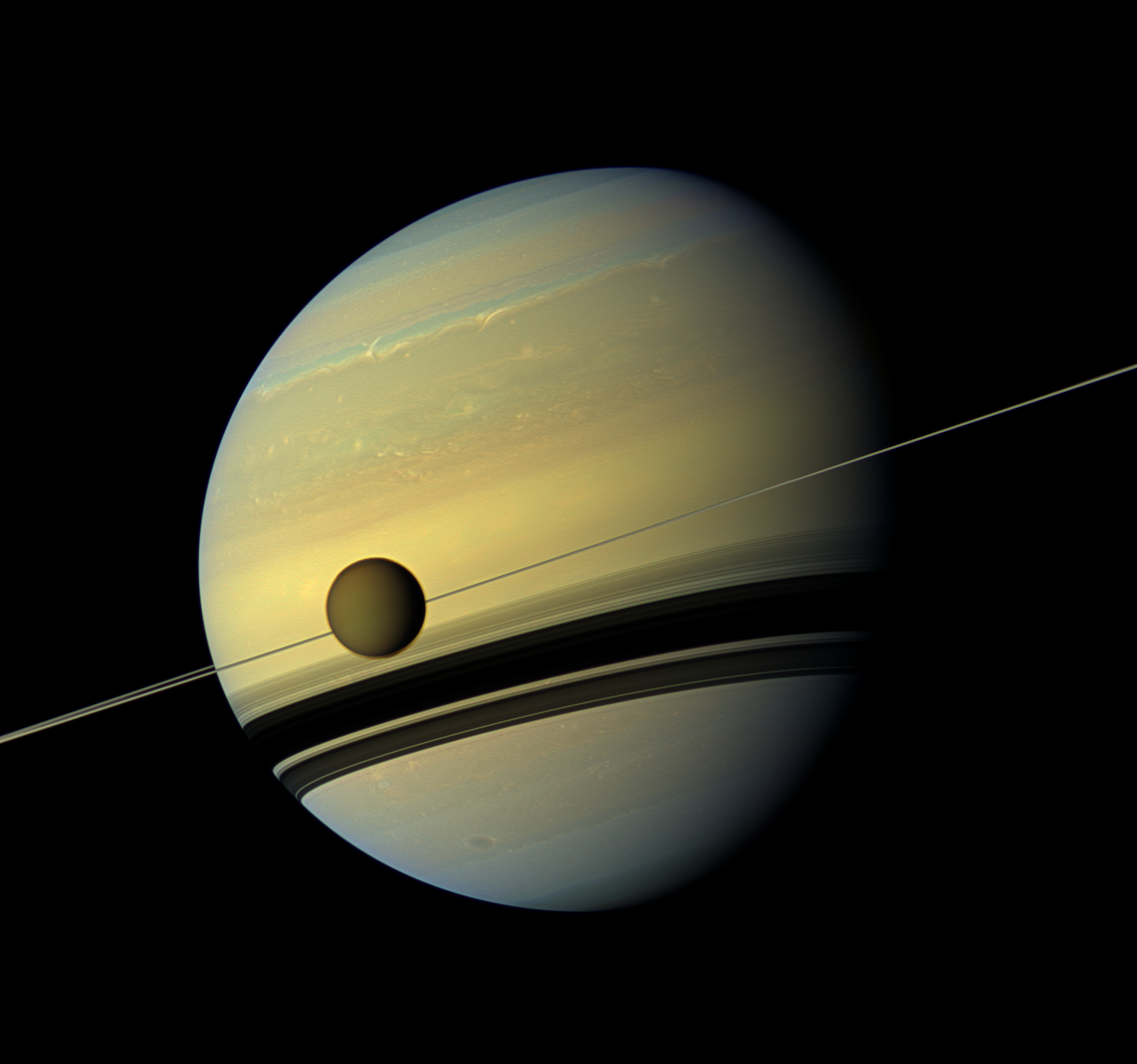
Guest starring Titan, Saturn's largest moon

Saturn, with Titan in the Foreground NASA/JPL-Caltech/Space Science Institute

Curiosity, you are such an amazing space mission that we will sacrifice a thousand blog posts, a million gallons of newsprint even, in your honor. But can you do this? NASA’s Cassini probe, not content to be forgotten in its faraway orbit around Saturn and its moons, has beamed back new natural-color images of the ringed planet that are absolutely breathtaking. Released yesterday, they show a very different planet than the one Cassini arrived at eight years ago.

The above image--can we call it a work of art?--is actually a six-image mosaic that captures Saturn’s moon system in perfect profile. That is, the thin line traversing the image is the ring system, viewed on its edge (you can see shadows cast by the rings on the lower half of the planet). In the foreground is Saturn’s moon Titan, the planet’s largest moon and one that is larger than the planet Mercury.

The symmetry in this image is dazzling of course, but it’s more than just a pretty picture. Seasons change slowly way out there at the outer planets, where revolutions around the sun take many, many Earth years. The blue hues indicative of Saturnalian winter that populated the northern hemisphere when Cassini arrived there in 2004 are fading now, resurfacing in the southern hemisphere where winter is coming on. Cassini is watching the seasons change in slow-motion there--the first time scientists have been able to witness this up close.
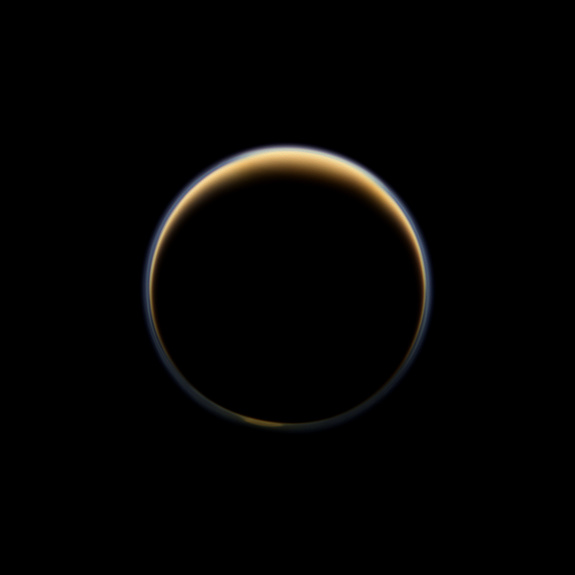
Titan, Backlit by Sunlight:  NASA/JPL-Caltech/Space Science Institute

Another image from the collection released yesterday shows Titan ringed in a halo of light, an effect created by sunlight streaming through the moon’s thick atmosphere. Titan is also undergoing seasonal changes, as are Saturn’s other moons. Cassini will continue observing them though at least 2017, the expiration date of the mission’s most recent extension.

[SPACE]

4 Comments

It's hard to believe that Cassini has been dazzling us with its images for almost a decade now. Its portfolio is truly breathtaking.

www.ciclops.org/ir_index_main/Cassini

Saturn is for lovers!

Since the gravity of small moons can easily be escaped by tether would it be cheaper to send fuel from far away from a moon like titan, or to rocket it from earth?

Here’s the plan.
Fuel is the biggest drag on space travel. Most of the expense is wasted on wind resistance of getting rockets into space. With a reactor and water at the end of a tether on the Moon, Mars or even Titan, we can make that fuel for decades, and put it just above the atmosphere for space plane to rendezvous with. With only two launches one for the tether and one for the reactor you could cost effectively replace the space shuttle with monthly flights into space. By taking the risk of launching one reactor in space, you could increase safety, and reduce the expense, of going into space enough to reach Mars in less than a decade. All the components exist today, are possible today, and could be done tomorrow.

@tmarti, You could be right in that we may be ready to pull a throw system off, but there are a lot of operational requirements where data is still being collected that go beyond basic technologies currently on deployment anywhere. Consider the Titan ground level info available. I don't know what all NASA knows, but mining includes digging, which means highly accurate full spectrum scanning of every known type at ever increasing depth, most of which we are still very much in development on. Or would you be willing to burn the first reactor? Failure is a killer to NASA. They aren't willing to do that.


June 2013: American Energy Independence

Five amazing, clean technologies that will set us free, in this month's energy-focused issue. Also: how to build a better bomb detector, the robotic toys that are raising your children, a human catapult, the world's smallest arcade, and much more.


Online Content Director: Suzanne LaBarre | Email
Senior Editor: Paul Adams | Email
Associate Editor: Dan Nosowitz | Email
Assistant Editor: Colin Lecher | Email
Assistant Editor: Rose Pastore | Email

Contributing Writers:
Rebecca Boyle | Email
Kelsey D. Atherton | Email
Francie Diep | Email
Shaunacy Ferro | Email

circ-top-header.gif
circ-cover.gif