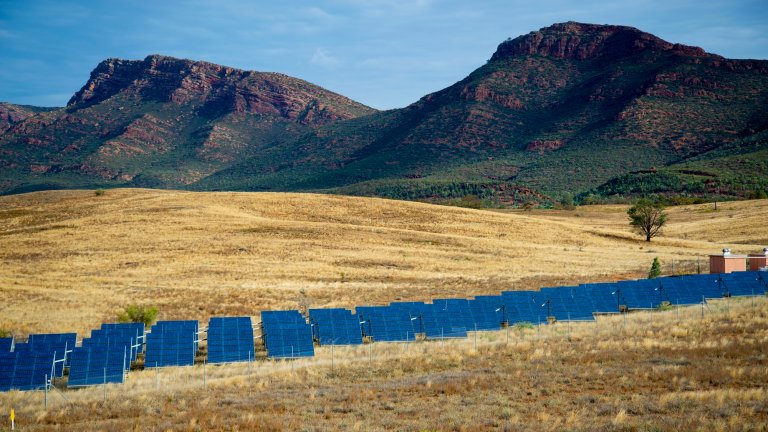
Concentrated solar power plants could get an efficiency boost inspired by flowers, according to MIT researchers. Designing solar mirrors in a spiral pattern similar to sunflower heads could reduce the space required for CSP plants and increase the amount of sunlight the mirrors collect.
Concentrated solar plants use an array of mirrors, called heliostats, that move with the sun as it tracks across the sky. They are installed in concentric circles and direct sunlight to a central tower, where heat is converted into electricity. There are only a few operational CSP plants in the world, partly because they require lots of space. Each heliostat must be arranged so it faces the central tower but also the sun, all without blocking another heliostat’s face. Current designs stagger the heliostats so that every other circle aligns, much like rows in a movie theater, according to MIT News.
Researchers at MIT and RWTH Aachen University in Germany came up with a better way to arrange them. First they studied efficiency problems in the existing layout, finding each mirror experiences some shading and blocking problems every day. Alexander Mitsos and Corey Noone of MIT developed a computer model to bring the heliostats closer together, and they noticed the suggested patterns looked a lot like spirals found in nature. So they turned to sunflowers for further inspiration.The head of a sunflower plant is not really a flower, but a group of small flowers (called florets) crowded together. The ones on the outside hold the petals, and the ones on the inside, which are called disc florets, develop into seeds. The disc florets are arranged in a spiral pattern that orients them at 137 degrees (the golden angle) with respect to each other. The angle produces a pattern of interconnected spirals that follow the Fibonacci sequence.
With this in mind, Mitsos and Noone devised a spiral heliostat field wherein each heliostat was oriented 137 degrees relative to its neighbor, MIT News says. This layout takes up 20 percent less space than the typical concentric circles, and there’s less shading and blocking. The design could be used to build more efficient CSP plants in less space, the researchers say. They’ve filed for a patent.
[MIT News]
140 years of Popular Science at your fingertips.
Each issue has been completely reimagined for your iPad. See our amazing new vision for magazines that goes far beyond the printed page
Stay up to date on the latest news of the future of science and technology from your iPhone or Android phone with full articles, images and offline viewing
Featuring every article from the magazine and website, plus links from around the Web. Also see our PopSci DIY feed
Engineers are racing to build robots that can take the place of rescuers. That story, plus a city that storms can't break and how having fun could lead to breakthrough science.
Also! A leech detective, the solution to America's train-crash problems, the world's fastest baby carriage, and more.


Online Content Director: Suzanne LaBarre | Email
Senior Editor: Paul Adams | Email
Associate Editor: Dan Nosowitz | Email
Contributing Writers:
Clay Dillow | Email
Rebecca Boyle | Email
Colin Lecher | Email
Emily Elert | Email
Intern:
Shaunacy Ferro | Email
It's funny that we can patent things found in nature. :) To bad the sun flower didn't file for one first. lol
---
In space, no one can hear a tree fall in the forest.
Here is a good video about natural patterns:
"Nature by Numbers"
http://www.youtube.com/watch?v=-WF6V9RQFz8&feature=related
This is a great video.
Boo on the patent attempt.
Thanks,
-Tony
Nature works in harmony with the environment.
When our desires and wants push and take and oppose the harmony of life, we create our own hardship, suffering and inefficiency.
Synchronize to nature and minimize your wants and desires and life will bring abundance to you.
Walk in peace. ;)
“I copied a flower. Now I apply for a patent."
Has anyone yet filled for a patent for the
SUN
MOON
TIDES
RAIN
OCEANS
WINDS
LIFE
ROCKS
LIVING
DIEING
WALKING
RUNNING
SINGING, etc.... LOL
......................
SPOOKY!...... Life is
A dome dotted by computer controlled frenel lens, a huge parabollic mirror beneath, and greenhouse gas for heat retention within the dome itself, still seemed more efficient for solar thermal since it won't be as affected by the wind or temperature fluctuations caused by erratic weather patterns. Not to mention that incorporating an extra outer layer to the dome made of transparent PVC puts an additional capacity for exploiting solar energy while practically occupying the same space.
*fresnel
(where's the edit button when you need one?)
I had some Frenel and dip last night. It was delicious..
Or
That Frenel soup was so good.
Or
Looking at your xray, we notice a very interesting Frenel.
Or
Isn’t Frenel next to France?
Or
Seems not we even have faster than Neutrinos speed. We call it Frenel DRIVE!
Ok, I am done now…..lol
.............................
Science sees no further than what it can sense.
Religion sees beyond the senses.
edit2: I also meant transparent photo-voltaic cells (PVC), not polyvinyl chloride.. haha..
Come to think of it, I wonder how effective it would be if transparent PV cells are layered on top of each other like onion skins turning them into multi-junction solar cells? hmm..
They want a patent for this?
The thing is this is the third such story I've seen right here on PopSci.
The first was that guy who designed solar charging stations in the shape of trees for efficiency and shade on the highways. (readers called it stupid)
The second was the kid who went for a hike in the forest and came up with the idea of using the pattern in the branches to build his own solar array. (readers called it brilliant)
Just check the related stories.
Now MIT wants credit for this like they thought of it first, or even were the first to figure out how to put it in practical use?
MIT should patent their proprietary system, the concept itself is already public domain and was independently reinvented many times.
@killerT: there must be some level of novelty/uniqueness to emulating plant life for solar power because most of the world is still just lining them up like usual.
Also, MIT has done the research on the specifics of the arrangement and angles of the florets AND figured out how to apply that information to something that isn't a flower. Mainly it's that second part that makes this patentable.
Can I patent an icon?
Yea, patenting some ideas are kinda stupid. Most people share their ideas freely, while others have the selfish tendency to think that everything that pops into their heads are theirs alone regardless of it's readily observable abundance in nature or the casual flow of developing trends.
Yes, I am talking about people like you Steve Jobs, er.. RIP.
this isn´t new
google: boy finds pattern solar power
Google is evil and the sheep or led blindly by this sheep herder...
.............................
Science sees no further than what it can sense.
Religion sees beyond the senses.
Biomimicry = Wheel Already Created. We don't need to recreate it!!!