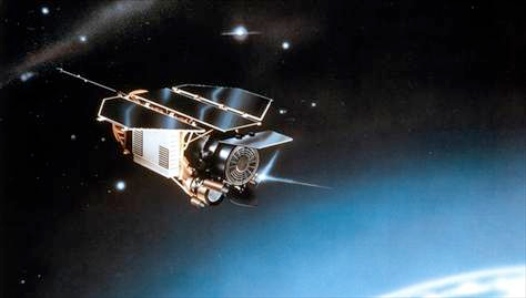
If you’re feeling lucky after NASA’s UARS satellite fell safely from orbit into the middle of the Pacific--rather than into the middle of Portland--let’s hope your luck doesn’t run out. The German Aerospace Center says the retired ROSAT satellite’s orbit is rapidly decaying, and pieces of it could start falling from the sky as early as Friday and up until Monday. That should make for an exciting weekend.
The 2.69-ton ROSAT is roughly the size of a minivan, and though parts of it will burn up in the atmosphere upon reentry, experts think as many as 30 pieces will survive the plunge to Earth. There’s no telling where they might land, of course, and pretty much every bit of real estate between 53 degrees north and 53 degrees south is a candidate landing zone.
But remain calm. The odds of that happening are very slim. In fact, the likelihood of someone somewhere on Earth being struck by a piece of ROSAT has been roughly calculated to 1-in-2,000--slightly higher than the odds with UARS because there are more and larger pieces coming down this time. But spread those already-long odds among the billions of people living between 53 degrees north and 53 degrees south, and your personal odds of being struck down by space debris are more like 1-in-14 trillion.
[AP]
Five amazing, clean technologies that will set us free, in this month's energy-focused issue. Also: how to build a better bomb detector, the robotic toys that are raising your children, a human catapult, the world's smallest arcade, and much more.


Online Content Director: Suzanne LaBarre | Email
Senior Editor: Paul Adams | Email
Associate Editor: Dan Nosowitz | Email
Assistant Editor: Colin Lecher | Email
Assistant Editor: Rose Pastore | Email
Contributing Writers:
Rebecca Boyle | Email
Kelsey D. Atherton | Email
Francie Diep | Email
Shaunacy Ferro | Email
Another one bites the dust! Hey! Hey!
Interesting side note of hacking, and so on....
Allegations of cyber-attacks causing the failureIn 2008, NASA investigators were reported to have found that the ROSAT failure was linked to a cyber-intrusion at Goddard Space Flight Center. This was also reported through Bruce Schneier's blog, a highly-regarded commentary on IT security issues.
The root of this allegation is a 1999 advisory report by Thomas Talleur, senior investigator for cyber-security at NASA. This advisory is reported to describe a series of attacks from Russia that reached computers in the X-ray Astrophysics Section (i.e. ROSAT's) at Goddard, and took control of computers used for the control of satellites, not just a passive "snooping" attack. The advisory stated:
"Hostile activities compromised [NASA] computer systems that directly and indirectly deal with the design, testing, and transferring of satellite package command-and-control codes."
The advisory is further reported as claiming that the ROSAT incident was "coincident with the intrusion" and that, "Operational characteristics and commanding of the ROSAT were sufficiently similar to other space assets to provide intruders with valuable information about how such platforms are commanded,". Without public access to the advisory, it is obviously impossible to comment in detail. However it does seem to describe a real intrusion, there is a plausible "no attack" explanation for ROSAT's failure, and the report is claimed to link the two incidents as no more than "coincident". IT security remains a significant issue for NASA, other systems including the Earth Observing System having also been attacked.
@Grunt,
wtf are you talking about.
on a serious note, i hope a piece lands on my lawn.
_________________
The people of the world only divide into two kinds, One sort with brains who hold no religion, The other with religion and no brain.
- Abu-al-Ala al-Marri
JediMindset,
Fair question, I found the above information near the bottom of
http://en.wikipedia.org/wiki/ROSAT
I was just adding more interesting information to this article, other than another satellite falls down.
@Grunt,
ohhh ok. thanks for the information.
_________________
The people of the world only divide into two kinds, One sort with brains who hold no religion, The other with religion and no brain.
- Abu-al-Ala al-Marri
I hoped bringing up the hacking would inspire more conversation. I guess it did not help.