
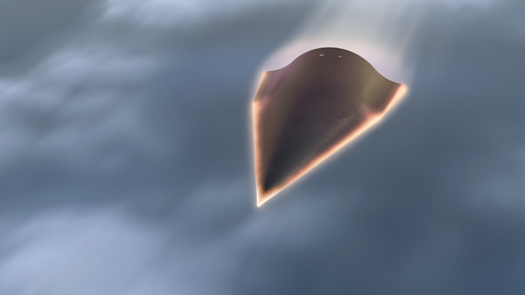
Last week, DARPA’s HTV-2 (Hypersonic Technology Vehicle 2) Falcon vehicle launched to near-orbital speeds aboard a Minotaur rocket before beginning what was designed to be a Mach 20 glide back to earth, demonstrating the kind of hypersonic capability needed to deliver a payload anywhere in the world in an hour. Then, a few minutes into its flight, HTV-2’s data transmitters went silent and so did the DARPA news stream feeding us the play-by-play.
Now we know what happened to HTV-2. Sort of.
HTV-2 separated from its Minotaur carrier rocket successfully and entered the descent phase of its flight with all systems looking nominal. But somewhere “post-perigee”--where it was supposed to start climbing again--HTV-2 encountered a flight anomaly that caused its autonomous systems to initiate a controlled termination of the flight. That is, the computer took over and crashed the hypersonic vehicle into the Pacific just as it was designed to do. Per DARPA director Regina Dugan via press release:According to a preliminary review of the data collected prior to the anomaly encountered by the HTV-2 during its second test flight, HTV-2 demonstrated stable aerodynamically controlled Mach 20 hypersonic flight for approximately three minutes. It appears that the engineering changes put into place following the vehicle’s first flight test in April 2010 were effective. We do not yet know the cause of the anomaly for Flight 2.
While not ideal news, don’t miss the most important message there. HTV-2 achieved stable Mach 20 flight for about three minutes, gathering data all the way through. That’s 20 times the speed of sound. And though DARPA isn’t sure what the “anomaly” was, HTV-2 also demonstrated that its autonomous systems worked perfectly--at least according to DARPA. You can’t have a rogue hypersonic missile out there roaming the skies out of control. When something went awry, HTV-2 offed itself in the controlled manner prescribed by its engineers.
So it wasn’t a completely successful flight, but it was a successful crash. No word on where the program goes from here, but its unlikely DARPA is simply going to sit on that valuable hypersonic flight data. Expect something equally cool to be in the works in coming months.

[DARPA]
Five amazing, clean technologies that will set us free, in this month's energy-focused issue. Also: how to build a better bomb detector, the robotic toys that are raising your children, a human catapult, the world's smallest arcade, and much more.


Online Content Director: Suzanne LaBarre | Email
Senior Editor: Paul Adams | Email
Associate Editor: Dan Nosowitz | Email
Assistant Editor: Colin Lecher | Email
Assistant Editor: Rose Pastore | Email
Contributing Writers:
Rebecca Boyle | Email
Kelsey D. Atherton | Email
Francie Diep | Email
Shaunacy Ferro | Email
that's fast as a ninja. Wow does each time past the speed of sound cause another sonic boom.
No, but it does mean that if the plane was flying for little over 2 hours, it would fly around the world and catch up to its own noise!
Ok boys, to shoot this thing down, listen for the boom, aim to the left, and shoot in 2 hours and 3 minutes!
It doesn't bother anyone reading this article that these missions are almost guaranteed to crash? How much do each of these cost? It's great they are pushing the limits of our technology, but is it really necessary to be so wasteful with their bloated defense budget? Really? Why can't they use program models, why are they just pissing in the wind to figure out which way it's blowing?
Actually, one hour is slow. A teleportation system could do that in terms of seconds.
Another DARPA silly device.
@JohhnStClair, you say another silly device. So what is your replacement device; what is your solution? PoPSCI readers and the Whitehouse are looking for something realistic and practical too. Please teleport yourself to the Whitehouse. They are waiting for your proposal, thank you.
@Eziodjinn Seriously dude? Im a physicist, a mathematician, and a programmer and I can assure you we don't have or I am unaware of simulations that will tell us everything about the real world. That's like telling me to do a computer simulation rather than use a real particle accelerator to do my work. Nothing comes close to what you gain from real world data...its what we use to we figure out better mathematical models which we use for real world simulations!
So in three minutes it went approximately the distance from New York City to Chicago. I can barely get from my office door to the sidewalk in 3 minutes!
@Eziodjinn...we can't model it because we don't know all of the parameters for flight at those speeds while NOT trying to reach orbit.
Shouldn't this be programmed to crash into Pakistan? oops, my bad
@BubbaGump
JohnStClair spends his day going from one science website to another talking about his alien buddies and spiritual super powers. He's not mentally stable and I do recommend you ignore him.
What is the glide angle of this thing? It is shaped like half a bullet slug or arrowhead, and it has no obvious airfoil. Does it have propulsion other then the piggy back rocket? Is it a glider, a jet, or a rocket? "Test vehicle" is about as vague as it gets.
It's probably a specially designed fuselage with some control surfaces and every available millimeter packed with sensors and an on board computer. I would wager it was programmed to terminate if it detected any significant turbulance, to avoid accidental collision with another aircraft. Even that light a mass going that fast would likely gut an A-380 from nose to tail, much less a smaller craft.
Mach 20 is about 4miles/second or as fast as det-cord burns.
Doesn't the Space Shuttle fly this fast? If I am correct, there is nothing new here. Seems like a waste of money.
@dinkster: It appears to me to be a lifting body, such as the x-24 or the x-38.
@svukelich: The shuttle orbits at that speed, but it does not fly in the atmosphere for extended periods of time at high speed.
The point of the HVT-2 is to research sustained atmospheric flight at high hypersonic speeds, data that simply cannot be gleaned from shuttle flights.
@svukelich: It doesn't really fly, it falls from orbit. The DARPA craft was accelerated to Mach 20 by a rocket, then maintained a heading at that speed for 3 minutes, until it encountered an anomaly which triggered its automatic systems to send it into the Pacific, and all that is quite a feat.
The shuttle was designed for resisting the heat of air friction at speeds reached during reentry, and slowing the craft to gliding speed; it had very little real control over its descent velocity.
@ dinkster the htv 2 is designed to reach its target speed, and then separate from the rocket, at which point its purely gliding.
journal about a major art theft.
http://alexiuss.deviantart.com/journal/43348269/
Well, at least some people have a job building 'em and crashing 'em.
Hopefully if DARPA can conquer these promblems, this sub-sonic jet will be an answer to china's anti-carrier missile
not that i'm encouraging war with china or have anything against them, i'm just being a stereotypical american and want to be the best
Personally, I'd much rather see my tax dollars paying someone in the U.S.A. to figure out hypersonic flight rather than let those sames highly educated workers draw unemployment benefits and not contribute anything to our nation prowess. Would you rather some other country conquer this technology? Defense contractors do not burn money...they spend it on all those things that provide jobs for other Americans. And at the same time, they find ways to minimize loss of life during all types of global conflict.
We cannot succeed if we do not try.
deanosity 08/18/11 at 6:34 pm
Mach 20 is about 4miles/second or as fast as det-cord burns.
"Light fuse - get away"
They are supposed to go up, down, up, down, up, down and then crush delivering the payload or drop it and glide to safety. Converting potential energy to kinetic and back. Advantages of air breathers over rockets etc.
An alternative weapons delivery platform and test platform but not much more. Then again we still need spy planes even if satellites are superior in most aspects.
Yes, but the all important question is, where did it come
down at ?
Hundreds of millions down the tubes, without an onboard
tracking system ?
Scientist usually like to study the remnants of an experiment, whether passed or failed.
I am a jet engineer and have designed a jet that has infinite speed there are no limits to what speed you can make something go its what it is attached to that makes it so extraordinary at that speed you have millions of pounds of pressure trying to split into 2 controlling something like that would be dam near imposable witch is were the money is going
@ killertertal : You have definitely designed a sentence that makes you come off like there are no limits to the amount of remedial education that you study before trying to come off like an ACTUAL engineer...of any type. Just so you know, if I were an engineer who designed jets; I would be an aerospace engineer, a structural engineer, or a mechanical engineer, in the most likely truthful scenario.