Atlantis Re-Enters the Atmosphere For the Last Time Click here for ginormity. NASA/Johnson Space Center

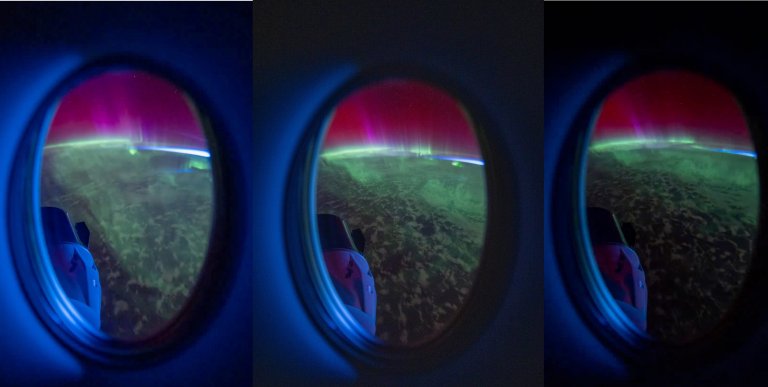
Alright, alright, one more farewell post for Atlantis just because this image is so very amazing. Captured by the crew aboard the International Space Station, the image shows Atlantis’s glowing hot re-entry into Earth’s atmosphere and the plasma trail it left behind.

Shortly before Atlantis’s textbook-clean landing in Florida this morning, it was moving some 17,500 miles per hour around the Earth. So naturally, things got a little warm when the shuttle plunged back into the atmosphere at hypersonic speeds. What you’re seeing here is the plasma glow leftover from the super-heated air around Atlantis’s heat shield as it made one final, fiery push through the atmosphere to safely return America’s space travelers to solid ground.

[NASA]

21 Comments

Beautiful! Superb! Fantastic! Wonderful! WoW! Awesome! Spectacular!

I agree -- this is an awesome sight! One that we won't be seeing again for some time, sorry to say.

I wonder what the Russians will charge us for similar pics in the future?

Austin SEO
www.Semantic-Ad.com

Truly a memorable shot.

Just a question. The shuttle appears to do a dive at the earth if this is truly a descent. I thought descents where made at a shallow angle making a long streak across the sky. But the contrail make me think that maybe this is liftoff because its brighter at the top and the light tapers off toward the ground. Just a thought, what do you think?

I think it's brighter at the top because they did a burn to slow down and gravity pulled them down when they dropped below orbital velocity.

I agree with Old Dude, it doesn't look right.

I would say it appears larger and brighter at the top for 2 reasons. It is miles closer at the top. Notice it is traveling down n away. And after the angle appears more steep the shuttle is cooling down somewhat and leaving a smaller plasma trail as it slows its approach. Plus we are not used to seeing things at such far distances, and just being in space makes things appear differently then we earthlings are used to. Things aren't always what they seem. A lot of uncommon science in that decent. It looked different than I would have thought as well. Just guessing. Awesome shot. Oh yeh, and it makes ashallow entry but then starts decending. They don't want to orbit earth inside the atmosphere.

And if it were liftoff then it wouldn't have an illuminated tail.

Actually I thought the same thing at first but I believe that's an illusion. The faint part is closest and highest while the brightest is where the shuttle is at. It's so faint close due to the cooling and dispersion of the plasma. Atlantis was traveling away from ISS toward the horizon.
It is a beautiful picture though.

BubbaGumb,

It might be an increase in descent which gives the curve at the top, but could also be the shuttle starting it's series of turns which help slow it down like a skier on a slope.

Now THAT is going to be my new wallpaper!

By the way, what's that yellow stripe near the shuttle?

Awesome photo! I would guess that it's brighter up top because the sun is reflecting off it there and hasn't made it to the lower trail yet but will as the earth rotates.

uh,

to all that are saying it is brighter at the top, implies they then drop like a ball....

zat would mean instant destruction

the majority is assuming the entry is from left to right

it is from right to left

thus the bright part is exactly what it is supposed to be

the heat/ friction you've seen in your movies

and the angle of reentry as seen this way (right to left)

is very small, the arc follows the circumference of earth

and the shuttle is actually almost parallel to it

"The shuttle appears to do a dive at the earth" ... funny

"and just being in space makes things appear differently then we earthlings are used to" .... funny

"Things aren't always what they seem." ... exactly !!

Bubbagump... you're the man !

It's a beautiful photo, but it looks altered. The ISS is moving at 17,500 mph, so for it to take a picture of its plasma trail over that length, it would have had to been holding still over the Earth, unless the glowing plasma trail remains long after the shuttle has descended. Am I missing something?

the ISS moving fast would not effect a pic at that distance, a couple of the posters above got it right, it was moving right to left, following the curvature of the earth and hence the curvature of the atmosphere giving the illusion of dropping straight down, which would obviously be disasterous, the brightest trail of plasma (upper left) gives it away as the shuttle started moving through an increasingly thicker atmosphere causing more friction

Would be nice if it were a video. Not sure how much video time they could have got at those speeds. I see it now. Its moving right to left and away. Once you visualize that then it no longer seems to dive suddenly. I agree. Its funny how you know how it should look but see it and can't comprehend what your looking at. Did you notice right away?

nope, i was confused at first, a couple of the previous posts gave me the correct perspective

@jaber Do you not see the blurred clouds from ISS's motion over the length of the exposure? You explained it yourself. The ISS is moving and all is accounted for.

Is it not possible to re enter at lower speeds? then avoiding over heating?

Those of you who said that the Shuttle is traveling from the right side of the image to the left are correct.

I've never heard of a plasma trail being caused by reentry, though I'm not an avid space-travel enthusiast, nor am I a physicist. I am, however, a photographer and I can tell you that this is a long-exposure photo, possibly taken over the course of several minutes. The trail tapers off to the right-side of the image because that is where the Shuttle begins to heat up and the trail gets brighter along the path the hotter the Shuttle gets during it's decent.

Granted, Space Shuttles are fast, but I'd hazard that the arc of the trail in the photo is about 30°, which, given the Earth's circumference of about 25,000 miles, covers about 2,000 of ground, more or less. During reentry, the Shuttle close to 18,000 MPH, as the article states or 2,000 miles every 6.67 minutes.

Negate my previous comment; the plasma trail actually makes perfect sense and explains the comparatively little motion blur seen in the clouds and stars, something I had been pondering, before, but chose to ignore. Based on the amount of motion blur present in the clouds, I'd guess the the of the ISS during the exposure was closer to about 1°, or about 70 miles.

So with that in mind, I'd say the exposure is actually closer to 15 seconds.

@xHaZxMaTx...thanks mate


June 2013: American Energy Independence

Five amazing, clean technologies that will set us free, in this month's energy-focused issue. Also: how to build a better bomb detector, the robotic toys that are raising your children, a human catapult, the world's smallest arcade, and much more.


Online Content Director: Suzanne LaBarre | Email
Senior Editor: Paul Adams | Email
Associate Editor: Dan Nosowitz | Email
Assistant Editor: Colin Lecher | Email
Assistant Editor: Rose Pastore | Email

Contributing Writers:
Rebecca Boyle | Email
Kelsey D. Atherton | Email
Francie Diep | Email
Shaunacy Ferro | Email

circ-top-header.gif
circ-cover.gif