From the backseat of a beat-up Toyota taxi, Thomas Taha Rassam Culhane points out the passing sights. Fraying sacks of charcoal cut from nearby forests wait beside makeshift shops. Corrugated metal, cardboard and other scrap make up the ramshackle huts. A stream of dirty water, stained red by runoff from a nearby factory, runs down the alley. Garbage is everywhere. The ingredients of life here in Mukuru, one of Nairobi’s largest slums, are raw. Yet Culhane leans forward in his seat, excited by the possibilities they present.
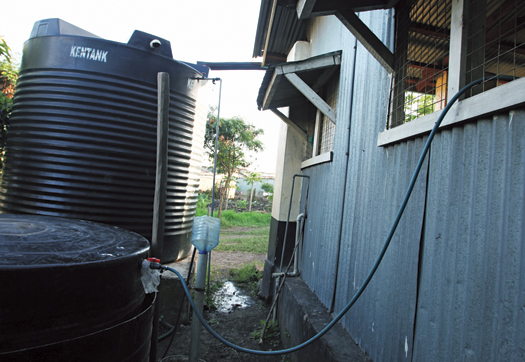
The taxi stops at the Mukuru Skills Training Center, an art and vocational school. A guard emerges from a small concrete shack to open the front gate. The Mukuru neighborhood is dirty and chaotic, but inside the compound, tidy bits of improvisation are everywhere: An art studio opens onto a small garden filled with herbs and saplings. Three composting toilets turn waste into fertilizer. And outside a bare-bones kitchen, a 500-gallon tank full of old beans and banana peels is slowly generating cooking gas.
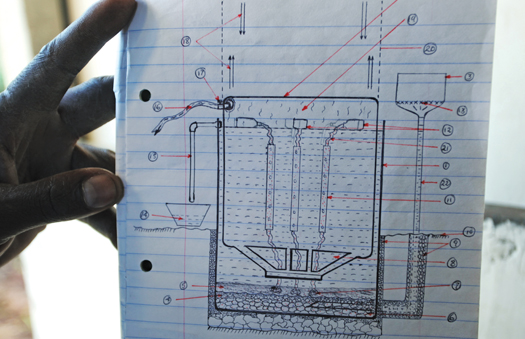
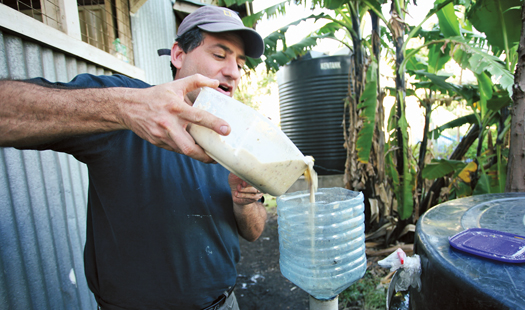
Thousands of miles from any sort of reliable energy infrastructure, Kenyans have improvised a system that is almost as reliable as that in any U.S. kitchen.Culhane, a 49-year-old American, designed the fuel system. It’s not providing as much gas as it should, so he’s here to make a few improvements. The first step is pretty simple. One tube delivers food waste to the tank, another tube delivers gas back to the kitchen, and right now the food tube is clogged. Culhane grabs a mop handle and works it into the tube, giving it a vigorous declogging. He then takes a container of goopy kitchen scraps and, using a sawed-off plastic water jug as a funnel, feeds them into the system. As he works, a crowd of children, having just finished a free Sunday meal at the school, wanders over to watch.
Culhane must work quickly. The sun is going to set soon, and it won’t be safe to travel through the slum, even by taxi. But he can’t resist the opportunity to explain his project. The kids crowd closer. Some of the smaller ones climb whatever they can for a better view. Culhane points to the tank. “There are bacteria living in here, but vigidudu sivya magonjwa,” he says, using the Swahili phrase for germs that are not diseased. “If we grind up all our food waste and put it in here, the bacteria will eat it and make cooking gas.”
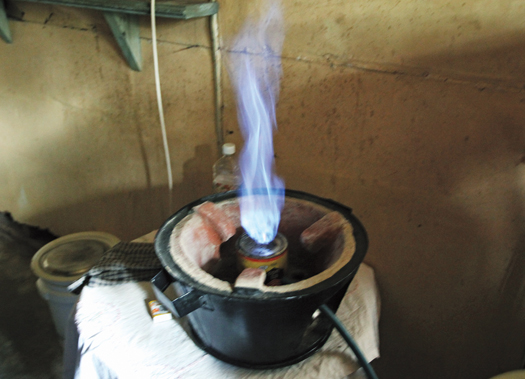
Culhane asks a boy watching from the front row if he is a good climber. The boy nods. “Come up here,” Culhane says, gesturing toward the tank. “But don’t ever do this if there are no teachers around.” The boy climbs on the tank and then, at Culhane’s request, jumps up and down on the lid. The pressure pushes the gas against a valve on the side of the tank. Culhane turns the tap, flicks a pocket lighter, and an orange flame spurts from a valve. “Aha!” Culhane cries. “You see that? Biogas!”
In the U.S., it’s difficult to generate your own energy, and nearly impossible to generate all of it. To even come close, you’d need to cover your roof and yard with enough solar panels to run all your lights, electronics and appliances. You’d also need a solar-thermal system for heating water, and an electric car charged by solar power.
And yet our existing energy systems, convenient as they may be, are also unsustainable. Sure, the infrastructure that serves our daily needs seems to work just fine. Turn a knob on the stove, and out comes gas. Take the trash out on Tuesday night, and a truck swings by Wednesday morning to haul it away. But these apparent efficiencies obscure the true inefficiencies of our system. Living in Connecticut, your gas may come from Wyoming; the garbage may go to New Jersey. This sort of blind, far-flung system needs to be updated, and localized.
The Mukuru slum has little infrastructure: no sewage system, no underground gas lines, no landfills. Residents toss potato peels and plastic bags into the street. Eyes sting from charcoal smoke. But this jumble provides an opportunity to rethink some basic things, and to improvise new forms of energy.
Here, a few biogas systems like Culhane’s are turning waste, the world’s most pervasive and overlooked energy source, into fuel.In the process, they’re also turning households into closed-loop systems of local energy production and reuse.
When microbes digest organic waste–sewage, manure, food scraps–in the absence of air, they produce methane (along with small amounts of carbon dioxide and water), which can run everything from electric lights to city buses. No one has figured out what kind of biogas system it would take to power a whole city. But in Kenya, a plastic tank and some tubing can transform a single household’s entire energy cycle.
Culhane runs a nonprofit called Solar C3ITIES (Connecting Community Catalysts Integrating Technologies for Industrial Ecology Systems). It has no paid employees and is funded, barely, by individual contributions. He has built low-tech, low-cost biogas systems in Cairo, Lagos and the West Bank, and trained local people to maintain and replicate them.
Culhane’s mother is Iraqi, and he has family in Beirut. He watched wars in each place destroy his relatives’ livelihoods, transforming them from wealthy, land-owning professionals into refugees. “I learned that historical events outside our control can erase any security we thought we had,” Culhane says. “I wanted to figure out a way we can better protect our families, and earning money isn’t it.”
Biogas systems don’t require much in the way of capital investment or scale, and so Kenyans have begun their own experiments.That search has carried him around the world. In the 1990s, he taught teenagers in South Central Los Angeles how to modify car engines to run on alcohol made in a solar still. After the American-led invasion of Iraq in 2003, he moved to Egypt, where he lived in a Cairo slum among the zabaleen, “garbage pickers” who collect organic waste and feed it to their pigs. Then, inspired by a viewing of the 1985 film Mad Max Beyond Thunderdome, in which a whole city runs on pig waste, he went to India to learn how to build simple biogas systems. Today he lives in Germany, pays the bills by teaching online courses for Mercy College in New York, and spends the rest of his time and money working on projects like the one in Mukuru.
Biogas is Culhane’s gospel, and he’s a talented evangelist. He stops at a Nairobi pharmacy to buy some malaria pills, and soon he’s sitting with the pharmacist, sketching biogas systems on scrap paper. He pops into a Catholic charity’s guesthouse to use the Wi-Fi and emerges with a date to take two Slovenian missionaries to see the Mukuru digester. By the end of the trip, I’m doing his work for him. Stuck in Nairobi traffic, I tell my taxi driver about biogas, and he wants to know where he can buy a system of his own.
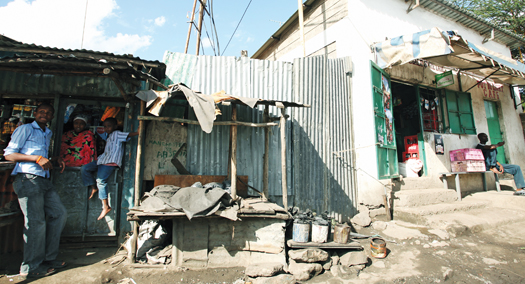
Kenyans need the kind of energy that biogas provides. Cooking fuel accounts for nearly all the power consumed at homes in developing countries, and the cooking fuel here in Kenya comes largely from wood, a dwindling resource that creates a great deal of pollution. Even in the wealthier sections of Nairobi, there’s no centralized gas distribution system; people cook with either liquid propane, purchased and hauled in small containers, or charcoal.
At the same time, the people of Nairobi generate about 3,000 tons of waste every day, most of which is organic. And they collect only about half of it. (Independent haulers take trash from wealthier neighborhoods to an open dump.) Burning biogas derived from the waste would help solve two problems at once. But the government has been unable to launch any kind of large- or medium-scale biogas projects. The city council recently considered a proposal for a dozen biogas plants but never acted on it. “There have been many plans in the past, but they haven’t materialized,” says Matt Woods, the operations director for Carbon Africa, a Nairobi-based carbon-credit company.
It may be that some people like the system the way it is. The local dump, for instance, is run by a powerful gang. After the company that handles flight catering at Nairobi’s international airport raised the idea of diverting the six tons of food waste that arrive on planes each day in order to make biogas, the gang sent threats. Trucks still deliver the airplane waste to the dump.
The ingredients of life in Mukuru, one of Nairobi’s largest slums, are raw. Yet they present exciting possibilities.Biogas systems don’t require much in the way of capital investment or scale, though, and so Kenyans have begun their own experiments. Small generators like Culhane’s are beginning to dot the city. In a Hindu temple that serves free meals to the homeless in Nairobi’s upscale Westlands neighborhood, for instance, one of the stoves is connected to a gas line that climbs over the kitchen wall and out to the back courtyard, where a 1,300-gallon tank produces three hours’ worth of biogas per day. The temple’s leaders will soon buy a second system from Bijal Shah, a Kenyan woman who runs GreenTech International, a renewable-energy company in Nairobi. And not far from the temple, Shah’s aunt climbs the stairs from her outdoor kitchen every evening to pour a bucket of leftover rice and cooking water into her own 400-gallon tank. Culhane, meanwhile, recently discovered an even more direct loop: An enterprising pay-toilet owner had tapped the valuable energy produced every day by his customers and piped the gas to a restaurant across the alley.
People have known how to make biogas for a very long time. In the 10th century B.C., Assyrians used biogas to heat their baths. In the late 1800s, Louis Pasteur generated biogas from manure to demonstrate that Paris’s horses could power street lamps. In the mid-19th century, India used it to light a leprosy hospital; today, there are roughly three million small-scale biogas plants in India, and 35 million in China.
Biogas isn’t the right tool for every job or every nation. In Germany, where 17 percent of the country’s electricity comes from renewable sources, biogas accounts for only about 2 percent of that mix. But in Sweden it has outpaced natural gas as a transportation fuel; some cities, such as Helsingborg, use it to power their entire bus fleets.
Here in the U.S., the Environmental Protection Agency estimates that nearly 8,000 farms are capable of producing significant amounts of biogas;167 American dairy, swine, poultry and beef farms already use anaerobic digestion to reduce pollution and contain odor. If even just the largest 160 farms installed digesters, the methane they produced could heat three million homes—or, by sending biogas to natural-gas power plants, provide electricity to 870,000 homes. Food waste, meanwhile, contains even more energy. A ton of manure yields 1,700 kilowatt-hours of electricity. A ton of butter produces 9,600 kilowatt-hours.
But tapping those resources is no simple matter. A city manager considering whether to adopt the use of biogas must weigh the cost of new equipment, the price at which he can sell the energy, and how landfill fees, land-use permits and other expenses will affect his profits and losses. It’s complicated and unfamiliar math. Bruce Fulford, a greenhouse designer and composting expert in Boston, has spent nearly three decades trying to set up a community-based biogas system there. “To get projects up and running involves hundreds of thousands or even millions of dollars,” he says. “Who’s going to absorb that risk? There aren’t enough precedents in the U.S.”
Fulford may just be looking for the wrong sort of precedents. Biogas, for instance, is quite familiar to city engineers, just not as a standalone source of energy. More than 1,000 wastewater-treatment plants use the process of anaerobic digestion to reduce the amount of sewage they must eventually haul away or burn. But until recently, most cities viewed the biogas that results as a by-product, not a commodity. Wastewater-treatment plants used it to heat the sludge digesters (the microbes like warmth) and to run some part of the energy-intensive water-treatment process.
A ton of manure yields 1,700 kilowatt-hours of electricity. A ton of butter produces 9,600 kilowatt-hours.Now, though, a few U.S. cities, prompted by high energy costs and new greenhouse-gas emission targets, are experimenting with ways to generate excess biogas. The New York City Department of Environmental Protection built eight 145-foot-high egg-shaped digesters that tower over the Brooklyn neighborhood of Greenpoint. The shiny silver eggs are a part of the Newtown Creek wastewater-treatment plant, where a million gallons of sewage arrives from a pumping station across the East River every day, and a million more flows in from parts of Brooklyn and Queens.
The waste feeds into a series of covered holding tanks, and the heavier materials settle to the bottom. That sludge passes through a centrifuge, where more liquid is removed, before moving on to the new digesters. Each one holds three million gallons of sludge for 15 days, mechanically stirring and heating it to a microbe-friendly 100°F.
The digesters were part of a $5-billion upgrade that began in the late 1990s and will take two to three more years to complete. The idea wasn’t to produce energy–it was to reduce maintenance. The old digesters didn’t generate much gas, but they did accumulate 10-foot-thick layers of grit that required manual removal every three years. The new digesters are better at mixing the sludge, so they create less buildup and are able to hold far more gas-producing material. When those went online, engineers discovered that they also produced twice as much methane, which is far more than the plant can use in its daily onsite operations: It’s enough energy to heat 2,500 homes. By next year, the city will be running that excess biogas through a cleaning system and then into the natural-gas pipeline. New Yorkers’ fecal matter and ground-up food waste will help cook their food and warm their homes, all while annually releasing 16,650 fewer tons of CO2 into the atmosphere.
The regional sewage-treatment agency in Milwaukee is working with researchers at Marquette University to determine which types of local high-energy waste can best be used for biogas without having to upgrade their system at all. For the past five winters, the agency has been vacuuming up de-icing fluid–propylene glycol, an organic compound–from the airport and trucking it to a water-treatment plant, where engineers put it directly into the digester to generate more gas. “When we started,” says Peter R. Topczewski, the director of water-quality protection for the Milwaukee Metropolitan Sewerage District, “you could see an instant spike. We were seeing two and a half times as much gas production.” The agency has also recently made a deal with a local Coca-Cola bottling plant to take its rejected ingredients.
Swedish Biogas International, meanwhile, has opened a North American headquarters in Flint, Michigan, where it is building a plant that will run on sewage sludge and waste from the processing of local products such as meat and salad dressing. The plant will generate about 1.6 megawatts of electricity for the city and also produce a steady supply of fertilizer. The essence of the project, as with all biogas systems, is tapping into what’s nearby. “We want to work on collecting local waste,” says Tom Guise, the company’s CEO.
Biogas won’t ever be a major fuel source in the U.S. If we tapped our entire supply of sewage, animal waste and landfill, we could replace about 6 percent of our natural-gas consumption. The newly established American Biogas Council estimates that if we used industrial sources of organic waste as well, biogas could perhaps account for between 10 and 15 percent of our natural-gas supply by 2030.
But biogas could become an extremely useful fuel source. “It’s a multi-solution,” says Nora Goldstein, a council board member and the editor of Biocycle, a trade publication. By being both a waste-disposal and energy-production system, she says, “it addresses multiple urban and rural infrastructure challenges.” It uses an overlooked fuel source, it localizes the production of energy, it produces useful by-products such as fertilizer, and it doesn’t require new, purpose-built facilities. “When you just look at the potential energy output,” she says, “that kind of gets lost.”
Culhane is not the only biogas evangelist in Kenya. Dominic Wanjihia designed his first biogas system while working as an auto mechanic more than a decade ago. And now, at the Jamhuri Renewable Energy Centre in Nairobi, he shows Culhane his latest prototype.
Wanjihia, increasingly concerned about the pollution and deforestation caused by firewood use, has come up with a flexible PVC “balloon” digester that runs on manure. To generate biogas, a farmer shovels manure into the tube and closes it with a sort of zipper made from a hose. Then he adds water through a pipe. It takes about three days to get rolling, but after that, the system will produce a constant supply as long as it’s fed. The system can produce enough gas for a typical household, using about 25 pounds of cow manure per day (less than the daily output of a single cow).
Wanjihia’s new company, Simply Logic, sells the digesters for about $525 as part of a package that includes installation and training. Wanjihia imagines selling the systems in supermarkets to customers who then have a local handyman install them, the same way we might acquire a new washing machine in the U.S. For biogas to succeed, he says, it must become a profession. “People will become skilled in a trade, and they will then find customers, get a commission on the sale, and do the maintenance,” he says.
The system will produce a constant supply of biogas as long as it’s fed.Culhane is obviously delighted by Wanjihia’s design. Oblivious to the midday sun, they chat excitedly about ultraviolet-resistant PVC and a new plastic joint Wanjihia has installed. Culhane mentions that his own biogas systems are designed to run on kitchen waste. Wanjihia looks dismayed. People won’t chop the food, he tells Culhane. It will never work. Culhane reaches into his bag and hands his fellow evangelist some literature. As Wanjihia reads, he begins to nod. He smiles and taps on the glossy brochure. It’s the promotional material for an InSinkErator Evolution 200, a garbage disposal—the perfect high-powered tool for turning kitchen scraps into raw pulp for biogas.
The InSinkErator costs $400, far too much for the average Kenyan. But a single garbage disposal could band several families together into one energy-producing unit. Wanjihia puts down the manual. “I could design a version we could manufacture in Kenya,” he says. And if two or three households share one to produce enough useful fuel, Culhane adds, their neighbors will see the flame, and might even be willing to chop food waste by hand to have a flame of their own.
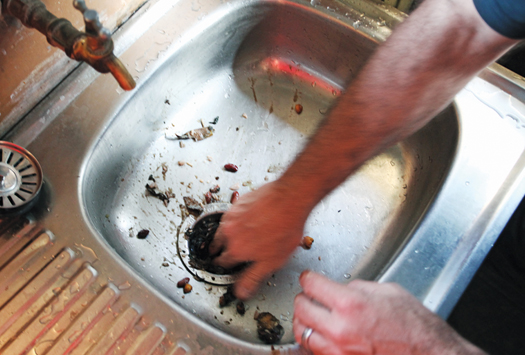
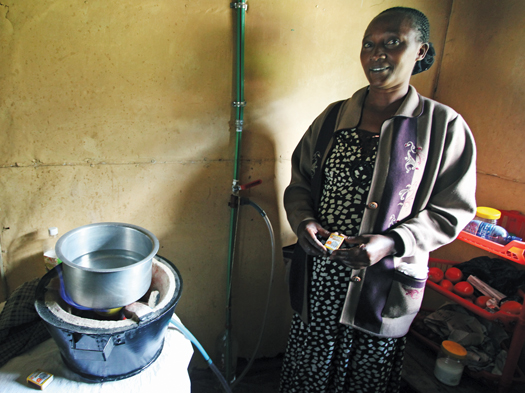
The next day, at the Mukuru school kitchen, Culhane zeroes in on a disconnected metal sink that no one’s been using, an ideal site for installing an InSinkErator that just arrived by plane. He and the school’s art teacher, David Redmond, spend half a day hunting down beat-up tools and frayed extension cords and drilling out the drain opening to hold the disposal. Another teacher, Henry Okeyo, lends a hand, and when the work is finally done, a pipe feeds the InSinkErator waste straight from the kitchen into the digester. Another pipe brings fuel into a biogas-ready stove bought from the Jamhuri Energy Centre.
It will take a small amount of electricity to run the InSinkErator, and if it breaks down, someone will have to order the parts and crawl under the sink to fix it. But it’s otherwise a seamless system, very nearly a closed loop. All it takes, Culhane says, is bacteria and garbage. Thousands of miles from any sort of reliable energy infrastructure, Kenyans have improvised a system that is almost as reliable as that in any U.S. kitchen. Culhane turns the knob. Out comes gas.
Hillary Rosner wrote about hydrokinetic power, cement that stores carbon emissions, and deep-water turbines in the July 2009 issue.