
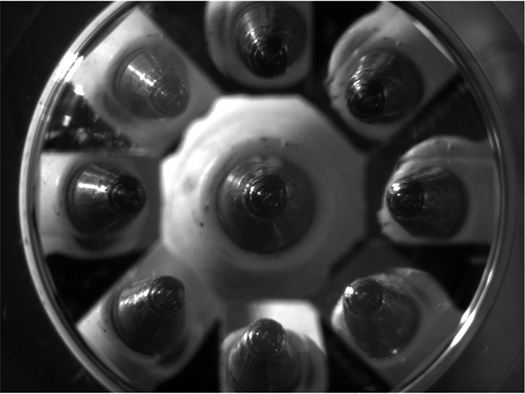
Engineers at Ohio State University have created the first stand-alone, stationary lens that can create microscopic 3-D images. Up until now, 3-D microscopes needed multiple lenses or movable cameras to capture all sides of an object. With this lens, viewers can capture nine different angles of a microscopic object at once.
Postdoctoral researcher Lei Li wrote a computer program to create the lens; then he and Ohio State associate professor Allen Yi cut the lens from acrylic glass, a type of transparent plastic, with a diamond blade. The finished product is shaped like a rhinestone, with a flat top and eight surrounding facets. Unlike a gem cut for jewelry, though, these facets are not symmetrical. Each one captures images from a different angle. The images from each facet are then combined on a computer to form the 3-D image.
The engineers have successfully used the lens to create 3-D images of a ballpoint pen tip, measuring about one millimeter across, and a tiny drill bit that has a diameter of 0.2 millimeters. The technology is intended to help simplify the currently complex machinery manufacturers use to produce tiny components. While the prototype lens was created with a precision cutting machine, the researchers say it could be produced less expensively with more traditional molding.
