
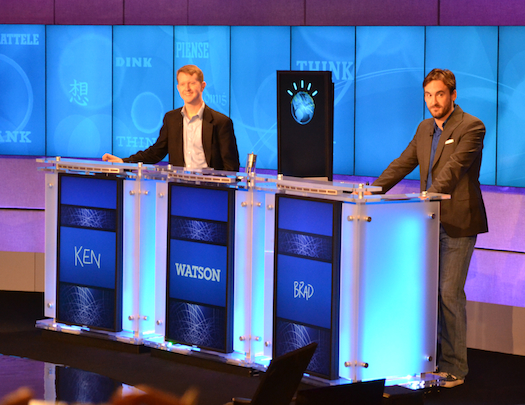
What better way to celebrate the romance of Valentine’s Day than watching a supercomputer robot defeat Jeopardy!‘s two greatest champions in a man-on-machine trivia throwdown? Gather your significant other; strap him or her to a couch if you need to, because this is important. Tonight, the first round of a very special Jeopardy! tournament begins.
Today at 7PM Eastern, the three-day mini-tournament will kick off, pitting IBM’s supercomputer Watson against the two greatest modern Jeopardy! champions: Ken Jennings, who holds the record for longest winning streak, and Brad Rutter, who has taken home the most total prize money. It’s an epic battle we’ve been looking forward to ever since we say Watson take on the champions in that preview battle last month–and it’s finally here. But actual trivia knowledge may not turn out to be the deciding factor in the contest.
Over at Boing Boing, former champion Bob Harris (the 13-game Jeopardy! winner, not to be confused with the Lost in Translation character) lays out perhaps the most overlooked variable in Jeopardy!: the buzzer. We’ve been concentrating largely on the task of actually figuring out the answers to the questions (or questions to the answers–thanks for that weird rule, Jeopardy!), which for the layman is certainly challenging. The mix of trivia, riddles, puzzles, irony, and wordplay were assumed to be the toughest part of the game, but Harris lets us in on a secret: It’s all about the buzzer. As he says, “At the top tournament level, every player can figure out nearly all of the correct responses, no matter how arcane.”
When Trebek finishes reading a clue, a producer hits a button that flashes a light, telling the contestants the buzzers can now be triggered. Once you’re at this top echelon of trivia mastery, the questions aren’t the deciding factor–it’s all about timing. Harris notes that “Since a computer can obviously react to the ‘go’ lights more rapidly and consistently than any human, it will probably win,” providing Watson is allowed to buzz in as fast as possible. That corroborates what I saw in the practice match: None of the contestants, man or machine, actually got a clue wrong, and none went unanswered. This game may turn into a speed contest.
But that doesn’t mean it won’t be incredibly fun (and romantic) to watch.
