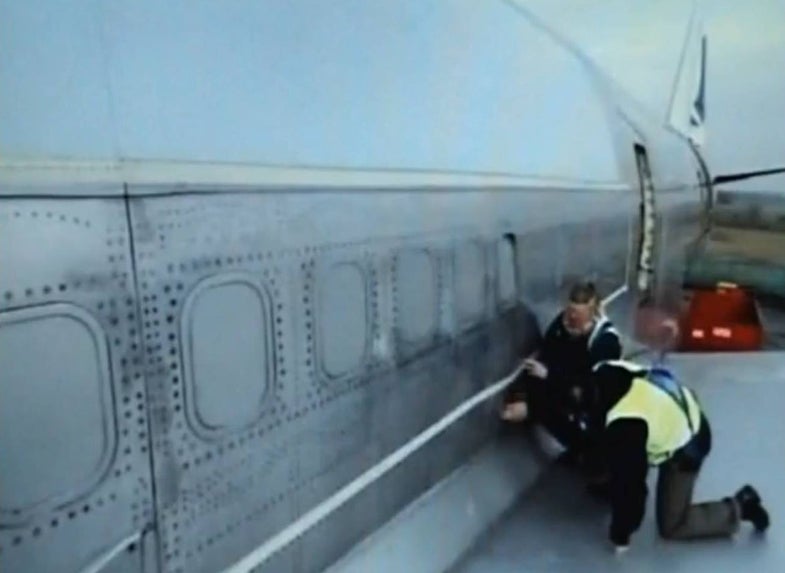
An explosion aboard Flight 253 on Christmas Day would not have crippled the Boeing 747, according to a recent test that simulated the success of would-be bomber Umar Abdulmutallab. Only the bomber and passenger next to him would have died, the BBC reports.
The test plane didn't quite get away without a scratch, but it only lost some rivets and suffered an outward dent. The flight controls and fuel tanks appeared safe post-blast to Captain J Joseph, an air accident investigator, and John Wyatt, an international terrorism and explosives adviser to the United Nations.
Abdulmutallab attempted to set off an explosion with pentaerythritol (or PETN) aboard Flight 253 from Amsterdam to Detroit. The experts enlisted by BBC recreated the scenario with a decommissioned Boeing 747 at an aircraft graveyard in Gloucestershire, UK.
Some BBC readers have questioned if the ground experiment actually replicated what might have happened in the air. But the experts said that Flight 253 had already descended to about 10,000 feet at the time of attempted detonation, and so the difference in pressure inside and outside the plane would not have mattered.
As comforting as this sounds, passengers would probably still prefer that explosives didn't get through at all. Let's hope that chemical sniffers, future airport scanners or Wii balance boards can somehow improve the screening process.
[via BBC]
138 years of Popular Science at your fingertips.
Each issue has been completely reimagined for your iPad. See our amazing new vision for magazines that goes far beyond the printed page
Stay up to date on the latest news of the future of science and technology from your iPhone or Android phone with full articles, images and offline viewing
Featuring every article from the magazine and website, plus links from around the Web. Also see our PopSci DIY feed
Science is reinventing play, from extreme sports to gamification to ridiculous roller coasters to the playgrounds of tomorrow, and this issue is chock full of fun. Also, on a less fun note: Did global warming destroy my hometown?
from London, ON
The plane wasn't pressurized. There was no door. You can also see that one of the window came out and would have caused the plane to depressurized
This needs to be verified by further tests. In any case, the issue is not with the aircraft but with the ineffective security screening at most airports. Let the bomb sniffing dogs ride on the airplanes...
www.manhattanbizbroker.com
Well Terrorist now you know what to do next time.
Even though the plane wasn't pressurized, didn't the article say that the pressure difference at 10K feet wouldn't matter? So having it on the ground with an open door is the same isn't it? The pressure inside and outside the cabin would be identical. Just venturing a guess. Though antaro may be correct in that 10K and ground level pressure can't be scaled proportionally. Also, about the window blowing in, aren't those windows double paned anyway? So it was only the outer window, there still would be the inner window?
Why would we even think this would do anything to the plane. Im positive the Myth busters on the discovery channel, dispelled any idea that a bomb that is not big enough to take out at least 10 rows will not cause a plane crash. And they did the test pressurized to legitimize results
This test has no validity whatsoever. The aircraft was not pressurized and the doors were open. I think this test is highly misleading and irresponsible. Such an explosion would likely cause an over-pressure that would lead to an explosive decompression and catastrophic structural damage.
I can see their point that being at low altitude would have eliminated the decompression issue. However, who's to say the next one will only happen at 10,000 feet? Also, the explosive force inside the aircraft will be bigger with the doors sealed. The large increase in air pressure inside the cabin would add to the damage, and has to go somewhere. In this case the doors were open, but in real life it may do more damage.
The main danger that concerns me is that the terrorists are still thinking that a bomb anywhere on board will do the job. Once they start figuring out that a much smaller shaped charge can do a lot more damage, we'll have a lot more problems to deal with. A small shaped charge placed at 45 degrees out by someone sitting over the wing box could, without too much difficulty, blow a hole into the wing area and possibly the fuel tanks that reside there as well. Needless to say, that could be devastating.
As an aerospace engineer, I have to agree with the results of this test. Granted, there would be additional aerodynamic loads due to flight, but cabin pressure is set to 10k ft. Worst possible case, maybe 1 psi of cabin pressure. Mythbusters tested at 8 psi. Unless the bomb was placed directly against the fuselage skin (not the plastic interior), popping a few rows of rivets should be all the more damage that it does.
I bet they didn't account for the pressure blast level that liquefies your internal organs. "Only the bomber and passenger next to him would have died, the BBC reports."
A couple of things to note. Aloha Airlines Flight 243 was flying at 24,000 feet had an explosive decompression due to structural issues. a good part of the plane was torn off and yet it managed to land. The only fatality was a flight attendant was suck out of the plane. Also, the amount of explosive used was not enough to create the required force to penetrate the fuselage, now that same amount with a shaped charge or projectile would possibly do so. But let us say that the skin is compromised, that does not mean that the whole plane is going to fall apart, as Aloha Airlines Flight 243 demonstrates.
My only concern with these BBC test, and discussions like this, help terrorists improve their methods. Basically the BBC hired top consultants to teach the terrorists where they need to improve.
I knew right off that the underwear bomb was no danger to the plane.
Explosives don't work like they do in the movies just watch Mythbusters.
It's not very much and was not a shaped charge so it's not very powerful.
Heck they probably can design future aircraft to be more reliant to small explosions.
I think they can lax the security some maybe even disband the TSA as this was the best the terrorists could do.
The security check points would be a better target then the plane because there they could drag in a large suitcase filled with explosives that could do real damage vs what amounts to a medium sized firework that would do little more then injure or kill the terrorist and cause a scare.
A composite hull might shrug it off with little damage but it would really depend on the quality of the composites.
They probably should tests composite hulls for this type of damage and then make any necessary changes so a device of this type can't destroy them.
Blanket security to stop all attempts does not work and no one in their right mind would agree to strip searches and cavity searches to fly so instead the damage mitigation should be used.
This means more robust hulls and stuffing the seats with material that can help snuff out an explosions.