
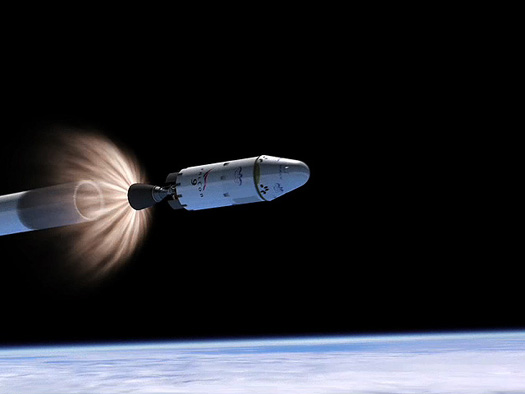
SpaceX's Dragon Spacecraft Separating from its Falcon 9 Carrier Rocket SpaceX, Courtesy of NASA

With the space shuttle ceasing service next year and the Constellation program unprepared to launch before 2014, NASA will spend at least four years planted firmly on the ground. But NASA's hiatus is the private space industry's gain, and commercial space carrier Space Exploration Technologies -- or SpaceX, for brevity's sake -- plans to launch its Dragon spacecraft on her maiden voyage to the International Space Station between May and November of next year.

Following on the heels of Virgin Galactic's unveiling of its commercial spacecraft last week, Hawthorne, Calif.-based SpaceX also said it has conducted its first training session with a handful of NASA astronauts that will eventually dock the unmanned Dragon craft with the ISS. Three of the astronauts will be aboard the ISS when that first Dragon spacecraft, carrying resupply cargo to the station, makes contact with the ISS next year.

The Dragon capsules will ride into orbit aboard SpaceX's own medium-lift Falcon 9 rockets, which will make their own debut in February barring any setbacks. The first Falcon 9 launch will carry a Dragon capsule, but it will not rendezvous with the ISS. Hooking up with the ISS will mark SpaceX's second milestone for the private space industry, having already gained the honor of being the first private company to deposit a satellite into orbit earlier this year.

[Space.com]

6 Comments

Looks like the privatization of space is well on it's way. There's a good 15 companies, probably more, who are involved in this, and have plans for the moon, mars, and beyond. It'll be interesting to see how, and how fast, this all progresses in the decades to come. Popular Science's latest issue, Jan. 2010, has a great article about this stuff.

Pretty cool. Too bad we won't see men on mars in our lifetimes. But at least our kids and grandkids will.

I just want to see us get back to the moon.

~Pretty cool. Too bad we won't see men on mars in our lifetimes. But at least our kids and grandkids will.~
Well if I live to eighty, the year will be 2071. :Stretches and yawns: Which oddly enough is about a hundred years after my dad graduated from highschool.

You will see it in your life-time, most definitely.

The U.S. has said they plan on putting a man on Mars during the 2030's. It may happen earlier, if we have more political support, money, and incentive. We could put a man on the Mars right now, today, 2010, we have the technology already to do it. I promise you this is more than possible in our lifetimes, and we will see it, you wait and see, =)

i just want to go back to the moon


June 2013: American Energy Independence

Five amazing, clean technologies that will set us free, in this month's energy-focused issue. Also: how to build a better bomb detector, the robotic toys that are raising your children, a human catapult, the world's smallest arcade, and much more.


Online Content Director: Suzanne LaBarre | Email
Senior Editor: Paul Adams | Email
Associate Editor: Dan Nosowitz | Email
Assistant Editor: Colin Lecher | Email
Assistant Editor: Rose Pastore | Email

Contributing Writers:
Rebecca Boyle | Email
Kelsey D. Atherton | Email
Francie Diep | Email
Shaunacy Ferro | Email

circ-top-header.gif
circ-cover.gif