
A common robot operating system could lead to a robotics revolution -- scientifically speaking, of course

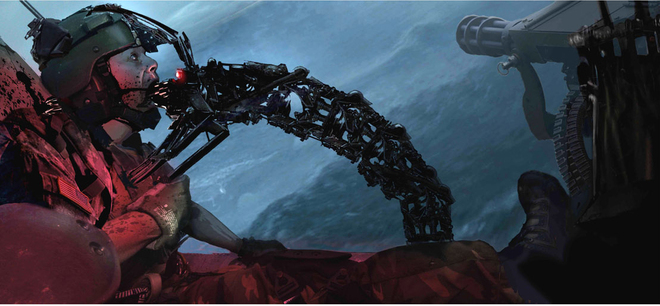
Robots Unite: Patch my operating system to 3.0 now, human!  Warner Bros.
Today's robots represent islands unto themselves that don't share either software or hardware with each other. But researchers have begun developing a common operating system that could revolutionize robotics and permit easier collaboration with less reinvention of the proverbial wheel. The change could rival that which rippled through the PC industry when Microsoft's Disk Operating System (DOS), and later Windows, burst onto the scene and became standard.

One such robot operating system, appropriately known as ROS, has evolved into an open-source collaboration between Stanford University in California, MIT in Boston, and the Technical University of Munich in Germany. New Scientist reports that this allows research teams to share code for high-level commands involving actions such as image recognition, robot navigation, or using arms and grippers. But robot interactions with the physical world still pose far more complex challenges -- and require more complex solutions -- than well-defined and abstract computer problems.

Even Microsoft apparently waded into the action with its 2007 product named Robotics Developer Studio. No word on whether that product has achieved initial success in becoming a Windows for robots.

Allowing robotic researchers to swap code for nimble-fingered tricks or scary motorcycle riding could certainly push robotics advancements to a much faster rate, given that individual labs would not have to each labor over reproducing the same robot abilities. Perhaps hardware could also follow a modular approach that would enable even more collaboration, not unlike open-source gadget company Bug Labs that provides handy modules for high-tech geeks. PopSci joined with Bug Labs last year to host the Build-a-BUG Challenge.

Open-source and common platforms should undoubtedly prove helpful for robotics. But we can still imagine some robot systems, notably military drones fighting on land, sea and air, which may prefer more proprietary operating systems just in case. Besides, humans shouldn't make it too easy for Skynet to hack its future army of gun toting motorcycle fiends.

For now, both hardware and wetware types might do well to gleefully memorize this stanza: "One robot nation, under ROS …"

[via New Scientist]

Want to learn more about breakthroughs in electronics, medicine, nanotech, and more?
Subscribe to Popular Science today, for less than $1 per issue!

10 Comments

There is no need to worry about this, whether ROS or another close effort. Its just not going to happen.

"Its just not going to happen"

I don't think you can say this with great certainty. Sure, its not going to happen in the next 10 years, but what about 50 years from now? The potential for our own creations to overthrow humanity is quite staggering.

What happens when we build the first computer smarter than a single human?
What happens when we build the first computer smarter than all humans put together?

The terminator scenario with human sized (and giant) robots being produced in factories is not the most likely way humanity could be exterminated. If a machine smarter than us wanted to do so, it would be prepared under our noses on the nano scale. Imagine a smart computer in control of a nano factory the size of a shoe box. Maybe a nano factory will be in everyones homes constructing everything we need by 'downloading' it, instead of one factory making everything and sending the ready made product to you.

Imagine your desktop gets taken over by the smart machine(s) and commands just your own nano factory to make millions of little robots that tear apart everything they touch and make new ones out of the materials they harvest.

Death by nano-bot cloud.

Kim, never say never, anything is possible. Humankind once believed flying was impossible, and now we have tons of airplanes. Humankind also once believed that spaceflight was impossible, yet we have space flight happening all the time now, and we've been to the moon and back as well. One can make predictions, but nobody will know for sure what will happen within the next 50 or 100 years. Yes, programmers, and the creators of these robots, and artificial intelligence, can set rules, guidelines, or make it so these robots don't become too advanced to threaten humankind, but that's still no guarantee. Someone, somewhere, will develop artificial intelligence, and if they aren't careful enough it could wreak havoc. All one can do is to set precautions. Scientific progress cannot be stopped, it will go on, it will progress, even if it takes decades or centuries. Science fiction is becoming science reality, and humankind will one day have phasers, starships, and teleporters like that in Star Trek, it's only a matter of time.

Your right. I should never say never. back at the beginning we had several O/S and early windows was a long shot, now look where we are.

Your right. I should never say never. back at the beginning we had several O/S and early windows was a long shot, now look where we are.

Your right. I should never say never. back at the beginning we had several O/S and early windows was a long shot, now look where we are.

1 out of 50 self aware programs will become hostal. that still leaves 49 robotic master minds to counter the faulty. its possable of course. but who is to say that all robots want to work together or will be bent on destroying things? perhaps to much star trek and tv? its a shame that popsci keeps refering to world dominating robots. i mean with out tech thier would not be a topic to write about :/

ahhhhhh scarrrrry D:

@beesnuts:

I can’t agree more.

Almost no one address the issue that we will actually (more accurate would be the word "possibly" :p) merge with our machines long before the so called "singularity" that will preatty much whip us out. Just think of this: If we have nanofacturing capability, why wouldn’t we install such factories inside ourselves, with our brains as their main control system? Why going thru the inconvenience of input data on a super computer when it is more effective and efficient to actually have such super computer directly interfaced with our brains?

Machines will not replace us because we will replace machines will hybrid versions of ourselves. It is clear today more than ever in the past than biology, computer science and cybernetics are in a mixing path that will lead to such an end. It would be cool a SF novel dealing with the emotional distress caused by this in its early stages... Does anyone know if there is such a novel?

First of all, I think a lot of the hype about killer robots, etc. is just that - hype. In reality, while it is possible for machines to malfunction - for instance, a Predator drone losing contact with its controller and drifting off-course - the likelihood of a computer somehow developing a grudge against human beings and intentionaly plotting to wipe us out is pretty remote.

Assuming that open-source code systems like ROS do become standard, it will help researchers and developers to effectively program their creations much faster and more efficiently - and no doubt spending less money, to boot. Imagine slashing the price of robotic devices by 25% or so, thanks to a much shorter and less difficult software-development phase. A development like this could really help make mass-market robots a reality, as opposed to all the dozens of flashy prototypes you see on the news (and on this site) that hardly anyone can afford.

Mr. Hsu has a point that military robots should probably use a different system(s) from the easily accessible civilian ones, to avoid incidents of robot hacking, but otherwise, I see no real problem with an industry-standard operating system or two for robots.


June 2013: American Energy Independence

Five amazing, clean technologies that will set us free, in this month's energy-focused issue. Also: how to build a better bomb detector, the robotic toys that are raising your children, a human catapult, the world's smallest arcade, and much more.


Online Content Director: Suzanne LaBarre | Email
Senior Editor: Paul Adams | Email
Associate Editor: Dan Nosowitz | Email
Assistant Editor: Colin Lecher | Email
Assistant Editor: Rose Pastore | Email

Contributing Writers:
Rebecca Boyle | Email
Kelsey D. Atherton | Email
Francie Diep | Email
Shaunacy Ferro | Email

circ-top-header.gif
circ-cover.gif
bmxmag-ps
