
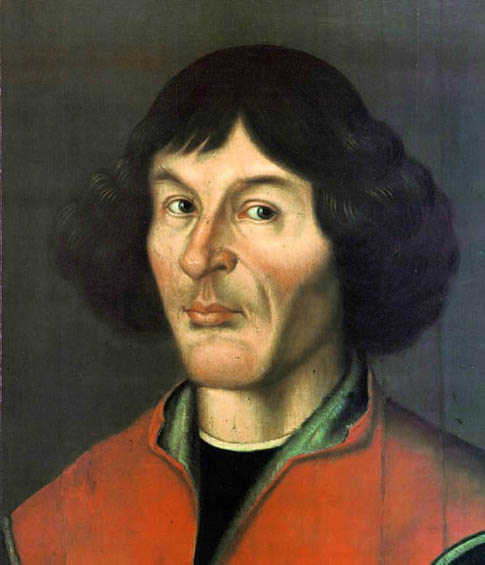
When we talked with element 112's discoverer, Sigurd Hofmann, on the significance of making a permanent mark on the periodic table, he told us he wanted a moniker that recognized a famous scientist while avoiding the flag-waving nationalism normally associated with the process. Today, Hofmann and his team made their decision public.
Good bye element 112 and ununbium, its placeholder name. Hello "Copernicium."
By choosing to honor the father of the heliocentric solar system, element 112 discovery team leader Sigurd Hofmann wanted to avoid the divisive names selected for past elements, salute an influential scientist who didn't receive any accolades in his own lifetime, and highlight the link between astronomy and Hofmann's own field of nuclear chemistry.
The idea was to go backwards, to honor someone who was not greatly honored in his lifetime," said Hofmann. "[Copernicus] had to be very careful when he was publishing his works. His book was published the day of his death. He was afraid to make his announcements during his lifetime, so he wasn't honored when he was alive."
Sticking with that theme, the team almost named the element after Galileo, but when Hofmann suggested Copernicus, everyone on the team instantly agreed.
Element 112 is the sixth element discovered by Hofmann's institution, the GSI, and the last four previously discovered elements were named after cities or states in Germany. By naming element 112 after a Polish scientist, Hofmann broke that nationalistic streak.
"After we have named elements after our city and our state, we wanted to make a statement with a name that was known to everyone," said Hofmann. "We didn't want to select someone who was a German. We were looking world wide."
Additionally, Hofmann wanted to highlight the contribution of nuclear chemistry to other fields, astrophysics in particular. Much of the most cutting edge astrophysics research deals with the formation of the universe during and shortly after the Big Bang. In particular, astrophysicists look to explain how the fundamental particles if of matter condensed into the heavy elements that make up the world as we know it. And any model regarding the creation of heavy elements rely on the research performed by scientists like Hofmann.
To that end, Hofmann bucked the trend of naming new elements after nuclear physicists like Niels Bohr, and picked a scientists who spent more time looking up at the heavens than down at the earth.
But to Hofmann himself, this is already ancient history. Notoriously unsentimental about the opportunity to carve a new name in the Stanley Cup of science, Hofmann has already put naming element 112 in the rear view mirror.
Said Hofmann, "we will wait for the IUPAC to rule on the new name, but the aim is now to look for element 120."
Five amazing, clean technologies that will set us free, in this month's energy-focused issue. Also: how to build a better bomb detector, the robotic toys that are raising your children, a human catapult, the world's smallest arcade, and much more.


Online Content Director: Suzanne LaBarre | Email
Senior Editor: Paul Adams | Email
Associate Editor: Dan Nosowitz | Email
Assistant Editor: Colin Lecher | Email
Assistant Editor: Rose Pastore | Email
Contributing Writers:
Rebecca Boyle | Email
Kelsey D. Atherton | Email
Francie Diep | Email
Shaunacy Ferro | Email
So is it "Copernicum" as the title suggests, or "Copernicium" as the article states?
there are 114 sura in Quran and most probably there are only 114 elements in our universe. We need to find 2 more elements.
MMaker14 im sorry to burst your colored bubble but there are already more than 114 they just havent named or found the ones in between heres a link if ur a visual learner Periodic Table
"www.doccasagrande.net/Images/Periodic_Table.jpg"
oh my mistake! i just guess it heheh
If I remember correctly, there are 92 naturally occurring elements in the universe. The rest have been man-made in the laboratory.
The article headline should read, "Newly Created Element 112 Named Copernicum."
yeah i heard it too, the man-made elements are not stable for a long period
JohnG45, are you making the claim that this element does not already exist in the universe?
Obviously since nothing can be created from nothing these elements exist everywhere.
Man-made is a misnomer. They are not made by man but discovered by man.
reductio ad absurdum
Greginnd and Rails: JohnG45 is quite correct; element 112 does not exist in the universe. A tiny number of atoms of this element were created in a lab in Darmstadt, Germany several years ago in an "atom-smasher." The atoms (more correctly, their nuclei) disintegrated by radioactive decay quickly after they were created. The atoms were created by firing zinc ions at speeds near the speed of light into a target containing lead. Out of trillions of zinc ions fired at the target, a few (literally just a few) formed nuclei of element 112 by a process in which a zinc nucleus (atomic number 30) fuses with a lead nucleus (atomic number 82) to give a compound nucleus of atomic number 30 + 82 = 112.
Very similar experiments have been conducted for years in Berkeley, Dubna (a city in Russia) and a lab in Japan. These heaviest elements --all the ones with atomic numbers greater than 92, uranium, have all been created by man. None have ever been found in nature. Most have been created in an atom smashing experiment (or in a nuclear reactor). Many of them last for a couple of minutes at most before they disintegrate into lighter elements. A few of them, like plutonium (used in bombs and nuclear power plants that make electricity) and americium (used in nearly all(?) smoke detectors are rather stable. Those elements take years to disintegrate.
So no, the atoms of elements such as 112 (and all the high number elements) are not discovered by man in nature. They are made by man in labs.
Chicago Science--
Thank you for clarifying some points. Going back about a half-century, satirist Tom Lehrer put the names of all the chemical elements at the time to the music of Gilbert & Sullivan. 102 are cited. More recently, I'd read that 8 had been "officially" discovered & named since then, with others discovered, but still not officially named; & even one of the "officially" named newer elements (I believe it's Meitnerium) was mentioned, & its name called into question, on an episode of TV's "The Big Bang Theory".
It does seem to me that, if an "element" does not already exist in nature, it cannot, then, by definition, actually be an "element", which not only would disqualify 112, but would also void, as you specified, any element with a higher number than 92, including, as you also mention, plutonium & americium (which, nevertheless, are among the listings in Tom Lehrer's concoction). TV's "The Big Bang Theory" is a favorite show of mine, & I guess I'm wondering (for whatever it's worth) if the line about "Meitnerium" was added in just for a laugh or if it really has a scientific basis, since the show does seem to have a fairly knowledgeable science consultant.
I guess I need to do some further research on just which "elements" should really count as elements & which would be better defined as "compounds" or, at least, "processed elements", but it would seem that we've run out of real natural elements to discover & are just trying to "invent" discoveries.
