Extreme Engineering
Canadian student pranksters have turned city lights into Morse code, covered the mayor’s house in fake paint, and dangled a car beneath the Golden Gate Bridge—just to show they can. Our writer risked injury and arrest to join the cult
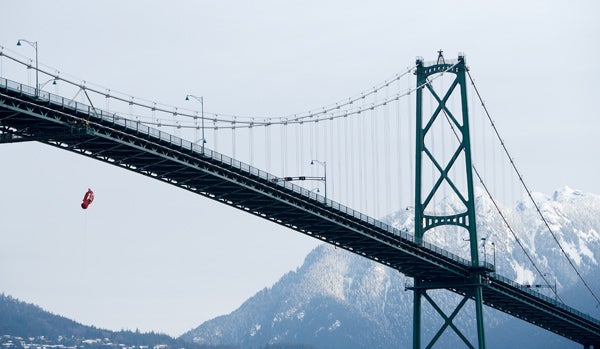
The Lions Gate Bridge carries some 70,000 cars almost a mile across the entrance to Vancouver’s harbor every day. In a city polishing itself up for the 2010 Winter Olympics, the bridge is prime postcard fodder.
Except today, what with the red-and-white car dangling from the center span. And since 4:15 this morning, it’s been the Ministry of Transportation’s problem to get the thing down. Allan Galambos, wiry and gray-bearded, is the ministry’s head structural engineer, and when he got the call that an old Volkswagen Beetle was hanging from Vancouver’s best-known bridge, he wasn’t amused.
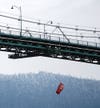
“Pranks create a lot of risk,” Galambos says. His first worry was that the car might fall onto a ship. But traffic is the real headache. By 11:30 a.m., two police cruisers have restricted drivers to a single alternating lane, and a boat circles below in case the Beetle falls. According to Canadian law, one cannot drop anything into the harbor, so Galambos’s crew can’t cut it down, even though the VW weighs only 390 pounds and comes stripped of all glass, engine and undercarriage. Instead, they have to bring in a crane to pull the car up. As the car rises, a hand-painted white “E” becomes visible on its roof. Several crew members roll their eyes in recognition.
“E” stands for “engineers.” University of British Columbia engineers. At many campuses, students play a prank or two—steal a rival’s mascot or move a roommate’s furniture to the quad. But only schools with rich engineering cultures put such awkward objects in such unlikely places. It’s a rare chance for engineers to show off their skills in a very public way, so much so that some of the greatest pranks resemble performance art.
UBC isn’t the only school known for its merry pranksters. Check out the full roundup of great collegiate capers at popsci.com/prank
Caltech, MIT’s greatest rival, tapped into the Rose Bowl scoreboard in 1984 and hooked up a wireless controller. During the big UCLA/Illinois game, when the score played across the screen during the fourth quarter, the names had been replaced: “Caltech 38; MIT 9.” And in 2006, MIT students got Caltech’s 1.7-ton ornamental cannon onto a trailer in broad daylight, partly through savvy social engineering: MIT student actors impersonated Caltech students and grilled the phony movers so passersby wouldn’t feel the need to do so.
![Team members [whose faces are obscured here to protect their identity] had less than six minutes to get the Beetle onto the bridge and over the side.](https://www.popsci.com/uploads/2019/03/18/FXBHE2PJVWSR2URBY4BHCHYWCU.jpg?auto=webp&optimize=high&width=100)
Feat of Imagination
In this arms race, UBC is the third superpower. One of its most sophisticated feats also took place on the Lions Gate Bridge, in 1988. Electrical engineer Johan Thornton, now a contract engineer in his late 30s, decided that he wanted to make the bridge lights —all of them—blink. Thornton will only broadly describe the hack, but he hints that the low current of the bridge’s daylight sensor was crucial. For hours, people assumed that the blinking bridge lights were broken. Then the crew of a passing cargo ship reported that the pattern was Morse code: “UBC engineers do it again.”
The first Beetle appeared on the UBC campus in 1980, when students put one atop the school’s 121-foot clock tower. Since then, at least 14 cars have shown up in such places as the Massey Tunnel in Vancouver, on top of the wooden roller coaster at a city amusement park, and suspended between the Granville Street and Burrard Street bridges. The last great stunt took place under the Golden Gate Bridge in February 2001. Students hung a cable from the bridge span one day before. Accomplices then hid underneath the bridge for hours before the car arrived in a moving van. They crawled out, clipped the car to the cable, and threw it over. U.S. authorities stopped bridge and seaport traffic for hours. The students made it back across the Canadian border before anyone could stop them.
Roughly two hours after the Golden Gate incident, at 5:48 a.m., the pranksters sent a press release to major news outlets, marking the 20th anniversary of the first car suspension from the Lions Gate Bridge (in their excitement, they made a rare miscalculation; it was actually the 19th anniversary). It hailed the value of engineers, “from building crop irrigation systems to designing better wheelchairs,” and noted that UBC’s engineering courseload is 30 percent higher than for science or art students. Using the polite, measured language of their profession, the students pumped their fists in tribute to engineers everywhere.
So Galambos knows that he’s up against a long legacy. And despite his understandable safety concerns, he accepts that pranks are part of the culture and education of young engineers. If anything, he’s become a reluctant connoisseur of their work. But as a result, when Galambos’s team reports that the steel cable holding the car was attached to the handrails, he explodes. To Galambos’s mind, the handrails are not structural elements of the bridge and thus might not have the same strength. “If you do something that’s an example of true engineering intelligence—well, that’s not such a bad thing,” he says. “But you need some foresight about safety. Did they take any time to calculate the strength of the handrail, or did they just hang it up?”
He has no idea.
THE SETUP
Stan Johnson (not his real name) planned the stunt for more than a year. “I admit that as a student, I may not know as much as a full-fledged engineer,” he says. “But we engineered the hell out of it.”

How to Suspend a Car in 328 Seconds
In the summer of 2006, with his junior year approaching, Johnson, a tall kid with wild hair, spied a vintage 1960s Volkswagen in an overgrown apple orchard. Sure, the Beetle prank had been done before, but for UBCers, it’s a joke that every comedian wants to tell better. Inside the family’s garage, Johnson and his father, a heavy-equipment mechanic who promised to help if his son kept his grades up, excised the undercarriage, engine and transmission with an oxyacetylene torch and a reciprocating saw. They sandblasted the car, painted it, and welded metal beams to strengthen the shell.
Johnson assembled a crew, took measurements of the bridge, drew up elaborate plans, and practiced the deployment over and over on campus. He even put a PR strategy in place when he e-mailed Popular Science early last year offering a chance to document a stunt in action. University engineers have never let an outsider in on the details of a stunt before, typically taking implicit responsibility as a student body to ward off charges—any one stunt can earn several local and federal indictments—against any single student. (“These cases are hard to prosecute,” Vancouver police constable Jana McGuinness told me. “No individual comes forward.”) But to Johnson, talking to a reporter was worth the risk if it helped to earn him “the Black E,” the coveted cloth patch worn by UBC engineers. The Engineering Undergraduate Society awards these on rare occasions, and only for bringing wide media attention to a major stunt (on the society’s site, the term used is “STUdeNT project”).
When I arrived on campus the night before the prank, the 24-year-old ringleader led me on a reverent tour of the headquarters for UBC’s 3,600 engineering students—a red-and-white monstrosity, squat and ugly next to a row of elegant West Coast Modern masterpieces. Under my feet, the beer-coated floor of the common area made a distinctive snick, snick, snick as I followed Johnson’s shock of hair to a wall of class photographs, some dating to the 1930s. Students in natty red outfits stared back at us, an army of highly skilled practical jokers.
We ducked behind a plain wooden door. Inside, the place had all the look of a special-ops headquarters. Selections from the Canadian criminal code had been photocopied on the wall under the heading “430: MISCHIEF.” There was a book called The Complete Guide to Knots and Knot Tying on a table, and about 60 yards of multicolored climbing rope. On the floor was a giant gleaming metal hook, roughly finished and measuring about three feet long. Nine attentive students conversed around a low table, shuffling through 8-by-10 photos of the Lions Gate Bridge’s roadbed, roadside handrail, pedestrian walkway, walkway guardrail and structural details beneath the guardrail. It was like the Rebel Alliance poring over blueprints of the Death Star.
A young woman addressed the group. She was holding a sheaf of maps with escape routes marked in red pencil. She had scouted the bridge for months. She knew that large cruise ships typically move through the harbor on Wednesdays, so the early-morning Monday stunt shouldn’t obstruct their passage. She knew about the security cameras at both ends of the bridge, and about the small lookout house under the span. The local emergency crews, she said, were slow to rouse. “The number of times someone has stopped their car, put the blinkers on, and puked over the side is huge,” she reassured the group. “They’re not going to respond until they see the car over the side.”
![The UBC students lift the car onto the walkway to rig it [above], a process they've rehearsed many times. But after lowering it off the edge [below], the rope caught, causing panic.](https://www.popsci.com/uploads/2019/03/18/ANNBN66R6BS7D6DFDHX2LEH4VY.jpg?auto=webp&optimize=high&width=100)
Pull it Together
“How long will we be on the bridge?” someone asked. “Three to five minutes,” she answered.
A tight division of labor would be the best strategy, Johnson explained to me. The woman with the maps was the chief lookout and transit logician. A woman with braided hair was in charge of hiding the car in a garage in North Vancouver. A woman with hipster eyeglasses was the getaway driver.
Last year, as Johnson and crew began formulating their plan, they foresaw a problem. At Golden Gate, authorities snipped the ropes and let the VW sink. Surely Vancouver authorities would use bolt cutters to send the car to the harbor bottom before dawn. The students didn’t know about the law against dropping things into the harbor, and they worried that there would be no worldwide media storm, no glory, no Black E patches.
So last fall, the group worked on a way to safely hang the entire car from a single point while also stalling maintenance crews. Posing as tourists, they went out to the bridge to study structural features and found a thick steel tab where the walkway’s handrail bolts to the deck. They measured it, and determined that its paint protection had saved it from corrosion. Back at school, they studied the tab’s structural allowances in a steel-design handbook and double-checked their findings against a set of current bridge blueprints (probably provided by a sympathetic alumnus, although the team wouldn’t identify their source to me). “We never got close to the weight limits of the steel,” Johnson says. The team designed a simple, reliable hanging device that was difficult to intentionally cut: an elongated steel J-hook with a narrow slot at one end that would fit the bridge tab like a puzzle piece, and a long shank at the other that would be too thick to sever with bolt cutters from above. (Over the winter, a student slipped designs for it in with a laser-cutting project as part of an externship.) Johnson and crew built the hook to hold the equivalent of six stripped Beetles and hoped that the hook’s long shank would stall response teams for a day to improve the chances of major media attention.
Close Up
As the group pulled on its coats to go catch a little sleep before the stunt, Johnson rose for a final pep talk. Earlier, he’d confided to me that his stomach had been seizing for weeks. Now, as his right hand twirled a pencil, he began by citing the quality of the equipment. “We have 2,400-pound cables,” he said. “Our carabiners are off-the-shelf parts with published tolerances. Our main job will be to get it over the edge and under the bridge in a safe manner.” On the eve of a massive practical joke, Johnson’s tone was that of a professional engineer. His team nodded in unison.
MISSION IMPROBABLE
A tourist has no business on the Lions Gate Bridge at 4 a.m. in winter. On the center span, I shivered as a barge slid past, 200 feet below. The muffled yap of guard dogs came from a railway yard on the north shore. And at the north end of the bridge, four police cruisers conducted a DUI checkpoint. A shiny new SUV flew by at high speed and braked suddenly when it saw the spinning lights.
I wondered if the police presence might cause the students to call it off. But at the stroke of 4:00, the cops departed, and soon a pickup truck and trailer materialized over the curve of the span. The truck stopped smoothly next to me, and students in dark clothing hustled out. One yanked the blue tarp off the trailer to reveal the Volkswagen. Four guys grabbed the body of the Beetle from the trailer bed and struggled to lower it to street level. The car shell buckled, trickling rust. A thin guy with a shaved head hopped off the bed and onto the street to receive the vehicle and unwisely took the bulk of its 390 pounds for a few seconds. “Coming my way?” he blurted as his knees started to buckle. The foursome found leverage and lifted together, passing the car between the bridge cables and onto the pedestrian walkway.
Everything happened simultaneously. While the foursome positioned the Beetle, Johnson and another crew member prepared the ropes. Success depended on securing two sets of rigging. One team would run the steel cable through a carabiner on a harness atop the car body. At the other end, the cable looped through the bottom of the custom steel hook. A second group would place a nylon rope through another carabiner on the car’s harness and use it to gently but quickly lower the car off the side of the bridge, like a dinghy off a cruise ship. When the car was at the correct position and the steel cable fully stretched, the plan was to remove the nylon rope entirely, to make it look like the car had been placed at the end of the cable by some giant hand.
At first, the group’s adrenaline got in the way. Teammates bumped into one another. Someone kept saying “good, good” too loudly. But then things began to click. Ropes spooled out hand over hand. A student backed toward the railing and, accessing his internal map of the space, reached behind and steadied himself without looking.
As students were busy rigging, Johnson’s father stood next to the truck. They caught his gaze as he looked uneasily at the south end of the bridge, and then a white car appeared. It pulled up quickly, stopping right behind the trailer. The anxiety of the group rose. Unmarked police vehicle? Johnson Sr., unfazed, waved the car around, and it drove off.
“Y’all set here?” he shouted.
“Yes, Mr. Johnson. Thanks a lot.”
The truck pulled away. Suddenly, knots appeared in Johnson’s section of rope. He pulled the excess down the walkway to inspect it. As another set of headlights swept across the scene, his attention moved frantically from tangle to tangle.
The car passed. “Rope’s in?” the skinny guy asked, moving through a memorized punchlist. Ten seconds went by. Thirty. Tasks finished, everyone watched Johnson. Finally, he stood up. “Rope’s in!”
The car was rigged and ready to go, but there was no sense of relief. The students kept a wary eye on the roadway. Four of them grabbed a corner of the Beetle and lifted it to the guardrail. It teetered, then slid over with a groan. The belay cinch whined as Johnson gently played out rope. But when it finally reached bottom, something wasn’t right, and faces became anxious. “Rope’s open?” called someone. He was asking whether the end of the rope was unhooked, ready to be pulled through the carabiner and up the other side. “Rope’s open,” came the reply.
But the rope was caught somewhere on the car and wouldn’t budge. The whole crew converged at the railing, leaning out to see what was wrong. Rather than hanging level, the car was at a wild angle. But Johnson knew they were out of time. “OK, cut rope, cut rope,” he cried, and one of the crew hacked at the line with a pen knife, tossing the rest over the top of the rail. “Somebody get on the phone—call for pickup,” Johnson commanded. They crossed over to the southbound lane, and five minutes and 28 seconds after they had arrived, they were mere onlookers, pedestrians, and nothing could touch them.
THE POSTMORTEM
Two hours later, driving through Stanley Park, looking for their handiwork in the predawn, the team listened as an AM radio station did the morning traffic: “On the Lions Gate this morning, you’re going to have to look out for a disabled car—under the bridge.” Johnson looked satisfied. The caravan stopped at a scenic overlook. Laughing and jostling, they could just make out the blinking LED they had attached to the side. An older man in a bike helmet pedaled by in the gray light and called out, in a shy but conspiratorial tone, “UBC engineers!” The group cheered.
The high spirits continued as the perpetrators, joined now by perhaps a dozen friends, filled a diner nearby. In a few hours, the incident received coverage from Reuters (“Engineered to Bug You?”), the Vancouver Province (“Car Drop Scores”) and international television. Rumors flew that the police might look for suspects on the bridge’s security footage. (The team logistics expert had warned members to alter their license plates with duct tape.) All day Monday, detectives questioned any student who came to Stanley Park to view the car, but by the time summer break rolled around, the police hadn’t made any arrests.
After years of post-9/11 security and paranoia, I was impressed to see someone engineer a little creative mischief for the hell of it. And in the end, the Beetle-hanging wasn’t just a stunt. It was a chance to learn the essentials of problem-solving—simplicity, planning, skill—by causing problems.
Of course, the plan didn’t entirely work out. On the descent, the cable caught the rear fender, yanking the vehicle upright. Then a rope pinched somewhere, and they had to abandon it rather than remove it without a trace, the stunt’s planned masterstroke. If they had it to do all over again, Johnson says, they would place the cable at the same spot but drop the Beetle at a greater distance from the hook so that while the shell descended, the cable would remain taut the whole time. And that’s when I realized that his being so bothered by the details is what will make Johnson a good engineer: In his moment of triumph, he was already refining his work. “It’s not exactly what we imagined,” he sighed. “I wanted it to be perfect.”
UBC isn’t the only school known for its merry pranksters. Check out the full roundup of great collegiate capers at popsci.com/prank
Bob Parks’s last article for PopSci_, about Darpa’s autonomous-car challenge, appeared in the May 2007 issue._

Caltech
At left, two of Caltech’s infamous name-in-lights pranks. In 1961, 30 million Rose Bowl viewers were stunned when the Washington Huskies unwittingly began cheering the small, neighboring technical school. Ten years later, pulled a similar prank on the Hollywood sign.
University of Wisconsin
The University of Chicago
Georgia Tech
MIT