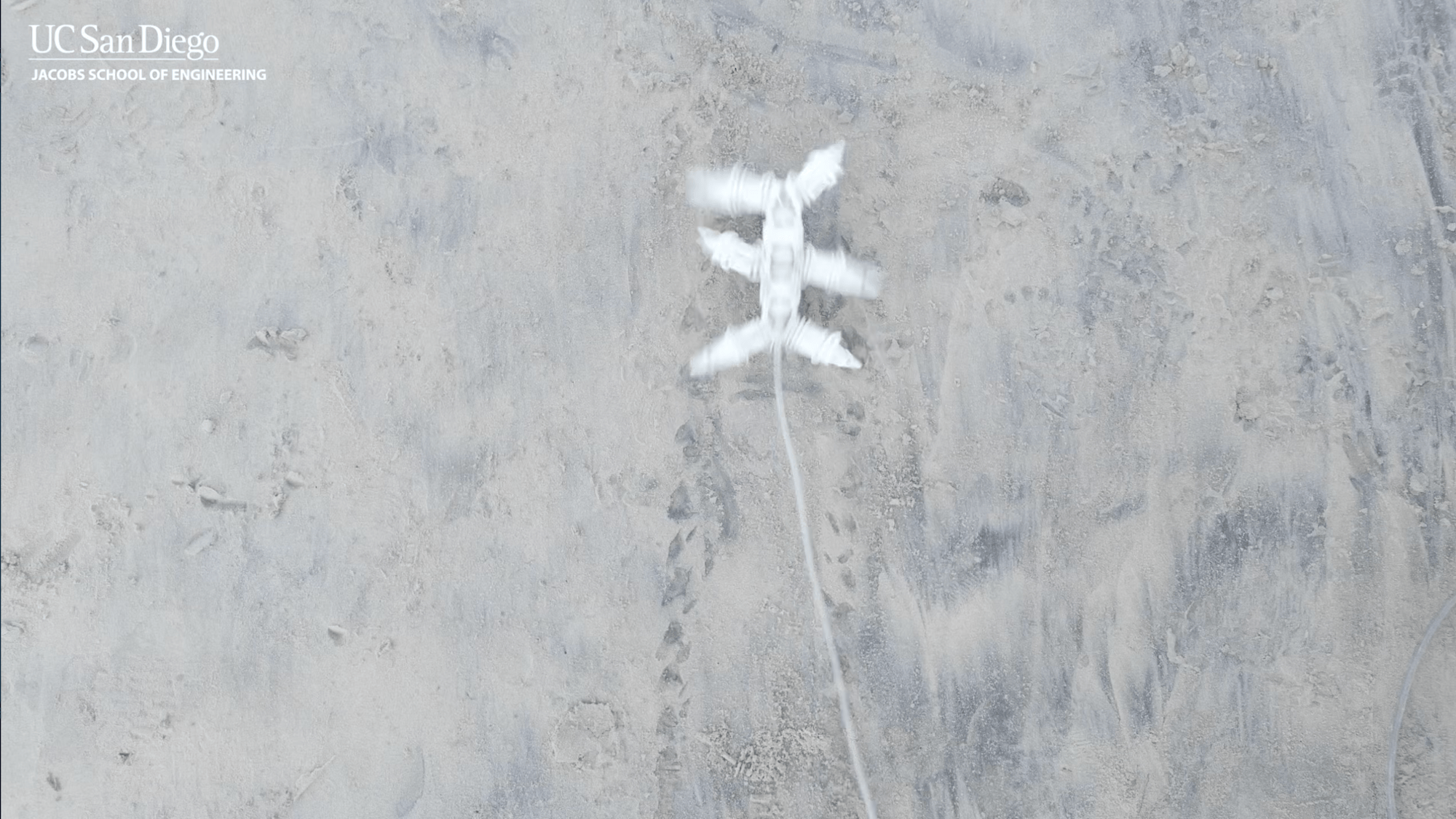
In 2022, researchers at the University of California San Diego developed a 3D-printed soft robot that used air power to scuttle along at a modest 1.5 inches per second. After a few years of adjustments, the engineering team now has a six-legged iteration that leaves its predecessor in the dust. Detailed in a study published in the journal Science Robotics, their new soft robot still contains no electronics, but runs across multiple types of terrain at speeds topping 15 feet per second. According to its designers, the machine is the fastest soft robot ever constructed.
“Our first walking robot demonstrated what was possible, but it was too slow. We hoped to overcome this limitation, and we were fortunate to find a solution to make the new robot 100 times faster,” Yichen Zhai, a study co-author and UC San Diego engineer, said in a statement.
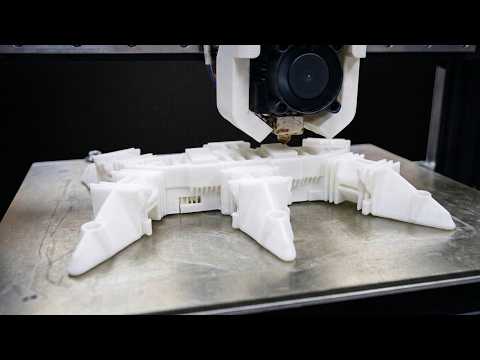
Fastest soft robot ever built can roll right off the 3D-printer–no assembly or electronics required
The invention’s speed comes from a novel compound steam engine that allows highly pressurized air to expand throughout numerous chambers not once but twice. This air first flows through the robot’s valves, then recirculates through wider, lower-pressure sections in its legs. The team’s creation maintained its efficiency and speed in multiple environments, including gravel, grass, mulch, and concrete. It even handles sandy surfaces and can work underwater.
“The key challenge was to implement a time-tested solution (the compound steam engine) in a soft running robot that can be printed in a single piece out of a single material,” explained Zhai. “We see this as a step towards complex and powerful robots that can be printed on the desktop using inexpensive materials.”
Their current version of the robot is still limited by its power source, and the tethered hose that delivers the pressurized. That said, they plan to design future variants requiring less air. This would hypothetically allow them to attach a portable power source like a compressed air cartridge, as well as enable more complex controls and maneuvering.
These prototypes are more than oddball experiments, too. Without any onboard electronics, similar robots could have an advantage while operating in highly irradiated environments, dangerous conditions, and even outer space.