One of the world's oil capitals opens the world's largest single concentrated solar power plant.

Abu Dhabi Solar
Abu Dhabi Solar Mirrors shine at the newly built Shams 1 concentrated solar power plant south of Abu Dhabi. Masdar on Facebook

One of the world's largest solar power plants opened this weekend in the oil-rich city of Abu Dhabi.

The 100-megawatt plant, called Shams 1, is a first step in a plan to make seven percent of Abu Dhabi's energy resources renewable, Sultan Ahmed Al Jaber, head of the Abu Dhabi Future Energy Company, said during a news conference. Abu Dhabi is part of the United Arab Emirates, which are famed for their oil wealth. The emirates rank 13th in the world for per capita GDP, a standing driven mostly by their oil exports.

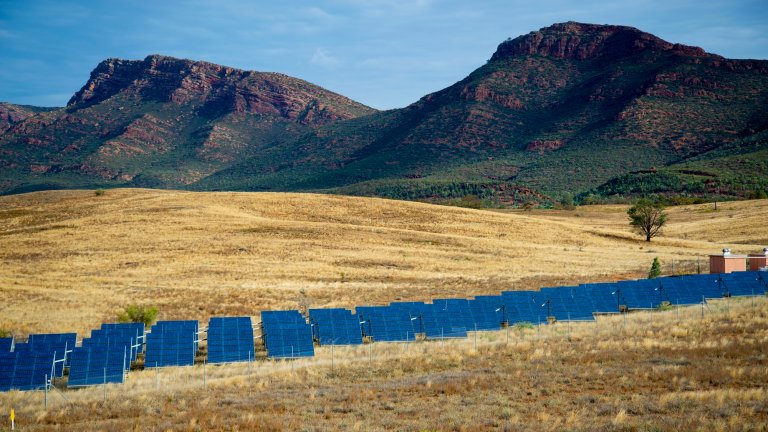
The new plant includes a huge field of parabolic mirrors located in the desert about 74 miles (120 kilometers) south of Abu Dhabi. Shams 1 will serve 20,000 homes and cost an estimated $600 million to build, the BBC reported. Similar Shams 2 and Shams 3 plants are in the works, Clean Technica reported.

Shams 1 is a concentrated solar energy plant, which means its technology is a little different from the flat, black photovoltaic panels you might have seen on people's roofs. Shams 1's uses mirrors to concentrate the sun's energy to heat a fluid, which produces steam to turn turbines to make electricity.

Shams 1 isn't a perfectly efficient solution, however. The plant's process still requires some natural gas to "superheat" the fluid, Clean Technica reported. It also requires uses some energy in the form of brusher trucks that clean the mirrors of sand. Even in the middle of the desert, it's impossible to make a solar power station totally efficient.

Although there are certainly other solar plants in the world Shams 1's size or larger, the Abu Dhabi plant holds the title of the largest single concentrated solar energy plant. Other concentrated solar plants are connected with thermal power plants, IEEE Spectrum reported. There are also larger concentrated solar energy projects that are near completion, but aren't yet plugged into their local grids.

[BBC, Clean Technica, IEEE Spectrum]

19 Comments

Well done!

$30,000 per home seems like they could have done better than that.

Imagine the shock of future generations a million years in the future when they did up this facility buried by 50 feet of sand!

The cavemen of tomorrow will marvel at what it was possibly for?

Maybe the sun god and workship?

@FutureEcho

I assume the cost (per home) of the project will come down once Shams 2 and Shams 3 are built, thus splitting the development costs associated with the project.

I have now seen a number of reports. None report some of the information which would be most meaningful.
The previous writer offered an example in relating the cost per home.
What will the cost of energy be per kWh? How does this compare with costs of other energy generators? In Sacramento, California, for example, the utility wind farm is producing energy at about 4.5 cents per kWh. How do these compare to the average costs of new energy installations in the U.S. and in Europe?

What are the temperatures in to the turbine and out? What is the efficiency of the turbine? What is the temperature of the working fluid feed to the collectors and what is the temperature out? If the feed temperature is not ambient, how does it get its heat?
How would this type of technology work at the latitude of Kansas, USA or Berlin or Stockholm example?

One report said that it would not be possible to operate without using fossil fuels to run mirror cleaning and to boost the input temperatures to the turbines. Neither of those things is true, it seems.

By comparison to the cost of this installation, Mr. Desai of Tiny Tech in India is offering a 90 sq meter solar collector at about $12,000. Using his steam engines and electrical power generators, 100 kW installations cost about $200,000. At that rate, if my calculations are correct, 100 MW would cost $200 million or one-third the cost of this new whiz-bang large high tech installation. Tiny Tech installations can be acquired in small modules and can be built locally by ordinary metal workers at lower costs. Find the video link by searching Tiny Tech Solar.

30 000$ per home is incredibly high amount. Assuming the lifespan of this plant is 20 years, that is 125$ per home per month, not counting the mantainance costs.

Seems like another "look at my new cool toy" saudi thing more than anything eltse.

Abu Dhabi literally has money to burn. The initial startup of $600 million is not a problem. They are building for oil independent free future.

The only true concern they have to worry about, is just maintaining this power source and once this is built, the latter is low by comparison.

@kcpet
90 kW from 100 sq.m: more than a kW a sq.m. Not in your wildest dream. I am sure that would beat any practical efficiency record by a factor of 10 or even more. I do not believe your figures for wind either.

@African Rover
The 90 sq meter collector was just one $12,000 component. It would require a combination of many of these (the exact number is not mentioned) to make the $200,000 facility for generating 100 kw proposed by kcpet.

It has been well proven that heat from the sun is already a true green solution. Many other examples of this technology exist and work well.

As for the numbers given we can't guess. A home there may very well consume 20 times or more the average home in Europe or USA. Also the cost to build there may be much higher since it is all imported. Then we get to the life span. It could have been built to last 100 years.

I suspect that they are trying to make very high pressure steam and getting close to that btu from sun isn't quite there. So they add in some last minute heat from fossil fuel. They could have used much lower pressure steam but either hard to manage in size or efficiencies involved.

In any case, any time you can displace fossil fuel you are ahead of the game.

Thanks for great comments and interest.
Information on the costs of various alternatives is basic information important to understanding. I have been looking for the source of my 4.5 cents per kWh cost to the Sacramento Municipal Utility District Wind Farm and can't find it. However I have found a quote of power purchase agreements at 5 to 6 cents per kWh. http://cleantechnica.com/2011/05/01/cost-of-wind-power-kicks-coals-butt-better-than-natural-gas-could-power-your-ev-for-0-70gallon/
Those figures seem unbelievably low. But there you are. The facts are unbelievable because they are only rarely reported and the technology is no longer what it was fifteen years ago.

There seems some confusion about the Tiny Tech Solar figures.
I hadn't looked at them for awhile.
As I remember the 96 sq meter collectors produce 10 HP of heat. That would be 7.5 kW. The cost of a single unit purchase is $12,000. They would be much less in volume and produced locally in many instances. It would take 13.5 collectors to get 100 kW. If the efficiency conversion to electricity is 20 % then the about 68 collectors would be needed to produce 100 kW electricity. Multiply by $12000 to get about $800,000. The cost to produce equivalent to the new farm would be $800 million. That is four times the figures from my earlier notes. I don't know why.

None-the-less, the Desai TinyTech approach would almost certainly be less costly than the new Abu Dhabi project.
With the added advantages of being small modular units locally produced.

Thanks again. Please knock some holes in my ideas.
I look forward to seeing more of your comments..

Check out this log plot of silicon solar prices overtime:

https://plot.ly/~alex/13/

You can see the unbelievable influence of Chinese solar manufacturing over the past 3 years.

(Graph made in plot.ly - drag to zoom, double-click to autoscale).

lanredneck

from Northfield, Vt

@jefro
here ya go on power consumption per capita
http://en.wikipedia.org/wiki/List_of_countries_by_energy_consumption_per_capita

http://www.aceee.org/files/proceedings/2008/data/papers/8_24.pdf

I found the information on the 90 sq meter concentrating solar collector from Tiny Tech in India.

The 40 kW heat capacity is much greater than I had remembered.

If 40 kW heat is correct, my original comment to the effect that the Tiny Tech system could match the capacity of the new Abu Dhabi project for about one-third of the cost seems OK.

Sometime last year I did check the insolation for India where Tiny Tech is located and the 40 kW heat collection for 90 sq meters seems consistent with incident solar radiation.

Here is the original announcement from Tiny Tech

"We have recently developed 90 sq mt solar concentrator. Mr Eerik came to help me from Finland. This is fixed focus, completely folding concentrator not requiring any foundation in the ground. Shipment volume will be 12 cu mt and one 20 ft container can take 2 concentrators. It can be assembled at site in 2 days and mirror focusing will take further 5 days. Then immediately it starts working.

" It will be useful for water pumping and running agro industries in the farm itself. This may bring real revolution in entire world. I feel that I am steadily approaching to my goal to make available tiny solar thermal power plant to every small farm.

"This solar concentrator of 90 sq mt will be unique alternative of fossil fuel based power plants. For small captive power plants for 5KW and for steam cooking system for hostels , this will be ideally suitable. It may cook for 800 to 1000 people. Heat power will be at about 40KW.

"Frame size is 11.5mt x 11.5 mt and will occupy space of 16mt x 16mt for revolving. Tracking is manual. But only one person can manage tracking of 5 such concentrators. So it is not big problem in poor countries.
FOB cost is US$ 12000/-.

By comparison, the 3rd power plant on the Grand Coulee dam generates over 4 Gigawatts at a total cost of $1.9 Billion in 1998 dollars (Wikipedia). The Grand Coulee generates a total of 6.8 Gigawatts and supplies power to 3 states including the city of Las Vegas. It will probably still be around in 50 years.

You would need 68 of these plants to equal the power output of the Grand Coulee Dam, and that would only be on a cloudless day. The Grand Coulee runs 24x7.

I'd still rather use clean unlimited power from the Sun than burning up finite polluting fossil fuels for energy. Maybe the Saudi's know something we don't - like how much oil they have left. $150 per month doesn't sound too bad considering my electric bill is over $300. I wonder what it will be 30 years from now.

@erikiscool: " Maybe the Saudi's know something we don't - like how much oil they have left."

Have you been paying any attention to the dramatic increase in the reserves of oil and gas, in the past few years? Your "peak oil" type of argument has never made less sense.

The oil age will end before too long -- but, not because we run out of oil. Some combination of alternate-energy technologies (solar, wind, biomass, even nuclear fusion) will, inevitably, become more cost-effective than fossil fuels. That day hasn't arrived yet, so the best use of our scarce resources is to continue to roll out new energy technologies slowly -- until such time as they are actually cost-competitive. Otherwise, we will simply be diverting resources from where they would do more good (feeding the hungry, educating the masses, etc. -- even the R&D phase of new energy technologies).

Shams....lol no one else thinks the name is hilarious?

*************** bit.ly/YniJRv **********
I'm creating $86 associate degree hour engaging from home. i used to be appalled once my neighbour told Pine Tree State she was averaging $95 however I see however it works currently. I feel most freedom currently that i am my very own boss. this is often what I do,
*************** bit.ly/YniJRv **********

Cute! The Arabs have been selling us oil for decades and have made billions from it. Now they have started to construct all kinds of futuristic projects, conceived, planned and built by European and US companies and also operated by imported labour. And of course, paying billions. I guess somewhere somebody is keeping tabs and once the price has been paid and renewable energy sources become mainstream,the desert dwellers can go back to their camels and their expensive projects will start to crumble and finally be covered by sand.


140 years of Popular Science at your fingertips.


Popular Science+ For iPad

Each issue has been completely reimagined for your iPad. See our amazing new vision for magazines that goes far beyond the printed page


Download Our App

Stay up to date on the latest news of the future of science and technology from your iPhone or Android phone with full articles, images and offline viewing


Follow Us On Twitter

Featuring every article from the magazine and website, plus links from around the Web. Also see our PopSci DIY feed


April 2013: How It Works

For our annual How It Works issue, we break down everything from the massive Falcon Heavy rocket to a tiny DNA sequencer that connects to a USB port. We also take a look at an ambitious plan for faster-than-light travel and dive into the billion-dollar science of dog food.

Plus the latest Legos, Cadillac's plug-in hybrid, a tractor built for the apocalypse, and more.


Online Content Director: Suzanne LaBarre | Email
Senior Editor: Paul Adams | Email
Associate Editor: Dan Nosowitz | Email
Assistant Editor: Colin Lecher | Email
Assistant Editor:Rose Pastore | Email

Contributing Writers:
Rebecca Boyle | Email
Kelsey D. Atherton | Email
Francie Diep | Email
Shaunacy Ferro | Email

circ-top-header.gif
circ-cover.gif
bmxmag-ps