China's New World-Beating Battery Facility Business Wire via Cleantechnica

The largest battery in the world has arrived, and you likely won’t be surprised where it landed: Hebei Province, China. The State Grid Corporation of China (SGCC) and electric car maker BYD--the company that most recently made big headlines a few years back when Warren Buffett’s Berkshire Hathaway took a 10 percent stake--have teamed to create a massive battery array capable of storing 36 megawatt-hours of electricity.

That’s enough to power something like 12,000 homes for an hour during a total power failure, and enough for SGCC authorities to declare it the world’s largest energy storage device. The $500 million facility is constructed of arrays of BYD batteries “larger than a football field,” according to an SGCC press release, and they should increase the region’s renewable energy efficiency by up to 10 percent.

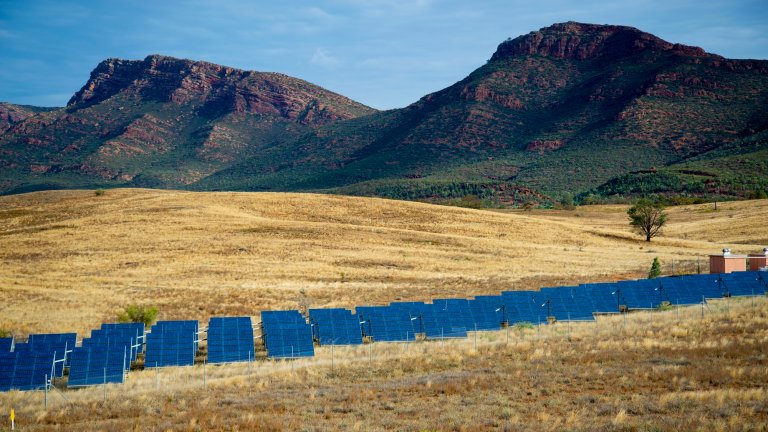
The array, located in Zhangbei, isn’t just a stand-alone battery. It is hooked into 140 megawatts of wind and solar power generation projects as well as a smart grid transmission system. Together, these elements represent China’s push toward a smart grid system that can generate renewable energy when conditions are ripe and store excess energy in its new battery array for use when energy generation troughs throughout the day.

The Deputy Director of China’s National Energy Administration is calling it the model for the future of Chinese renewable energy development, which means it will probably be the first such battery facility of many. That’s good for both China and BYD, which has been having a bit of trouble selling its electric cars both at home and abroad.

And it’s an intriguing test-bed for the rest of the world as well. There’s been a lot of chatter globally about using various kinds of energy storage devices to smooth the peaks and valleys inherent in wind and solar power generation so that we can rely more heavily upon them. Now that China’s gone and done something on a truly large scale, the rest of us have a real-world project to watch and learn from.

[Cleantechnica]

63 Comments

40,000 dollars per house for 1 hour during a total power outage, doesn't sound too cost effective.

ugh

Yup thats $15K a kilowatt hour enough to cover 12K homes for 1 hour.

Gee what if the we had one of those large area two week periods in the middle of the winter with no wind.

Lets see 24*14*500/12000 or $14 Million per household.

Now there's a deal a greenie is a gonna go for sure.

@hollycow....

How cost effective is it to keep going on the same trend of destroying our earth...so we eventually have no were to live...thats real cost effective...screw cost we need more of this kind of thing world wide...more renewable clean energy sources...

This is a step in the right direction.

This... is a step towards a back and forth annoyance match.

While it might actually end up being a good thing to antagonize others into jumping on board the bandwagon for lithium, etc. It does nothing to smooth over issues between the U.S.A. and China.

>Lithium isn't much of a renewable resource by the way. That's assuming they are using lithium with their iron-phosphate-style batteries {something this (and many other articles} doesn't touch on.

It looks neat.. too bad it's "Made In China"

Kudos to china (again)….they are being forced into this corner because they are really dependant on our oil. And since they buy the majority of their oil, they really have no choice. In the west it’s a different story, we make billions off of our oil. Even countries like Russia, Saudi Arabia, etc (top oil producing countries) have American or European companies as partners…so we are making billions off of their oil as well. And countries that don’t want to cooperate (Iraq, Iran)…we know what happens to them. We will not see a project like this in the west..dare I say…ever.

@z7U2v 10 years ago “made in china” meant cheap and low quality. Today, this is not the case, you’d be surprised how many, high end products flow from China. Thanks U.N and U.S government, Canadian government (NAFTA) for de-industrializing our western nations.

These batteries aren't likely going to be just sitting idle until a power outtage. More likely they will be in active use on a regular basis, primarily for solar and wind power.

Doing so will significantly increase the efficiency of both sources of energy, as a lot of the energy loss for renewable systems comes from converting energy from DC to AC and back, not the generators themselves.

So the numbers folks are crunching -- $15k a kilowatt hour to cover 12k homes for 1 hour -- are completely off the mark. Note, they're getting the number by dividing the total building cost (500 million) by the amount of energy stored (32 gigawatts, or 32,000 kilowatts).

Another point: the initial cost to create the building is not the same cost as filling it up with energy. You don't have to rebuild it every time you drain its supply. And, as I said, it will likely be in continual, active use, and primarily for renewable energy sources.

Another note, explaining that this battery can power 12,000 homes for an hour is *only* a means to explain the amount of energy it can store. It is *not* the same as saying this battery will be reserved for that purpose. That would be silly.

Powering 12,000 homes for an hour is the same as saying 6,000 homes for 2 hours; 3,000 homes for 4 hours; 1,500 for 8 hours; 750 homes for 16 hours; 325 homes for 32 hours, and so on.

They will be building more.

Personally, I don't really like massive, industrial batteries like this, because the batteries themselves are terrible for the environment, but it is a step in the right directly converting the current infrastructure into one that's more friendly towards renewable energy. The battery complexes can be easily replaced in the future with better technology; the infrastructure itself is much more difficult to change.

I'm hoping this will spawn more "energy" stations/bars, rather than gas stations/bars.

By the way ALH, you're wrong. We have in fact seen projects exactly like this in the west. And we will see more, though perhaps not as quickly as we might need them.

Consider this one, switched on in 2003: http://www.telegraph.co.uk/technology/3312118/Worlds-biggest-battery-switched-on-in-Alaska.html

Some 5 or 10 years in the future and downstream from this "China's World-Beating Battery Facility", babies being born have a higher death rate or deformity. For those babies that are female, China pays zero attention. It is only much later as this hits the media and how it is effecting male babies.

..........................................
See life in all its beautiful colors, and
from different perspectives too!

The Helms pumped storage facility (hydro) in California, which opened in 1984, is many times bigger, over 1,200 mw. Probably a lot less expensive to build, better for the environment, safer and no battery degradation.

Exactly Canadian_Skeptic, the point of these batteries is to smooth out the sometimes erratic nature of renewable energy. Around home we have a lot of windmills. It works well in our area because we have nearly constant wind. However, in areas that don't they spend too much time moving energy around so they don't have to ramp their base power (Coal, Nat. Gas) up and down. Its a lot easier to flip windmills on or off than it is to ramp a boiler up and down. But, if you have a battery, which can than be used to regulate the flow out of your windfarm, there is no need to worry about dramatic shifts in power generation. With a battery system this large they can feed more power into the grid as the wind slows or the sun goes down and that way there can be a slow ramp up of their base power to compensate. Back home they did the same thing with a battery the size of a semi trailer to act as the regulator.

D13, Im not certain batteries themselves are necessarily more efficient than other means of generating power. It's how well they work with renewable sources of energy that's so important here.

But simply adding batteries to each building would not make them more efficient; in fact, the exact opposite is true. It would force that energy to undergo yet another transfer from DC to AC, resulting in energy loss.

The point here is to reduce the number of times energy needs to be converted. That's where the energy savings comes in.

Space, projecting forward 20 years into China's future will likely yield a much, much greater focus on the welfare of female babies, as there's a ridiculous gender gap in the sheer numbers of adult males to adult females right now. Also, this will happen as the country itself undergoes certain social revolutions (slowly, but they are happening).

As for deformities and such, batteries in and of themselves are not harmful; how you dispose of them potentially is. So it's not where the batteries are active you need to worry about (unless there's a catastrophic malfunction), so much as where these batteries are eventually put to rest.

In this regard, they're not totally unlike nuclear power (Nuclear waste is significantly longer lasting and of course radioactive -- but the issue of how to deal with the waste remains the same).

True ajohnson. Actually, my points were primarily about the energy savings by reducing the number of times the energy needs to be converted. But you're also absolutely right about batteries regulating the amount of energy input you're receiving, since both solar and wind are very erratic energy sources (sometimes you have wind, sometimes you dont).

You're all forgetting a huge bonus to coupling batteries with wind energy. One of the main reasons is that it's often windiest at night time when peak energy demand is lowest, so there's about a third of your energy that won't be used because there's no where to store it. Coal fired power plants often will not shut down a generator even if it has no demand at night because it takes such a long time to go back through the start up process.

FYI. Batteries don't generate power, they store it, and include losses of AC to DC conversion as well as DC to chemical conversion because they store chemical energy, not AC or DC.

Another note, this huge battery is really nothing new. I know of a battery in the US that is 1.5 MWh that's the size of a full sized pick up truck.

And oddly enough, Lithium batteries have little to no actual Lithium in them. Large batteries (kWh range) usually have on the order of grams Lithium.

D13, that would be true if the infrastructure supported DC current primarily.

Unfortuantely, AC is by far the most widespread. When you plug a device into a wall outlet, you're tapping into AC power. Batteries, however, are DC. To convert DC into the usable form of AC, there's inherent energy loss.

But, you're correct to the extent that, if DC energy was directly usable and more mainstream, batteries inside buildings would be a big advantage. In fact, even moreso because DC operates much better over short distances.

Really, it's the conversion of DC to AC that's the big issue here, in my mind.

I guess this qualifies as a plug in hybrid powerplant ha.

a2011, very true regarding coupling wind power with batteries. Solar power works in tandem in the same way.

However, I will correct that chemical energy isn't the same as AC or DC. Batteries store energy via chemical reactions, but they release their energy via a direct current (DC). So you could say a battery uses both chemical energy and direct current.

They still have to convert from AC to DC, then DC to chemical energy to start though, which is exactly what I said. The DC to chemical loss is small, but it's still there.

Also, solar doesn't demand battery power nearly as much because the sun is up only during the day, when peak power is happening. You can dump power onto the grid and know that it will be used and power station generators will still be operating at some efficiency higher than idle.

and i was going to make a battery the size of a shipping container to power my house in powerfailures.

Fair enough, a2011.

You could power your house for days with a battery the size of a compact car if you wanted. Good luck paying for it, as well as maintaining it though.

It has been suggested by a few, all batteries run out December 21, 2012.....

or is it December 12?

..........................................
See life in all its beautiful colors, and
from different perspectives too!

It wasn't done in China first. They do that stuff here too, just not with such an enormous battery. Also, photovoltaics are still more expensive per watt-hour of energy over their lifetime WITH subsidies, which is why they haven't taken off. As for Big Oil holding back battery technology, that's hillarious. The Military drives a lot of the battery industry and that's one entity that has an even larger incentive to reduce fuel consumption than consumers. The single largest consumer of oil in the world is the US military. Add on fuel delivery costs into warzones and they have incentives a thousand fold larger than consumers to push forward battery tech.

Believe me D13, I dream of the day when every building has solar panels and/or a small wind turbine. So much clean energy and space wasted because we don't take advantage of them.. it's really quite sad.

Space, it's also been suggested the flying spaghetti monster is real.

"Extraordinary claims require extraordinary evidence." - Carl Sagan

Canadian_Skeptic,
Flying Spaghetti Monster is real.

Go to Italy and sit down to a nice resturant and cut the spagetti with a knife. I promiss you, you will see the "FLYING SPAGHETTI MONSTER" sir. lol

..........................................
See life in all its beautiful colors, and
from different perspectives too!

There's something I don't understand. Maybe you guys could help me out?

So apparently, Hebei Province has 100MW wind and 40MW solar (adding up to the 140MW number quoted above). Using this huge battery, BYD expects to increase renewable energy efficiency by "up to 10 percent". What does this actually mean? In the context of renewable energy, is "efficiency" just the ratio of generating capacity vs delivered power? Does this mean that their 140MW generating capacity which delivers (let's say, more or less randomly) 550 GWh/year will now be able to deliver 605 GWh?

Thanks for your help!

Wow! . . .

Maybe they will build a colossal battery grid that covers an entire desert region of China . . . that would be a marvel of engineering. If anyone could do it, China would be it -They now have the will an the power to do it. In the mean time, Americans are bickering over weather tax paying citizens have a right to be healthy (Health Care).

I've said this before . . . At this rate, China is the future. How many people on this board believes that if a project on this magnitude would have been given to an agency like NASA, for example, it would have EVER actually been completed. This is the reason I believe China will be the greatest nation on earth by 2100. By then, America will be to China what England is to us today - an irrelevant superpower on the world stage.

Suggestivesimon, efficiency in this manner largely relates to how much energy is lost between generating the energy, moving it to its intended destination, and converting it back into usable energy (for example, turning on your T.V.).

One way these batteries get that 10% increase is because of the type of current it uses. Typically Solar and Wind power provide a direct charge (DC). But to put that energy back into the grid, you have to covert it to alternating current (AC). This conversion inherently causes a certain amount of energy loss, reducing the efficiency of the system.

Having these massive storage facilities gets around the problem a little bit by not having to convert the stored energy into AC. Unless they take the energy stored in these batteries and feed it directly into the AC grid.. then that's another issue (I'm not sure how they're doing this, exactly).

Other people have mentioned other reasons, such as the fact that often power plants waste a lot of energy during non-peak times (it isn't always simple to throttle back energy production as energy use decreases). Batteries allow this energy to still be used; otherwise, this "waste" energy is often just fed right back into the ground.

So really, it doesn't mean you're gaining, it more means you're not losing as much.

Let's say a wind turbine generates 100 GWh. Converting this energy to an AC current and transporting it to a persons home for use loses, let's say, 40% of the energy due to various inefficiencies. So the actual energy output in use by people is 60 GWh -- a loss of 40 GWh, or 40%. Most of this loss will be in the form of waste heat vented into the atmosphere.

Increasing efficiency by 10% may mean that 70 GWh (70%) will actually end up in use by people. Alternatively, it may mean 64 GWh are put to use (I'm not sure how they do their math; 10% increase could be an overall gain of 10%, so 70 GWh, or it could mean a 10% increase over the existing loss, so 10% gained of the lost 40 GWh, or a gain of 4 GWh for a total of 64 GWh).

Does that make any sense?

--------------------
"Extraordinary claims require extraordinary evidence." - Carl Sagan

I see no mention of cost in the article.

Menoc, Why would you want to build a battery bank across an entire desert? Most batteries operate horribly in extreme temperatures at best, and at worst, explode. Making the battery huge adds in exponential electrical connections which just adds more and more ways for the battery to fail, and by fail, I mean shoot out flaming plasma that will burn through inches of metal (seen it). So by all means, go ahead and have China build a battery across a desert. Such a ridiculous thought and waste of money. For anyone who doesn't know what a large scale, top-end battery costs, it's insane. Energy dense batteries can cost upwards of $10k and are the size of a microwave. Want to put that across a wide expanse of land?

@Canadian_Skeptic

Thanks for the explanation. In trying to respond to your comment, I think I might have figured part of it out.

First of all, I get that energy storage capacity reduces the required peak generation capacity for a utility company. In my mind, that's the first big advantage of such a system.

But I'm not getting your conversion loss argument. 40% loss seems exaggerated. DC to AC inverters are routinely between 80-95% efficient. Furthermore, once the power is on the AC grid, transportation losses are usually less than 10%. Realistically, it would be a 15-20% loss. Furthermore, as has been discussed in previous posts: battery array or not, you'll still have to convert the DC into AC to get it onto the distribution grid.

I believe that the second big advantage of this system is that it allows the utility to move the inverters from the generators themselves to a central location. The inverters could then always operate at peak capacity (and hence peak efficiency).

To branch into a discussion you were having with D13, I read about the Vehicle2Grid system which would use the growing number of electric cars as a giant distributed battery for the electric grid. I believe this kind of system coupled with the development of better and better capacitors (to replace batteries) is where the future lies.

I still don't know what their "10% better efficiency" means, though. :-)

Fossil fuels are the stone age. It's time to evolve.

@a2011,

First, it depends where/how you build it.

1. The Arid, dry deserts of the north will take care of the heat. Or some tempered area in between.

2. They already have a massive system that works. So if one system works, then you build multiple stan-alone systems and build a grid based on those systems. It's basically just a power grid of a different flavor. I'm sure someone at some point considered building our current super-massive electrical grid a super-massive waste of money. Right? Right.

3. In regards to wasting money . . .
Let me remind you about how much cash China has . . . As of January 2011, foreign countries owned $4.45 trillion of U.S. debt. The largest single holder of U.S. government debt was China, with 26 percent of all foreign-held U.S. Treasury securities. And . . . should I mention the monopoly they have over rare earth minerals. So f@#@n what if batteries are expensive, they have already built a system, therefore they don't care. They will build more.

I kinda agree with D13 that it would be more efficient if the batteries was redistributed across urban areas rather than occupy a singularly massive structure so that even private citizens could pitch in on their local power grid and act us buffers and/or sell their own surplus energy if in case they are capable of producing their own through renewable sources. Although, as Canadian_Skeptic has put it, the loss from conversion needs to be taken into account as well.

But I envision our future cities to fully integrate the means to generate energy through renewable sources into urban areas. Such as solar thermal domes powered by fresnel lens and transparent PVCs on top of skyscrapers, and double-helix wind turbines (with metal screens to protect it from bird and insect collisions) along highways to capitalize on the wind generated by the electric cars breezing across the road. Vertical urban farms, vehicular battery exchange stations, Space elevators in isolated areas anchored to geosynchronous satellites acting as space ports for our corporate asteroid miners, Circular subterranean tunnels dedicated to transporting resources at inhumanly break-neck speeds, Direct Democracy via internet using a physically isolated yet publicly monitored gateway system, Holographic quantum computers, large-scale humanoid robots for industrial/military use, and the proliferation of seasteading independent states..

It could be a great era to be born in for geeks.

@vidar

AMEN AND HALELUYA!! . . . But we'll have to pray hard.

Suggestivesimon, my suggestion of 40% energy loss may seem exaggerated is probably because it was.. I made that number up (I don't actually know what realistic energy loss is due to conversion, though I do know it's significant enough to be a major concern. Your suggestion of it being a 15-20% loss may well be significantly more accurate -- I dont know.)

I was only using 40% arbitrarily to try and illustrate how energy might be lost.

But if it's true that it's only a 15-20% energy loss normally (let's just say 15%), and these batteries improve efficiency by 10%, then I can only assume it means 10% of 15%, or 1.5% efficiency gained. Thus, the system is now 86.5% efficient, up from 85% efficiency.

Which while not seeming like much, can actually add up to a lot of energy and money savings over a long term, for a project as big as this.

Again though, I don't know the actual numbers.

Vidar, I agree with most of that (varying between then next 50 to 1000 years from now). But, it's definitely getting a little ahead of ourselves for now, unfortunately.

Still, things like more prolific use of solar panels on houses *will* steadily increase over the next 20 years. My hope is that around that time it'll hit a certain critical mass and go mainstream. By 2050 we may no longer remember a time when every house didn't have some capacity to generate its own power.

When that happens, doors will open to accomplish all the other things on your list, and more.

At least, a man can dream..

----------------
"Extraordinary claims require extraordinary evidence." - Carl Sagan

so, if a AA battery is a few centimeters long, and this battery is about half a kilometer, how many As is that?

i wonder what kind of explosion would be possible if you overvolted it?

@Canadian_Skeptic wrong about what? Stop trolling me you fanboy. What I said about china and oil consumption is true. And you are way off as per usual. That plant was not built in the continental U.S. It was built in Alaska, an "electrical island". You won't see one of those built in California or New York.

P.S did you learn anything about chemtrails or are you still a sheep?

Dang it Aldron, this thread was getting interesting until your road-rage reared its ugly head.

Put a lid on it, son.

Question: Remember the old grandfather clocks that were powered by a weight hanging on a chain? They worked quite well without a battery, so why hasn't anyone engineered the use of a large weight, say 100,000 tons or so, as a mechanical gravity-powered 'battery'?

Utilize excess grid energy - or intermittent wind energy - to jack it up so many feet with the use of large hydraulic rams or low-friction gears etc., and then reverse the process whenever energy needs to be extracted.

The response time needed to get an electrical generator spinning would be minimal, and you wouldn't have the unavoidable chemical and electric hookup, maintenance and disposal liabilities of a huge battery-bank. (I've seen what happens when electrolyte leaks out of a cracked battery and finds an electrical path to ground, in a large high-voltage, high-current lead-acid battery bank. It's more dramatic than the 4th of July, and makes a real mess.)

This proposed energy storage concept would be all mechanical, dependent upon gravity alone.

Just place a mothballed freighter in a permanent dry-dock, fill it up with solid concrete, and turn some hotshot mechanical engineers loose on the levitation problem. It's not exactly rocket science, for example with the right gear-leverage and redundant safety features it wouldn't be hard to winch or push a heavy ship, on low-friction rollers, up a steep inclined plane twice the length of a football field. --Up, and down. Up, and down. Up, and down, sort of like the tide going in and out.

What's a workable rule-of-thumb for converting foot-pounds to kilowatts, in a case like this?

Old Curmudgeoun I’m not your son, kid. I bring up totally valid points about oil consumption and why all of your clean energy fantasies will NEVER come to fruition in the states. I have to spell everything out for you numbskulls. America is run on big oil interests, projects like this and even your ideas will never be funded because of that. What about that can’t you understand?

And like I said to Canadian Sheep Skeptic, the battery he mentioned was built in Alaska in a location where “there are no power lines”. Put two and two together you dumb sheep. I’m annoyed at you sheep following me around trying to point out mistakes, but missing the big picture…you can’t see the forest for the trees son.

Good to see China wasting more money on projects they can't afford. Much like the entire cities where no one lives. Bravo China, Bravo. It'll be interesting to see the free fall when their Bubble Bursts!

my roomate's aunt makes $83/hr on the laptop. She has been without work for 8 months but last month her pay was $8682 just working on the laptop for a few hours. Read more on this site...Nuttyrich . com

Um not really that much of a worldwide testbed. My hometown has had a similar, if smaller scale, system installed and running since 1997.

http://restoreenergysystems.com/ideas-in-action/metlakatla-power-light-mpl-metlakatla-alaska/

We've got the tech we just havent installed it in enough places yet.

Looking at the figures posted in other comments, they are way off the mark for the intent of the design. Numbers from:
from the North American Electric Reliability Corp. (NERC)

there were 156 outages of 100 megawatts more during 2000-2004

These would be able to be taken care of by a similarly sized system. So apart from its main purpose of evening out the cyclicalities of day to day service, such a battery system will be able to sustain the grid during most of their outtages.

We should have such things regularly distributed throughout our grid, and that would help. Our electrical companies have increibly quick response times and offer a 97% uptime with most outtages being measured in minutes not hours. Such a system would make all that work seemless to the end user.

Interestingly Ive found some of the testing done on the batteries to the system I linked above.

http://www.osti.gov/bridge/servlets/purl/756428-JuPKM7/webviewable/756428.pdf

It shows that there is virtually no degradation of the energy cells tested in that system after the first 30 monthes of operation. ..and mentions that battery systems mainly used up to that point in telecommunications (2000-2001 at that point) were not used to their potential based on observations from that plant.

So operations like this provide data for more then just power generation companies..

@Aldrons Last Hope

You clearly dont know what you're talking about when talking about the GVEA project. Fairbanks alaska IS isolated, but is a fully functioning american town with all the conveniences thereof. ..and yes that includes power.

They have power, running water, broadband internet based on fiber optic cables from GCI, and a fairly decent university.

The fact that Alaska (which is in fact part of the continental US just not the contiguous US) is an electrical island is of little consequence. Electrical generation in Fairbanks isn't just a convenience for most monthes of the year its a life and death issue. They spend monthes at a time at 40-50 degrees below zero, and power losses cant be tolerated for extended periods.

Your claim that "you won't see these systems in California or New York" is similarly baseless.
New York
http://jcwinnie.biz/wordpress/?p=1579
http://www.smartgridinformation.info/pdf/4635_doc_1.pdf

California
http://library.abb.com/global/scot/scot271.nsf/veritydisplay/627968be8161966fc1256e3f004e0366/$File/38-43%20M848.pdf

www.pdenergy.com/press_030911_california.html

2 systems in each of the aforementioned states. Even if it WERE true, the idea that our majority antiquated system isnt installing new technology is not an argument proving the worth of that technology.

This is a magazine of big ideas and promotion of big technology. Hopefully we can make use of that to reclaim our heritage of innovation instead of taking luddite potshots at every idea.

Considering all the positive attention this article has gotten in POPSCI, I consider it a politically positive thing we should be doing greatly in USA. It seems a great quantity of people approve of this type of technology!

.............................
Science sees no further than what it can sense.
Religion sees beyond the senses.

Mystixa, that's good info on the Metlakatla battery plant. They evidently found the correct 'sweet spot' for battery loading, because when Exide examined Metlakatla's cells that were removed after 12 years in service the paper stated that those batteries would definitely be good for at least 20 years total life, instead of the initial estimated life of just 8 years. Looks like Metlakatla made a good investment. I wouldn't be surprised if that particular Exide battery system catches hold in a lot more locations.

Incidentally, Fairbanks is actually connected to Alaska's 700-mile-long 'railbelt' electrical grid which encompasses 80% of Alaska's electrical needs, so Aldron's statement that Fairbanks is located where there are 'no power lines' only illustrates how some individuals aren't hemmed in by the truth in order to prove their own prejudice.

Old Curmudgeon referred to a energy storage in a grandfather clock. An easier approach is evident in pumped storage. Another commentator referred to the Helm's Pumped Storage facility operated by PG&E in California.

Whenever I drive from the Bay Area to LA, my eye follows the massive canal that "steals" water from the Sacramento/San joaquin River Delta and takes it to the Central Valley and Los Angeles. At a place called "The Grapevine" the road and the water rise about 3,000 feet to gain access to the LA basin. My car, unfortunately uses a gasoline engine. The water system may use its own generator sets or rely on the grid, I don't know. I do know that the open channels feed into pumps that fill the pipelines one can see climbing the mountain ridge. Up in the mountains of "The Grapevine" are at least two substantial reservoirs. Near one of them is a small museum describing the purpose and workings of the water works. However, there is no reference to pumped storage at the site. If Helms was built in 1984, surely this potential pumped storage generating resource is used by now. Can anyone confirm or explain why not?

It does seem like a lot of money, but then any power project runs into the $billions.

Better solution is to build LFTRs. Liquid Flouride Thorium Reactors run on cheap thorium, create no long term radio-active waste or pollution, and are inherently safe. See flibe-energy.com China is the only country researching this type of nuclear reactor. I hope they have success soon.

Hi guys, just wanted to let you know that The Energy of Word, an international media competition aimed at journalists writing about energy issues, will start accepting applications in February 2012. Please spread the word:globalenergyprize.org/en/request/pen/new

@mystixa please take a course in reading comprehension. All of your points are wrong or missing the point, let me show you why.

1)That little town is an Electrical Island in terms of it is not connected with the rest of America, I was quoting the link the canadian skeptic posted. Fairbanks is an electrical island...don't get your small town panties in a bunch...pwned

2) You say I'm wrong about similar projects being initiated in more populace, developed states. Then you post something about buses? We are speaking of large scale batteries the size of football fields, not hybrid engines...stay on topic!

3) What you posted about "California" is about the same project we are all talking about in Fairbanks counting on people not clicking your links??

Lastly your conclusion, what do you mean even if it "WERE" true? It is true , you are right this is a magazine, go pick up a book, and learn about the state of the worlds economy. ANd how big oil will stifle ideas like this in the west, and that's why China is innovating and not us.

Think before you write to me, because I expose all frauds.

ALH, I'll continue "trolling" you so long as you continue spreading misinformation like an STD.

Don't like my Fairbanks example? Fine -- http://theenergycollective.com/energynow/71781/massive-battery-system-captures-wind.

Largest, or one of the largest, battery storage facilities in use for -- guess what -- wind power. This storage facility is an *extremely* close analogue to the very one in this article.

Here's a couple important points made:

"[Wind power] is a multi-billion dollar industry that employs 75,000 people in 42 states and generates about 2 percent of the nation’s electricity. And, the Department of Energy says that number could grow to 20 percent of America’s electricity by 2030."

[Note that the advancement of windpower is linked with the advancement of adequate battery systems. Improvements in one will *necessitate* improvements in the other, by their very nature]

"'Projects like these are the beginning of a long wave of energy storage projects to come,' said Kathpal. AES is taking the next step in West Texas, where it want to build a second battery project, roughly three times larger than the West Virginia system."

Sounds to me like these types of battery systems in the states not only already exist, but they're actually flourishing.

I can keep this up all day, ALH.

By the way, what does "I bring up totally valid points" even mean? Is that like the kind of argument someone from Wayne's World would use ("whoa, that's like, totally radical, man!"). Does this qualify for a valid argument anywhere besides your head?

Far as I'm concerned, your little quip "I don’t have to provide a source" in the China producing rain article sums up just about everything anyone ever needs to know about you.

http://www.popsci.com/science/article/2011-12/china-aims-modify-weather-producing-more-rain-produce-more-crops

pwned?

----------------
"Extraordinary claims require extraordinary evidence." - Carl Sagan

It´s amaizing!


June 2013: American Energy Independence

Five amazing, clean technologies that will set us free, in this month's energy-focused issue. Also: how to build a better bomb detector, the robotic toys that are raising your children, a human catapult, the world's smallest arcade, and much more.


Online Content Director: Suzanne LaBarre | Email
Senior Editor: Paul Adams | Email
Associate Editor: Dan Nosowitz | Email
Assistant Editor: Colin Lecher | Email
Assistant Editor: Rose Pastore | Email

Contributing Writers:

Kelsey D. Atherton | Email
Francie Diep | Email
Shaunacy Ferro | Email

circ-top-header.gif
circ-cover.gif