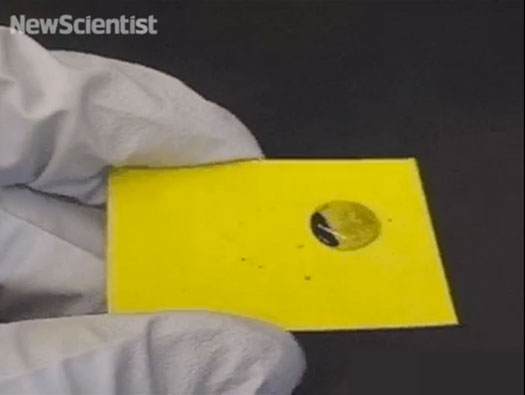
A new artificial material appropriately named SLIPS is one of the most slippery materials ever created. The new material, developed at Harvard, is self-cleaning and never gets dirty for a simple reason: nothing can stick to it.
SLIPS (Slippery Liquid Infused Porous Surface) was inspired by carnivorous pitcher plants, whose slippery, cylindrical leaves slide insects into the digestive juices at the base of the plant. The surface of the leaves' spongelike texture is infused with water, which repels the sticky oils on insects' feet. Lead researcher Joanna Aizenberg, a material scientist at Harvard, and her colleagues created an artificial version of the leaves surface, immobilizing a "lubricating film" (3M's Fluorinert FC-70 perfluorinated fluid) inside a similarly spongy layer of Teflon. The result is "omniphobic," repelling both water and oil-based materials. Liquids from oil and water to blood all roll right off the material when it's tilted at merely 2 degrees, compared to 5 to 30 degrees for other surfaces.
The lubricating liquid in SLIPS seeps into any holes in the Teflon, so the material is also self-repairing. And because liquid does not compress at high pressure, the material works at the pressures found seven kilometers underwater.
There are many possible applications for SLIPS, from highly efficient oil pipes to a coating for airplanes that repels ice. But Aizenberg points out another application for the high-tech coating: the dreaded last drop of ketchup in the bottle. "It is a problem we all face," she says. "We have a bottle of sauce and we are trying to get the last bit out but nothing is happening. If we used a substance like ours to coat the insides of bottles, it would be possible to get it all out."
Five amazing, clean technologies that will set us free, in this month's energy-focused issue. Also: how to build a better bomb detector, the robotic toys that are raising your children, a human catapult, the world's smallest arcade, and much more.


Online Content Director: Suzanne LaBarre | Email
Senior Editor: Paul Adams | Email
Associate Editor: Dan Nosowitz | Email
Assistant Editor: Colin Lecher | Email
Assistant Editor: Rose Pastore | Email
Contributing Writers:
Kelsey D. Atherton | Email
Francie Diep | Email
Shaunacy Ferro | Email
well the ketchup bottle application would be best for funding the other projects.
Wicked. For practical use, how about coating vehicle windshields, motorcycle visors, and glasses? For completely non-practical applications, could you make any-surface "ice" skates? How about giant non-water slides for grown-ups? I can also imagine some excellent practical jokes.
Coat the underside of a water vessel with this material. Bye Bye barnacles, hello super hydroplaning!
The airplane wing application is seriously interesting.
The article didn't say how it responds to ice. In the atmosphere, supercooled water droplets freeze instantly on contact with an airplane wing so there isn't time for the water phase to run off. If the first thin layer of ice just blows off, this is a game changer for light airplanes.
Beyond ice, performance of the new generation of extremely low drag airfoils are significantly degraded by bug residue. If the bug juice blows off - wow!
The basic idea is not unlike a current industrial process called "Hard coat" anodize which leaves a nano-porous surface into which Teflon or other solid lubricants can be infused.
anyone thinking a new non-stick cooking ware haha....... this is very interesting wish they would post the temps. that this can survive in. It could be used on spacecrafts if it can hold up to the temps. of lift off, etc.
How do you get 'the most slippery material ever' to stick to any surface? How did they get it to stick to Teflon?
What happens if you ingest this stuff? (ketchup bottle) What happens if this material accumulates in your intestines over time? Remember the "leakage problem" caused by Olestra (Olean)? The FDA should make a preemptive ruling requiring food manufactures to label that their containers are lined with SLIPS.
Ah... nothing like a game changer inspired by nature.
i like the idea of sticking this on boats and ships, just by covering the underside of a boat you could probably increase efficiency by 10 fold.
to mars or bust!
I always love it when we find inspiration from the natural world around us. I have grown carnivorous plants, including pitcher plants. They are fascinating. There may be some considerations about safety down the road, especially when it comes to use in food packaging. That’s later. Right now I like all the ideas and used that everyone is coming up with. Any surface skates would rule and imagine the wipeout videos that could come from those! How about mixing it with “rhino lining” for a paint job that is nearly indestructible and never needs to be washed. Any rain or snow would just slide off so cleaning the car off in winter would be cake too.
@nighthawkich exactly what I was thinking. I guarantee you though, there would need to be some rigorous validation work done on the toxicity of the material and its potential impact on the marine environment before it becomes a possibility. Always gotta placate the environuts.
Ah, funny! Banana yellow. Slippery. I get it.
I can say for sure it has no use in food. There is enough junk in our diets.
It would be useful to fine a way to use or retrofit some energy saving. Maybe something as simple as putting it in your engine oil would save fuel.
I see SLIPS as a great coating for green houses, so long as it allows a high percentage of light through.
This material oughta be great in minature motors for micro engines. The fluid dynamics must be phenomonal compared to most micro-techs.
Although we could just take the Ketchup bottle and cut it into strips and make our very own line-rider with a little penguin.
" Science without religion is lame, religion without science is blind." Albert Einstein
Can you apply this onto engines or motors to reduce friction? Less force needed to turn windmills and such?
all these ideas sound good, but will it evaporate once it is heated?
-Knock knock
-Who's there?
-The Doctor.
-Doctor Who?
-Yes
I wonder how safe it is to handle this stuff. I can just imagine it seeping right through your skin and getting into your body. Once in the human body, then I wonder what kind of damage it may cause.
The potential use of this material is great.
This could be used as non-stick cooking ware, engine lubricant, near- frictionless enviroments...The list is endless.
Engine lubricant is a great idea, I wonder how this stuff holds up to heat; granted less heat would be produced by a reduction in friction.
This could be a great additive to clear coats on cars and a coating on windows so you'll never need to wash these items.
Very nice....please put a coating of this stuff on the inside my toilet bowl.
Sorry guys, low temperature applications only. Anything a pitcher plant can survive goes. :) It is water based after all.
What effect would this have on the aero-dynamic properties of cars? Automobiles are slowed down by wind/air resistance, as well as the suction of the air void behind the vehicle (when travelling at high speeds). If an automobile was coated in this material, wouldn't it achieve much better coefficient of drag results that would improve MPG significantly over regular paint?
How about swimwear for olympic swimmers?
Waterless slip and slide?
ski resorts in the desert, no snow required?
bearings! get this stuff to coat bearings and improve the efficiency of everything.
combine this material with that crazy inverted tube toy that you can never hold because it always rolls out of your grip, and make it even harder to hold. sorry, that's just silly.
Obviously for crowd control.
great idea actually peter, slippery policemen what a laugh that will be! :D
Ps ever heard of dune boarding, same as snow boarding but on sand no snow required.
I also wonder if this would help Water Powered Cars from producing rust in the tanks and pipes?? There are some Water Powered cars, wish there was more but maybe this could solve the problem with rust on the inside???